
Build Your Business Vision With AI: Stop Guessing and Start Building With Intention
Most business owners don’t have an idea problem.
They have a clarity problem.
They know they want to grow. They want more customers, more revenue, better systems, more automation, and eventually a team that can help carry the workload.
But ask a more difficult question:
What exactly do you want your business to look like three to five years from now?
How much revenue should it generate? What will your team look like? What will your role be? Which responsibilities will you still own? Which will be delegated or automated? How many hours do you want to work? And can the business continue operating when you aren’t available?
Those questions are much harder to answer.
And that’s where AI can become far more valuable than simply writing your next social media caption.
The Problem Isn’t That You Need a Better Business Plan
One of the biggest challenges I see with entrepreneurs is that they are incredibly busy running the business they have today.
There are leads to respond to, customers to support, content to create, invoices to send, meetings to schedule, problems to solve, and dozens of decisions competing for attention.
That leaves very little time to think about the business they are actually trying to build.
And without a clear vision, almost every opportunity can look like a good opportunity.
A new service? Maybe.
Another social platform? Sure.
New software? Possibly.
Hire someone? Maybe it's time.
Automate something? Absolutely, but what?
The problem is that without knowing where you're going, it's difficult to determine which decisions actually move you forward.
Your business vision gives those decisions context.
Your Vision Should Be More Than “I Want to Grow”
"I want to grow my business."
"I want to make more money."
"I want more freedom."
"I don't want to work as much."
These are perfectly reasonable goals, but they aren't yet a business vision.
A useful vision needs specificity.
Instead of saying:
“I want a successful consulting business.”
Start defining what success actually means.
Does the company have five employees? Fifteen?
Are you still delivering services personally, or are you leading a team that delivers them?
What revenue is the company generating?
What types of clients are you serving?
What services are you known for?
What processes have been automated?
How many hours are you personally working?
Could you take a two-week vacation without constantly checking your phone?
That is when your vision begins becoming useful.
And this is exactly where I believe AI can change the way entrepreneurs approach strategic planning.
Don't Ask AI to Write Your Business Vision
There is an important distinction between using AI to generate a business vision and using AI to help you develop your business vision.
I recommend the second.
If you type:
Write a five-year vision for my business.
AI can absolutely give you something that sounds impressive.
But it might not represent the business you actually want.
Instead, use AI as a strategic thinking partner.
Ask it to question you.
Challenge you.
Identify inconsistencies.
Push vague answers further.
Help you see what you may be overlooking.
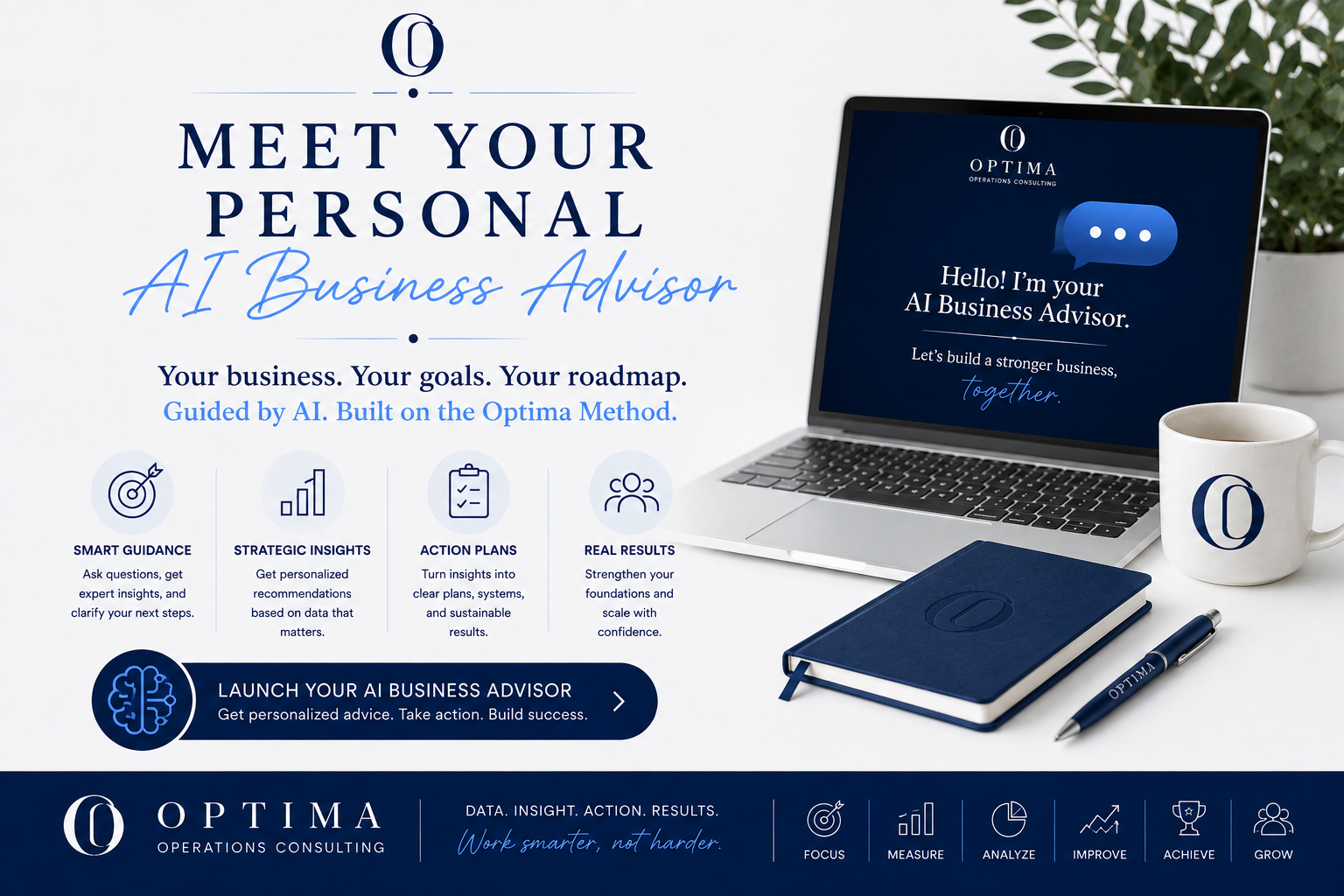
That's how I've designed the Optima AI Business Advisor to be used.
Rather than simply generating another document, the goal is to help you think through your business more intentionally.
Explore the Optima AI Business Advisor
8 AI Prompts to Help Build Your Business Vision
If you're working through a Business Vision Workbook or simply trying to get clearer about where your company is going, these prompts can help.
1. Start With the Big Picture
“I want to work through my Business Vision Workbook. Act as my strategic business advisor. Ask me one question at a time to help me define where I want my business to be in 3–5 years. Challenge vague answers and help me make the vision specific, measurable, and realistic.”
The important part of this prompt is “ask me one question at a time.”
You're creating a conversation rather than asking AI to produce the finished answer.
2. Make Your Vision Specific
Once you've described where you'd like the business to go, ask:
“Based on my answer, what parts of my 3–5 year business vision are still unclear? Ask me questions about revenue, customers, products or services, team structure, operations, and my role in the business.”
Now you're forcing yourself to move beyond "I want to grow."
You are beginning to define what growth actually looks like.
3. Define Your Future Role
This is one of the most important—and overlooked—parts of business planning.
Ask:
“Help me define my ideal role in this business three years from now. Ask me what responsibilities I want to keep, what I want to delegate, what should be automated, and what I should stop doing completely.”
Your future business shouldn't just have different revenue.
Your role should probably look different too.
If your company triples in size but every decision, customer, process, and problem still requires you, you've created a larger business without removing the bottleneck.
4. Connect Your Business to the Life You Want
Your personal vision matters too.
Try:
“Challenge my business vision against the life I want to create. Ask me about my desired schedule, family time, flexibility, income, vacations, workload, and how dependent the business should be on me.”
This can expose contradictions.
You might want greater flexibility while building a business model that requires your constant involvement.
Or you may want to take vacations without working while creating systems that still depend entirely on you.
Those gaps matter.
5. Identify the Gap Between Today and Your Vision
Once you know where you're going, ask:
“Compare the business I have today with the 3–5 year vision we've created. Identify the five biggest gaps preventing me from reaching that vision. Categorize them under Vision, Operations, Process, Leadership, Growth, or Personal.”
This is where vision begins connecting to execution.
You aren't simply asking:
Where do I want to go?
You're asking:
What needs to change for me to get there?
6. Determine What Matters First
Not every gap needs to be solved tomorrow.
Ask:
“Based on those gaps, identify the three highest-priority areas I should address over the next 12 months. Explain why each matters and what could happen if I ignore it.”
This is particularly important for overwhelmed entrepreneurs.
AI can generate an enormous task list very quickly.
That doesn't necessarily help.
Prioritization does.
7. Create a 12-Month Direction
Now bring the long-term vision closer:
“Turn my 3–5 year vision into a 12-month direction. Recommend the major milestones I should reach this year without giving me an unrealistic list of tasks.”
You are creating the bridge between where you want to be someday and what deserves attention now.
8. Ask AI to Challenge You
Finally, don't just ask AI to validate your ideas.
Ask:
“Act as a critical business advisor. Review everything I've told you about my vision. What assumptions am I making? What am I overlooking? Where might my plan be unrealistic? What questions should I answer before committing to this vision?”
This may be one of the most powerful ways entrepreneurs can use AI.
Don't only use AI to get answers. Use AI to ask better questions.
Your Business Vision Becomes a Decision-Making Filter
Once your vision becomes clear, it starts influencing everyday decisions.
Imagine you're considering adding a new service.
Instead of simply asking:
“Could this make money?”
You can ask:
“Does this move us toward the company we're trying to build?”
Someone approaches you with a partnership.
Does it align with the vision?
You're considering hiring.
Which role removes the biggest constraint between today's company and the company you're building?
You're considering automation.
Which repetitive tasks are keeping you trapped in responsibilities you don't want to own three years from now?
Suddenly, your vision isn't a document sitting in a folder.
It's a filter for how you operate the business.
Vision Comes Before Automation
AI and automation can save entrepreneurs enormous amounts of time.
But automating without direction can simply help you do the wrong things faster.
Before asking:
“What can I automate?”
Ask:
“What am I building?”
Then you can determine which activities support that future and which shouldn't require your time anymore.
That's why Vision is the starting point within the Optima Method.
Your Vision Foundation establishes the destination.
Your Operations and Process Foundations help create the systems to reach it.
Leadership reduces owner dependency.
Growth helps you expand intentionally.
And the Personal Foundation ensures the business supports the life you're trying to create, not the other way around.
Start by Finding the Weakest Foundation in Your Business
You may already have a clear vision.
Your biggest constraint might be somewhere else.
Maybe you know exactly where you're going, but your operations are chaotic.
Maybe you're repeating the same tasks every week because nothing has been documented or automated.
Maybe you're struggling to delegate.
Maybe you're growing, but your existing systems can't support the growth.
That's why I recommend starting with the Free Business Foundation Assessment.
It helps you look across the six foundations; Vision, Operations, Process, Leadership, Growth, and Personal; and identify where your business needs attention.
Take the Free Business Foundation Assessment
Once you've identified the opportunity, you can use the Optima AI Business Advisor to start working through it.
Meet the Optima AI Business Advisor
AI Shouldn't Build Your Business for You
AI isn't a replacement for your judgment, experience, or vision.
But it can help you slow down long enough to ask questions you haven't been asking.
It can challenge vague thinking.
It can uncover gaps.
It can help you connect today's decisions to tomorrow's goals.
And it can help turn:
“I want my business to grow.”
into:
“This is the business I'm building, this is the role I want to have in it, and these are the priorities that will get me there.”
That's a very different way to run a business.
Don't use AI just to do more.
Use it to become clearer about what deserves to be done in the first place.
Create. Optimize. Operationalize.
Structure creates freedom.
Watch the step-by-step guidance on how to use the AI Business Advisor here.