

Business Chaos Doesn't Stay at Work: How to Protect Your Family Time With Better Systems
Back-to-school season has a way of exposing every weak system in your life, and your business.
Suddenly, the calendar is full again.
School drop-offs. Pick-ups. Practices. Games. Homework. Lunches. Grocery shopping. Dinner. Appointments. Work deadlines. Client requests.
And somewhere between all of that, you're still trying to grow a business.
For entrepreneurs, and especially parents running businesses, the solution isn't simply becoming better at managing a busy schedule.
The business itself needs to become easier to manage.
Because chaos at work rarely stays at work.
It follows you into the carline. It sits at the dinner table with you. It interrupts practices. It turns into emails after bedtime and unfinished tasks on Sunday afternoon.
If you're building a business because you want more freedom, the systems behind that business have to support the life you're trying to create.
Back-to-School Season Changes Your Business Capacity
One of the biggest mistakes we can make as business owners is planning our businesses as though our personal lives don't exist.
Your available capacity changes throughout the year.
When school starts, your schedule may suddenly include:
Earlier mornings
School drop-off and pick-up
Sports and extracurricular activities
Homework
More structured meal times
School events and appointments
Less flexibility during certain parts of the day
But many entrepreneurs continue operating their businesses exactly as they did during the summer.
Then something has to give.
Usually, it's personal time.
Instead of accepting that as the price of entrepreneurship, use the change of season as an opportunity to reassess how your business operates.
Ask yourself:
What hours do I realistically have available to run my business during this season of life?
Build from that number, not from the number of hours you wish you had.
Your Family Calendar Should Influence Your Business Calendar
If you want your business to support your life, start your weekly planning with the things that matter outside of work.
Look at the family calendar first.
Block school schedules, practices, appointments, games, dinners, and other commitments that matter to you.
Then look at the time remaining.
That's your actual business capacity.
From there, determine what deserves space on your business calendar.
Your priorities might include:
CEO time: Planning, reviewing numbers, making decisions, and determining what happens next.
Revenue-generating work: Sales conversations, client delivery, proposals, and follow-ups.
Growth activities: Marketing, content creation, partnerships, and business development.
Operational work: Processes, documentation, automation, finances, and administration.
Everything cannot be the priority.
A structured calendar forces you to decide what actually moves the business forward.
Meal Planning and Business Operations Have More in Common Than You Think
Think about the difference between two Tuesday evenings.
In the first scenario, it's 5:30 PM.
Everyone is hungry.
There's practice later.
You haven't decided what you're making.
You open the refrigerator and start figuring it out.
One small decision suddenly creates unnecessary stress.
Now imagine that the meal was already planned.
The groceries are available.
You know what needs to happen.
Nothing complicated changed.
You simply removed a decision from the moment it needed to be made.
That's exactly what good business operations do.
A documented process removes the question:
"How do I do this again?"
Automation removes the question:
"Did I remember to send that?"
A defined responsibility removes:
"Who's supposed to handle this?"
A structured calendar removes:
"When am I going to get this done?"
Good systems reduce the number of decisions you have to make repeatedly.
And that matters because your mental capacity isn't unlimited.
Find the Business Tasks Following You Home
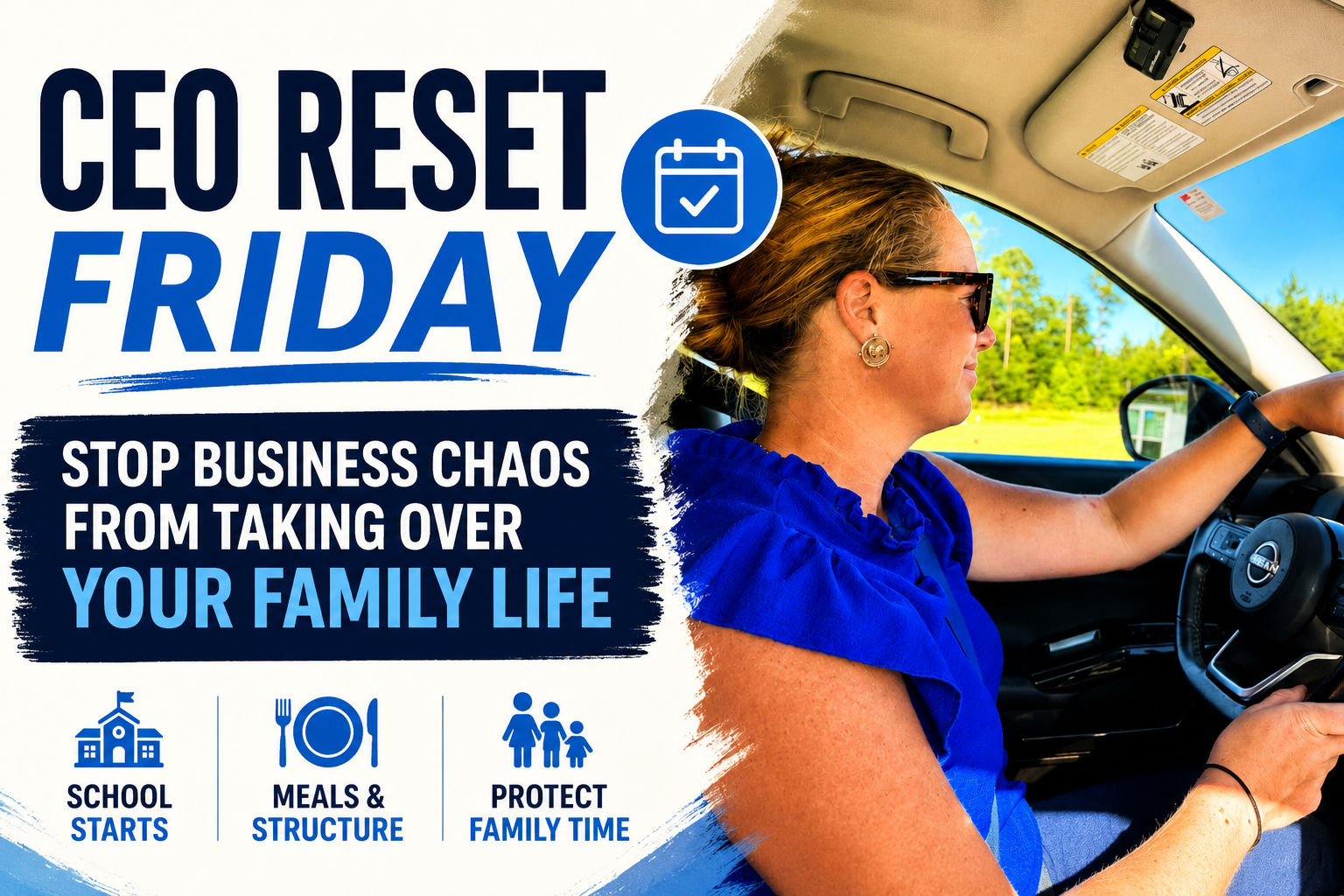
During your next CEO Reset Friday, review the previous week and ask one important question:
What happened in my business that unnecessarily took time away from my family?
Maybe you answered client emails during dinner.
Maybe you worked from the sidelines at practice.
Maybe you spent two hours after bedtime completing administrative work.
Maybe a customer needed information only you knew how to find.
Maybe you remembered an important follow-up at 9 PM.
Maybe you spent Sunday preparing for Monday because there wasn't a system for planning during the week.
Don't immediately assume you need to manage your time better.
Instead, investigate the operational problem.
Why did that task reach you at that moment?
Use the Five-Question Operational Test
When something repeatedly interferes with your personal time, run it through five questions:
1. Can I eliminate it?
Not every task needs to exist.
Sometimes we've been doing something for so long that we stop questioning whether it's still valuable.
2. Can I automate it?
Repetitive, predictable tasks are often strong automation candidates.
Think about appointment reminders, lead follow-ups, recurring emails, data entry, status notifications, and routine administrative tasks.
3. Can I delegate it?
If the task requires a person but doesn't require you, determine who else could own it.
Delegation requires clear expectations, documentation, and accountability, not simply handing someone a task.
4. Can I document it?
If you're repeatedly explaining how something works, that's a signal.
Document the process.
The goal is to create a business where knowledge doesn't exist exclusively inside your head.
5. Can I schedule it differently?
Some work isn't unnecessary. It's simply happening at the wrong time.
Batching similar tasks or creating defined administrative blocks can prevent work from constantly leaking into the rest of your day.
Protect Your Non-Negotiable Family Time
Entrepreneurs are often told to time-block their most important business priorities.
Do the same thing with your personal priorities.
Maybe dinner is protected.
Maybe you don't schedule client calls after school pickup.
Maybe Tuesday and Thursday evenings belong to sports.
Maybe Saturday morning is completely off-limits.
Maybe you stop working at a specific time each afternoon.
Put those boundaries on the calendar before the business consumes the space.
Because there will always be more you could do.
Another email.
Another post.
Another project.
Another idea.
Another improvement.
Being the CEO doesn't mean doing everything.
It means deciding what deserves your attention, and building systems around everything else.
Structure Isn't About Creating a Perfect Routine
A structured business isn't a rigid business.
It's actually the opposite.
Structure gives you room to adjust.
When processes are documented, tasks are automated, priorities are clear, and your calendar reflects your actual capacity, an unexpected change doesn't have to derail everything.
A child gets sick.
Practice changes.
School closes.
A client reschedules.
Life happens.
The goal isn't to prevent those things.
The goal is to build a business capable of absorbing them.
That's one of the biggest differences between being self-employed and intentionally building a business.
You don't want to create another job that requires your constant presence.
You want to create an operation that becomes increasingly capable of functioning without you touching every task.
Use AI to Identify What's Stealing Your Time
AI can be extremely valuable here, but don't limit it to writing emails or generating social media posts.
Use AI as a strategic advisor.
Try this prompt:
Act as my business operations advisor. My family schedule is changing with the start of the school year, and I need my business to operate within more defined working hours. Ask me questions about the tasks that regularly spill into my evenings and family time. Help me identify what should be eliminated, automated, delegated, documented, or rescheduled. Then help me create a realistic weekly operating structure.
The objective isn't to use AI so you can squeeze even more work into your day.
It's to identify where unnecessary work can be removed from your day altogether.
Your CEO Reset Friday Challenge
Before you start another week, take 20–30 minutes and reset.
Review your family calendar.
Review your business calendar.
Look at what interrupted your personal time last week.
Then answer:
What is happening in my business that is unnecessarily stealing time from my family?
Write down three things.
Choose one.
Then decide whether you need to:
Eliminate it. Automate it. Delegate it. Document it. Or schedule it differently.
You don't have to rebuild your entire business this weekend.
Fix one recurring operational problem.
Then do it again next Friday.
Small improvements compound.
One automated task becomes hours saved every month.
One documented process becomes something someone else can eventually own.
One boundary becomes an evening you're actually present.
One system becomes less mental load.
And eventually, you begin creating a business that doesn't require you to choose between growth and the people you're building it for.
Build a Business That Gives You More Freedom
Business and family life will never exist in completely separate boxes.
And they don't need to.
The objective isn't perfect work-life balance.
It's building enough structure into your business that you have choices.
Choices about when you work.
Choices about what needs your attention.
Choices about what can happen without you.
Choices that allow you to close the laptop and actually be present.
Because business chaos doesn't stay at work.
But neither do the benefits of a well-run business.
Structure creates freedom.
Ready to Find the Gaps in Your Business?
Use the Optima AI Business Advisor to work through the operational challenges consuming your time and identify practical opportunities to simplify, automate, and create more structure.
AI Business Advisor:
https://www.optimaoperationsconsulting.com/ai-business-advisor
Or start by identifying which area of your business needs the most attention with the Free Business Foundation Assessment:
Looking for more? Check out the Optima Method Youtube Channel.