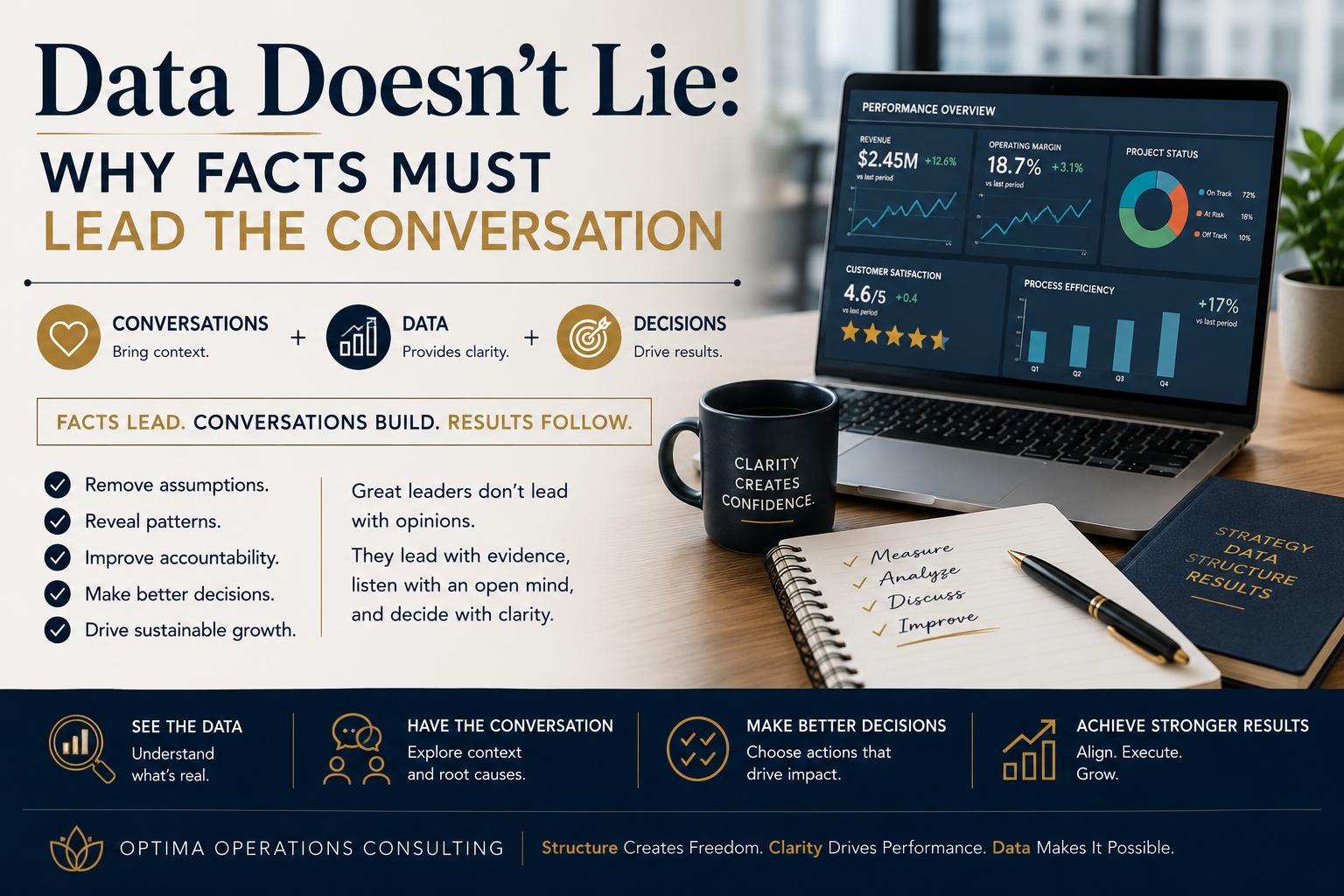

Data Doesn’t Lie: Why Facts Must Lead the Conversation
One of the biggest operational mistakes organizations make is allowing opinions, assumptions, and emotions to outweigh data.
Not because people intentionally ignore facts. But because conversations often become subjective long before the data is fully understood.
At Optima Operations Consulting, one of the recurring patterns we see across businesses, leadership teams, projects, and operational reviews is this:
People often want the outcome to feel successful even when the data tells a different story.
And honestly, this happens more often than many leaders realize.
Because data creates clarity. And clarity can sometimes be uncomfortable.
But sustainable growth cannot happen without honest visibility into what the data is actually saying.
The Difference Between Perception and Reality
Perception is emotional. Data is measurable.
Perception says: “I feel like things are improving.”
Data says:
Revenue decreased
Deadlines were missed
Productivity declined
Error rates increased
Customer satisfaction dropped
Adoption rates stalled
That does not mean perception has no value.
Conversations matter. Experiences matter. Employee feedback matters. Customer feedback matters.
But subjective feelings alone cannot drive operational decisions.
Because emotions shift. Opinions vary. Experiences differ.
Data provides consistency.
And organizations that ignore measurable outcomes often create larger operational problems over time.
Why Leaders Avoid Data Conversations
Data conversations can be uncomfortable because they remove ambiguity.
The numbers either support progress or they do not.
The metrics either improved or they did not.
And when leadership teams become emotionally attached to an initiative, project, strategy, or process, it becomes difficult to separate effort from actual results.
But effort alone does not equal effectiveness.
This is especially important in:
Operational transformation projects
Change management initiatives
System implementations
Team performance reviews
Financial decision-making
AI adoption strategies
Process improvement efforts
Because organizations can spend months believing progress is happening while measurable outcomes remain unchanged.
And that disconnect creates risk.
Data Creates Accountability
One of the greatest benefits of data is accountability.
Data removes assumptions. Data creates visibility. Data reveals patterns. Data identifies gaps. Data highlights operational breakdowns.
Without measurable data points, organizations often rely on:
Personal interpretation
Emotional reactions
Inconsistent reporting
Bias
Assumptions
That creates decision-making instability quickly.
Strong organizations build operational maturity by using data to:
Validate decisions
Measure outcomes
Track performance
Identify trends
Improve accountability
Support transparency
Because operational clarity requires measurable visibility.
Conversations Still Matter
Now, this does not mean conversations should disappear.
In fact, the strongest leadership environments balance both:
Data
Dialogue
Because while data tells the measurable story, conversations provide context.
For example: A project may show declining performance metrics.
The data identifies the issue.
But the conversation may reveal:
Training gaps
Resource constraints
Communication breakdowns
Burnout
Misaligned expectations
Process inefficiencies
The problem happens when organizations ignore the data entirely because the conversation feels more comfortable.
Facts should lead the conversation. Not be avoided because they create discomfort.
The Danger of Leading Emotionally
Organizations that consistently lead emotionally instead of operationally often experience:
Inconsistent decision-making
Lack of accountability
Leadership frustration
Misaligned priorities
Reactive management
Performance confusion
Operational drift
And over time, culture begins shifting away from clarity and toward assumption-based leadership.
This creates environments where:
Teams become uncertain
Performance standards become subjective
Accountability weakens
Operational consistency declines
Strong leadership requires the ability to separate emotional attachment from measurable outcomes.
That does not remove empathy. It strengthens clarity.
Data Supports Better Conversations
One of the most important mindset shifts leaders can make is understanding this:
Data is not personal. It is informational.
The purpose of data is not punishment. It is visibility.
And when teams learn how to approach data collaboratively instead of defensively, conversations improve dramatically.
Instead of: “Who failed?”
The conversation becomes: “What is the data telling us?”
That shift changes everything.
Because operationally mature organizations use data to improve systems, not attack people.
Data and AI: Why Structure Matters
This conversation becomes even more important as organizations adopt AI and automation.
AI tools can generate insights quickly. But if organizations lack:
Clean processes
Accurate reporting
Defined metrics
Operational governance
Structured workflows
Then the outputs become unreliable.
AI amplifies structure. It does not replace it.
And data integrity becomes even more critical in environments where automation and analytics drive business decisions.
Because poor data creates poor outcomes — faster.
The Most Effective Leaders Welcome Transparency
Strong leaders do not fear visibility.
They welcome it.
Because measurable transparency creates:
Better strategy
Stronger accountability
Faster improvement
More honest conversations
Clearer priorities
Better operational alignment
And honestly, one of the most transformational leadership skills is learning how to have honest conversations around measurable reality without allowing emotion to override facts.
That balance matters.
Final Thoughts
Data does not lie.
But people sometimes avoid what the data reveals because clarity can feel uncomfortable.
The strongest organizations are not the ones pretending every initiative is successful.
They are the organizations willing to:
Measure honestly
Review objectively
Communicate openly
Adjust intentionally
Improve continuously
Because facts create visibility. Visibility creates clarity. And clarity creates stronger leadership decisions.
Conversations matter. People matter. Context matters.
But facts must still lead the conversation.
Because structure creates freedom. And operational clarity starts with truth.