How AI Can Make Things Overwhelming for a Business
A practical guide for entrepreneurs navigating the AI revolution
Artificial intelligence has quickly become one of the most powerful tools available to modern businesses. From automating tasks to analyzing customer behavior and generating marketing content, AI promises increased efficiency and productivity.
But for many entrepreneurs and organizations, the reality feels very different.
Instead of clarity, AI sometimes introduces more complexity, more tools, and more decisions. Businesses jump into AI hoping it will simplify operations, only to discover that the technology itself can create new challenges.
Understanding these challenges is the first step toward using AI effectively rather than becoming overwhelmed by it. How AI can make things overwhelmed by it.
The Promise and the Pressure of AI
Artificial intelligence offers tremendous potential. It can automate repetitive tasks, analyze large volumes of data, and improve customer engagement through personalized experiences.
However, rapid AI adoption has created a new problem: too many tools, too much information, and not enough structure to manage it all.
Without a clear strategy, AI can overwhelm teams, drain resources, and complicate operations rather than improving them.
Let’s explore the most common ways AI creates overwhelm for businesses.
1. Information Overload
AI systems generate enormous amounts of data and insights.
While this data can be valuable, it can also create analysis paralysis.
Business leaders suddenly find themselves surrounded by:
Dashboards
Reports
Metrics
Predictive models
Performance analytics
Instead of simplifying decision-making, AI can flood teams with more information than they can realistically interpret or act upon. As noted in the guide, decision-makers often struggle to prioritize when too many insights compete for attention. How AI can make things overwhelmed by it.
The result?
Leaders spend more time analyzing data than actually making decisions.
2. Implementation Complexity
Adding AI tools to an existing business isn't as simple as flipping a switch.
AI systems often require:
integration with existing software
new infrastructure
process redesign
ongoing maintenance
Organizations without in-house technical expertise may find these requirements daunting. Implementation delays, technical challenges, and unexpected costs can quickly turn a promising AI initiative into a stressful project. How AI can make things overwhel…
For entrepreneurs running lean teams, this complexity can feel overwhelming.
3. High Costs and Resource Demands
While many AI tools advertise affordability, true implementation often requires significant investment.
Businesses may need to pay for:
software subscriptions
AI model training
consultants or developers
employee training
ongoing system maintenance
For smaller businesses especially, balancing AI investment with day-to-day operational costs can be difficult. The financial and human resource demands can quickly stretch teams thin. How AI can make things overwhel…
4. Skill Gaps and Training Needs
AI adoption requires new skills that many teams simply haven't developed yet.
Employees may suddenly need to understand:
Prompt engineering
AI workflows
Automation tools
Data interpretation
Technical integrations
Without proper training and support, teams can feel overwhelmed by the learning curve. In some cases, employees may also worry about job security, creating resistance to adopting new technology. How AI can make things overwhelmed by it.
Successful AI implementation requires education, support, and clear communication.
5. Ethical and Compliance Challenges
AI introduces important ethical considerations that businesses cannot ignore.
These include issues related to:
data privacy
algorithm bias
transparency
regulatory compliance
Organizations must ensure that AI systems operate fairly and responsibly. Navigating these responsibilities can feel overwhelming, especially as regulations and best practices continue to evolve. How AI can make things overwhelmed by it.
AI isn't just a technology challenge—it’s also a governance and accountability challenge.
6. Overdependence on Technology
Another risk of AI adoption is relying too heavily on automation.
AI systems can make mistakes, produce inaccurate outputs, or misinterpret data. When businesses depend too heavily on automated systems without human oversight, these errors can cause operational disruptions.
Maintaining a balance between automation and human judgment is essential for maintaining reliability and trust. How AI can make things overwhelmed by it.
7. Rapid Technological Change
The AI landscape evolves incredibly fast.
New tools, models, and frameworks appear almost weekly. For businesses trying to stay competitive, this can create a constant feeling of being behind.
Teams may feel pressured to continually:
Evaluate new AI tools
Update systems
Retrain employees
Revise processes
Keeping up with innovation can strain both budgets and team capacity. How AI can make things overwhelmed by it.
8. Cultural Resistance Within Teams
Technology changes rarely succeed without people fully embracing them.
Introducing AI can disrupt established workflows and company culture. Employees may resist new tools due to fear, uncertainty, or mistrust of automation.
Successful AI adoption requires strong leadership, transparent communication, and a clear explanation of how AI will support—not replace—the team. How AI can make things overwhelmed by it.
The Real Solution: Structure Before AI
Many businesses assume AI will fix operational problems.
But the truth is the opposite.
AI amplifies whatever systems already exist.
If your business processes are disorganized, AI can make the chaos worse by producing more information, more automation, and more tools layered on top of unclear workflows.
The real solution is operational structure.
Before implementing AI, businesses should focus on:
Documenting processes
Building SOPs
Defining roles and responsibilities
Creating clear workflows
Establishing decision frameworks
When strong operational systems exist, AI becomes a powerful accelerator rather than a source of overwhelm.
Final Thoughts
Artificial intelligence is transforming how businesses operate, but adoption without strategy can quickly create confusion and stress.
The businesses that benefit most from AI are not the ones using the most tools.
They are the ones with the strongest operational foundations.
By approaching AI with thoughtful planning, structured processes, and a focus on human collaboration, businesses can harness its power without becoming overwhelmed.
AI should simplify your business, not complicate it.
5-Step Guide to Using AI to Systemize a Business
Turn Artificial Intelligence Into an Operational Advantage
Most businesses are experimenting with AI.
But very few are using it to build real operational systems.
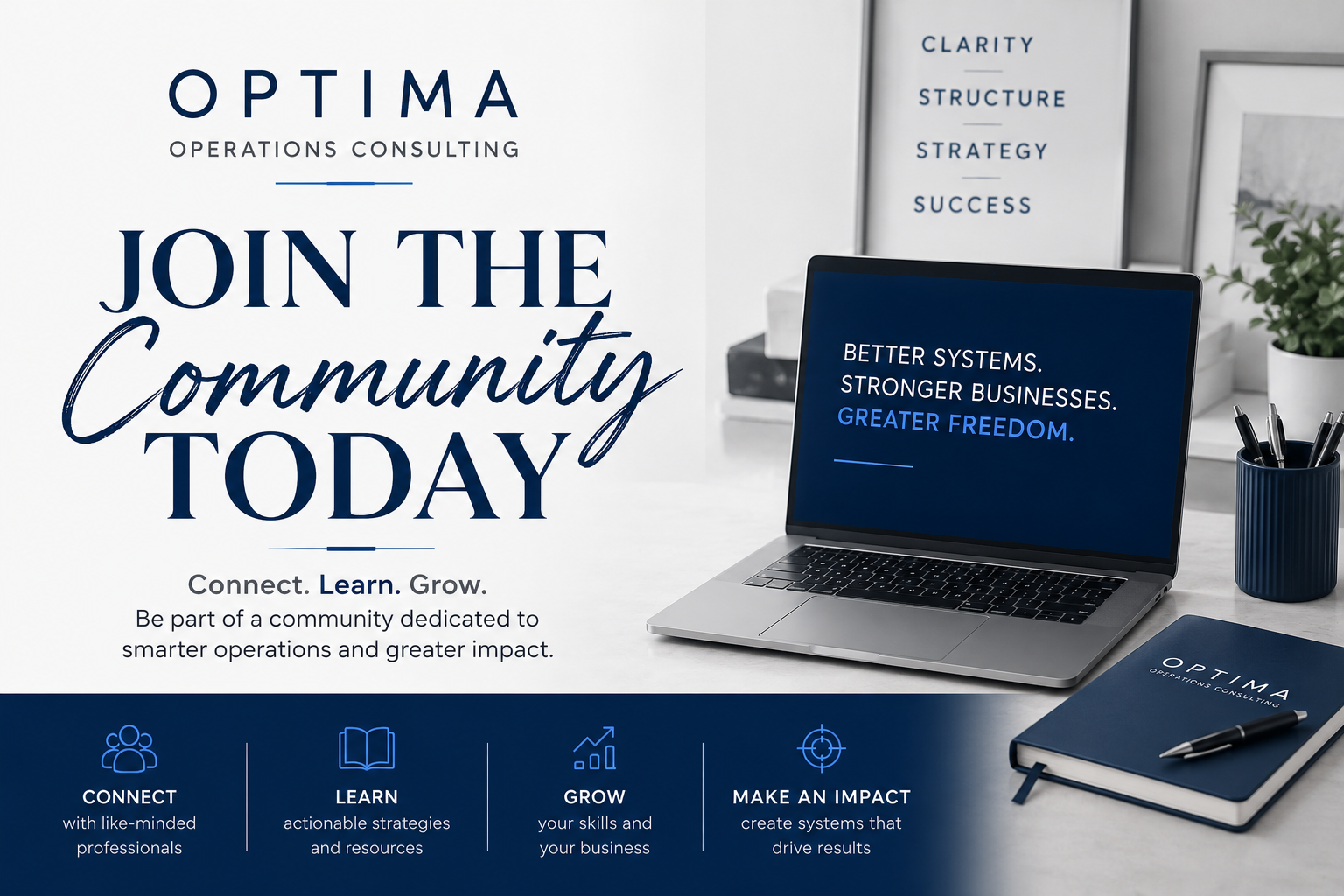
The 5-Step Guide to Using AI to Systemize a Business from Optima Operations Consulting is a practical framework designed to help entrepreneurs, business owners, and leaders move beyond basic AI use and start implementing structured operational systems that scale.
This guide walks through a clear, step-by-step approach to identifying the areas of your business where AI can eliminate repetitive work, improve efficiency, and strengthen decision-making.
Rather than focusing on trendy tools or quick hacks, this resource focuses on operational structure, helping businesses create sustainable processes supported by AI.
Inside the guide, you will learn how to evaluate your business operations, select the right AI tools, automate data workflows, and integrate AI into daily operations in a way that improves productivity across your organization.
What’s Included in This Guide
This structured resource walks through five key operational stages to help businesses successfully implement AI systems.
1. Identifying Repetitive and Time-Consuming Tasks
The guide begins by helping you identify recurring tasks within your business that consume time or are prone to human error. Examples include administrative work, scheduling, customer support, inventory management, and data entry. By identifying these operational bottlenecks, businesses can determine where AI automation will deliver the greatest impact. Optima Operations Consulting_5-…
2. Choosing the Right AI Tools and Platforms
Not all AI tools serve the same purpose. This section outlines how to evaluate AI platforms based on business needs and operational scale. It includes examples such as AI chatbots for customer service automation, AI-driven CRMs for lead management and forecasting, predictive analytics tools for planning, and AI content tools for marketing execution. Optima Operations Consulting_5-…
3. Automating Data Collection and Analysis
Data is one of the most valuable assets in any organization. This step explains how AI systems can automate data gathering, analyze trends, and generate actionable insights. Businesses can reduce manual reporting while gaining the ability to make faster, data-driven decisions supported by predictive analysis. Optima Operations Consulting_5-…
4. Streamlining Workflows Through AI Integration
The guide demonstrates how AI can be integrated into day-to-day operations to create seamless workflows across departments. Examples include automated email responses, AI scheduling assistants, and AI-powered project management tools that help teams track progress and allocate resources more efficiently. Optima Operations Consulting_5-…
5. Monitoring Performance and Scaling AI Systems
Successful AI adoption requires continuous improvement. The final step focuses on monitoring AI performance metrics, gathering team feedback, and refining workflows to ensure the system continues to deliver value as the business grows. Optima Operations Consulting_5-…
Who This Guide Is For
This resource is designed for:
• Entrepreneurs looking to scale operations
• Small business owners overwhelmed with manual tasks
• Operations leaders implementing new technology
• Consultants building structured business processes
• Teams seeking more efficient workflows
If your business feels reactive, inconsistent, or overly dependent on manual work, this guide will help you begin implementing operational systems powered by AI.