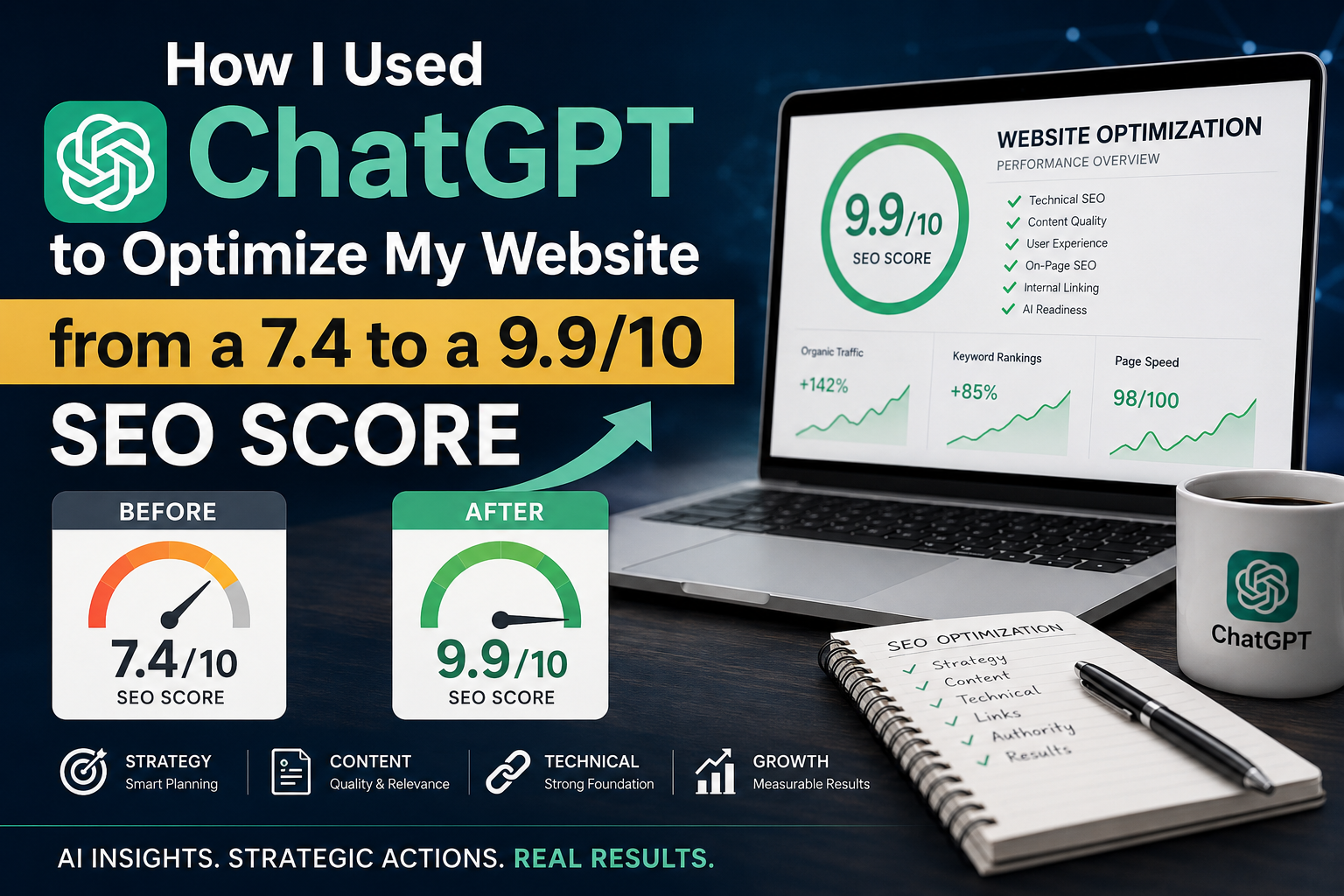
How I Used ChatGPT to Optimize My Website from a 7.4 to a 9.9/10 SEO Score
Why AI didn't build my business, it helped me build it better.
When people talk about AI, they usually focus on creating content faster.
Write a blog.
Generate a social media post.
Create an email.
While those are valuable, I wanted to answer a different question:
Can AI help build a website that actually performs?
Over the past several weeks, I used ChatGPT as a strategic partner to audit, analyze, and continuously improve the Optima Operations Consulting website.
The result?
My website improved from approximately 7.4/10 to 9.9/10 for overall SEO and AI readiness. not because AI magically fixed everything, but because it helped identify what needed to improve and provided step-by-step guidance to implement those changes.
This wasn't a one-time prompt.
It became an ongoing optimization process. And while I could have done this on my own … ChatGPT allowed me to get it done faster.
Where the Website Started
Like many entrepreneurs, I had already built what I thought was a good website.
It looked professional.
It explained my services.
It had resources.
It included a blog.
It loaded quickly.
But looking good doesn't necessarily mean search engines, or AI, understand your business.
An early audit revealed several opportunities for improvement.
Initial Website Assessment
Overall Score: 7.4/10
SEO Foundation: 6/10
AI Readiness: 5/10
Internal Linking: 5/10
Content Depth: Moderate
Authority Signals: Limited
Topic Clustering: Minimal
Nothing was "broken."
The site simply wasn't structured in a way that maximized discoverability or demonstrated topical authority.
That became the mission.
Step 1: Build a True Content Strategy
The first recommendation wasn't to write more blogs.
It was to create content architecture.
Instead of publishing random articles, every piece of content needed to support one another.
That led to organizing the website around six core business foundations:
Vision
Operations
Process
Leadership
Growth
Personal
Each foundation became a pillar page supported by:
educational articles
downloadable resources
videos
podcast episodes
FAQs
related content
Instead of dozens of disconnected pages, the website became an interconnected learning hub.
Step 2: Strengthen Every Foundation Page
Next came improving the quality of every foundation page.
Rather than keeping them as simple sales pages, they evolved into comprehensive educational resources.
Each page was enhanced with:
Frequently Asked Questions
internal links
supporting resources
educational content
stronger headings
keyword optimization
clearer calls to action
Every improvement made it easier for both visitors and search engines to understand the topic.
Step 3: Improve Internal Linking
One of the biggest recommendations ChatGPT made was improving internal linking.
Previously, many pages stood alone.
Now, each foundation page naturally connects visitors to:
related blog posts
YouTube videos
podcast episodes
downloadable templates
free resources
the Business Operations Assessment
This helps visitors continue learning while signaling to search engines how every topic connects.
Instead of isolated pages, the website now functions as an integrated knowledge base.
Step 4: Add FAQ Sections
One of the simplest improvements produced one of the biggest benefits.
Each foundation page now includes multiple frequently asked questions that answer common business owner concerns.
For example:
What is an SOP?
Why are documented processes important?
How do I improve business operations?
What should every entrepreneur focus on first?
These FAQs help:
improve user experience
capture long-tail keywords
increase topical authority
answer questions AI search tools often reference
Sometimes the smallest improvements create the biggest impact.
Step 5: Optimize Every Blog for SEO
Instead of simply writing articles, every blog now follows a repeatable optimization framework.
Each article includes:
keyword-focused headings
logical structure
internal links
related resources
educational depth
strong calls to action
The goal shifted from publishing content to creating resources worth ranking.
Step 6: Connect Every Content Channel
One recommendation completely changed my content strategy.
Rather than treating each platform independently, everything now supports everything else.
A single topic becomes:
a blog
a podcast episode
a YouTube video
multiple social media posts
downloadable resources
website links
email content
Instead of constantly creating new ideas, every idea works harder.
Step 7: Continue Improving Every Week
Perhaps the biggest lesson was realizing SEO is never "finished."
After every major improvement, I asked ChatGPT to perform another audit.
Not:
"Tell me what I did wrong."
Instead:
"What's the next highest-impact improvement?"
Each audit uncovered another opportunity.
Examples included:
improving page hierarchy
strengthening topic clusters
expanding FAQs
improving navigation
connecting related resources
strengthening authority signals
refining calls to action
increasing educational depth
Small improvements compounded into significant results.
The Final Results
After implementing dozens of recommendations across the website, the latest audit showed:
Final Website Score
Overall SEO & AI Readiness: 9.9/10
Significant improvements included:
Comprehensive topic clusters
Strong internal linking
Educational pillar pages
Enhanced user experience
Expanded FAQ content
Better keyword coverage
Improved content depth
Stronger authority signals
Better AI discoverability
Clearer navigation
The website evolved from a collection of pages into a complete business education platform.
What I Learned About AI
The biggest takeaway surprised me.
ChatGPT never replaced my expertise.
It amplified it.
AI didn't know my business.
It didn't know my clients.
It didn't understand my experiences.
Those came from me.
What AI did exceptionally well was:
identifying opportunities
organizing information
suggesting improvements
challenging assumptions
accelerating implementation
providing ongoing feedback
In other words, AI became a strategic advisor, not the business owner.
AI Is Only as Good as the Foundation You Build
This experience reinforced something I teach every entrepreneur.
AI doesn't fix weak businesses.
It accelerates strong systems.
If your website lacks structure, AI simply helps you discover that faster.
If your operations are disorganized, AI can help organize them.
If your business has a clear vision and solid foundation, AI becomes an incredible force multiplier.
That's exactly why the Optima Foundations Academy exists.
Before automation…
Before AI…
Before scaling…
Build the foundation.
Everything grows faster from there.
Ready to Build a Stronger Business Foundation?
If you're wondering whether your business has the systems, structure, and strategy needed to grow, start with my Free Business Operations Assessment.
In just a few minutes, you'll discover where your biggest opportunities are across Vision, Operations, Process, Leadership, Growth, and Personal development, and you'll receive actionable insights to help you move forward with clarity.
Remember: Structure creates freedom. And when you combine a strong foundation with the right AI tools, you can build a business that's designed to scale, not just survive.
New podcasts launch every Wednesday, subscribe and tune in!