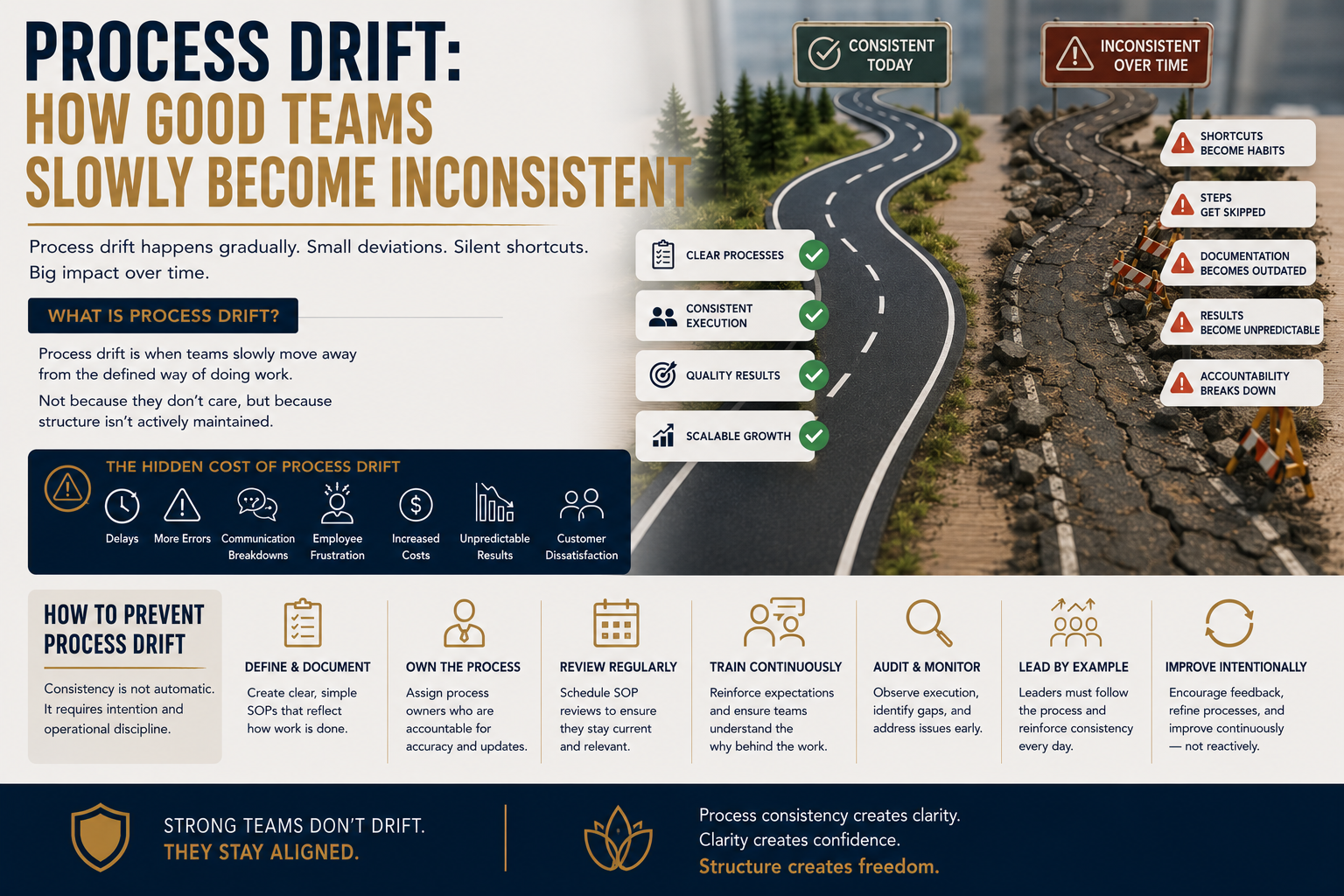

Process Drift: How Good Teams Slowly Become Inconsistent
Most operational breakdowns do not happen overnight.
Teams rarely wake up one morning completely disorganized.
Instead, inconsistency happens slowly.
Quietly.
Gradually.
Almost invisibly.
A shortcut here.
A skipped step there.
An undocumented workaround.
A process interpreted differently by one department.
A leader allowing “exceptions” repeatedly.
An SOP that no longer reflects operational reality.
And over time, what once was a strong, consistent process begins drifting further away from the original standard.
This is called process drift.
And it is one of the most common and most expensive operational challenges organizations face.
At Optima Operations Consulting, process drift is something we see across businesses of every size, especially growing organizations moving quickly without intentional operational governance.
Because even good teams become inconsistent when structure is not actively maintained.
What Is Process Drift?
Process drift occurs when teams slowly move away from the defined way a process was originally intended to operate.
Not because employees are intentionally doing poor work.
But because operational consistency is rarely self-sustaining without visibility, accountability, and reinforcement.
Over time:
Steps get skipped
Processes become personalized
Departments create their own variations
Documentation becomes outdated
Expectations become unclear
Accountability weakens
And eventually the organization no longer operates consistently, even though everyone believes they are following the “same process.”
That disconnect creates operational instability.
Why Good Teams Still Experience Process Drift
One of the biggest misconceptions in leadership is believing process inconsistency only happens because of poor performance.
In reality, process drift often happens inside highly capable teams.
Why?
Because people naturally optimize for speed, convenience, and efficiency in the moment.
Without intentional governance:
Shortcuts become habits
Workarounds become unofficial processes
Exceptions become the standard
Documentation becomes ignored
Tribal knowledge replaces structure
And slowly, operational consistency disappears.
This is especially common in fast-growing organizations where teams are under pressure to move quickly while processes struggle to keep pace with growth.
The Hidden Warning Signs of Process Drift
Process drift is dangerous because the warning signs often appear small initially.
It may sound like:
“This is just easier.”
“We usually skip that step.”
“That process is outdated.”
“Everyone does it differently.”
“It depends who handles it.”
“We’ve always done it this way.”
But those small inconsistencies eventually compound into larger operational problems.
Over time organizations begin experiencing:
Quality inconsistencies
Delays
Communication breakdowns
Increased errors
Leadership frustration
Customer dissatisfaction
Accountability confusion
Training gaps
Operational inefficiency
And because the drift happened gradually, many organizations struggle to identify when the inconsistency actually began.
Process Drift Weakens Accountability
Accountability becomes difficult when processes are no longer standardized.
When every employee or department operates differently:
Performance becomes subjective
Expectations become unclear
Leadership struggles to enforce standards
Training becomes inconsistent
Results vary dramatically
Strong accountability requires operational consistency.
Because employees cannot consistently execute against undefined or constantly shifting expectations.
This is why operational structure matters so much.
Defined processes create measurable expectations.
And measurable expectations create stronger accountability.
Documentation Alone Does Not Prevent Drift
One of the biggest mistakes organizations make is assuming documentation alone solves process inconsistency.
It does not.
Processes drift when documentation:
Is outdated
Is inaccessible
Is ignored
Lacks ownership
Is not reinforced operationally
Does not reflect actual execution
SOPs should not function as static documents sitting in folders.
Operational structure requires:
Governance
Reviews
Accountability
Visibility
Process ownership
Continuous improvement
Because operational consistency must be actively maintained.
Leadership Often Unintentionally Creates Drift
One of the most overlooked causes of process drift is inconsistent leadership behavior.
For example:
Leaders approving exceptions repeatedly
Managers bypassing workflows
Teams being rewarded for speed over consistency
Processes changing verbally without documentation updates
Accountability being enforced inconsistently
Employees follow operational behavior more than written expectations.
And when leadership deviates from the process regularly, teams eventually begin doing the same.
Consistency starts at the leadership level.
Process Drift Creates Operational Fatigue
One of the hidden impacts of process drift is mental exhaustion.
When processes are inconsistent:
Employees constantly seek clarification
Teams redo work
Communication increases unnecessarily
Leadership spends more time resolving confusion
Decisions slow down
Trust weakens
And over time, operational fatigue grows.
People become frustrated not because they lack capability, but because operational expectations no longer feel stable.
Structure creates operational confidence.
Without it, organizations become reactive.
AI and Automation Amplify Process Drift
As organizations adopt AI and automation, process drift becomes even more dangerous.
Why?
Because automation amplifies whatever structure currently exists.
If processes are inconsistent:
Automation becomes unreliable
Data quality suffers
Reporting becomes inaccurate
Workflows break down
Operational visibility weakens
AI cannot standardize undefined execution automatically.
Strong automation requires:
Clear SOPs
Defined workflows
Governance
Process ownership
Operational consistency
Otherwise organizations automate inconsistency itself.
How Organizations Prevent Process Drift
Preventing process drift requires intentional operational governance.
Strong organizations:
Review SOPs regularly
Define clear process ownership
Reinforce accountability consistently
Document process updates immediately
Train teams continuously
Audit operational execution
Align leadership behavior with expectations
Encourage process feedback and improvement
Because operational consistency is not a one-time initiative.
It is an ongoing operational discipline.
Structure Creates Freedom
One of the core operational truths many organizations eventually realize is this:
Structure is not restrictive.
It is stabilizing.
Strong operational structure:
Reduces confusion
Improves execution
Builds accountability
Protects quality
Supports scalability
Reduces stress
Creates trust
Improves communication
And perhaps most importantly, it allows good teams to remain consistent even as the organization grows.
Because consistency is not built accidentally.
It is operationalized intentionally.
Final Thoughts
Process drift rarely happens because teams stop caring.
It usually happens because structure stops being actively maintained.
And over time, small inconsistencies quietly become operational instability.
The strongest organizations are not the ones without change.
They are the organizations disciplined enough to maintain operational clarity while evolving intentionally.
Because successful scaling requires more than growth.
It requires consistency.
Documentation matters.
Processes matter.
Governance matters.
Accountability matters.
But operational structure is what keeps everything aligned long term.
Because structure creates freedom.