

The Business Audit Every CEO Should Complete Quarterly (Before Problems Become Expensive)
Most business owners wait until something breaks before they stop to evaluate their business.
Revenue starts slowing.
Employees become overwhelmed.
Customers begin noticing mistakes.
Cash flow becomes tighter than expected.
You find yourself working longer hours just to maintain the same results.
The problem is that these issues rarely appear overnight. They build slowly beneath the surface until they become impossible to ignore.
Successful CEOs don't wait for chaos to tell them something is wrong.
They schedule time every quarter to audit their business before small issues become major obstacles.
At Optima Operations Consulting, we believe a quarterly business audit is one of the highest-return activities any entrepreneur can complete. It creates clarity, identifies hidden bottlenecks, and ensures your business continues moving toward the vision you've created.
Why Quarterly Audits Matter
Businesses are constantly changing.
New customers arrive.
Employees grow.
Processes evolve.
Technology changes.
Goals shift.
If you never stop to evaluate those changes, your business slowly becomes more reactive than intentional.
Think about it this way.
You wouldn't drive across the country without occasionally checking your fuel level, tire pressure, and engine.
Your business deserves the same attention.
A quarterly audit allows you to:
Catch problems early
Improve efficiency
Reduce unnecessary expenses
Strengthen leadership
Improve customer experience
Refocus on long-term goals
Instead of constantly putting out fires, you're proactively preventing them.
The Cost of Skipping Business Audits
Many CEOs believe they don't have time for an audit.
Ironically, that's usually the first warning sign.
Without regular reviews, businesses often experience:
Duplicate work
Missed deadlines
Poor communication
Employee burnout
Declining customer satisfaction
Inconsistent decision making
Lost profitability
None of these happen because leaders don't care.
They happen because businesses naturally become more complex as they grow.
Without intentional review, complexity becomes chaos.
What Every Quarterly Business Audit Should Include
At Optima, we organize businesses around The Six Business Foundations because every successful company depends on each one working together.
Rather than reviewing random metrics, evaluate each foundation individually.
1. Vision Foundation
Start by asking:
Are we still working toward our long-term vision?
Have priorities shifted?
Are current projects aligned with our goals?
Are we saying yes to opportunities that distract us?
Many businesses drift simply because they stop checking their direction.
Clarity should always come before activity.
2. Operations Foundation
Review how the business actually operates.
Ask yourself:
Where is time being wasted?
Which meetings no longer provide value?
Are priorities clear?
Is work consistently getting delayed?
Operations should create momentum, not confusion.
3. Process Foundation
Every recurring task should become more efficient over time.
Evaluate:
Which SOPs need updating?
What manual work could be automated?
Where do mistakes happen repeatedly?
Are team members following documented processes?
Weak processes eventually limit growth.
Strong processes create consistency.
4. Leadership Foundation
Businesses rarely outgrow the leadership behind them.
Ask:
Are responsibilities clearly defined?
Is accountability consistent?
Are employees growing?
Am I delegating effectively?
Many CEOs unknowingly become the bottleneck because everything still depends on them.
Quarterly audits help identify where leadership should evolve.
5. Growth Foundation
Growth isn't just about increasing revenue.
It's about growing intentionally.
Review:
Customer acquisition
Marketing performance
Sales conversion
Profit margins
Customer retention
Key Performance Indicators (KPIs)
Growth without visibility often creates more problems than opportunities.
6. Personal Foundation
This is the area most entrepreneurs ignore.
Ask yourself:
Am I constantly exhausted?
Have I taken time off recently?
Is my family getting my best energy?
Am I building a business that supports the life I actually want?
A successful business should improve your life, not consume it.
If your business cannot function without you for even a few days, that isn't freedom.
It's dependency.
Questions Every CEO Should Ask Quarterly
Set aside uninterrupted time and answer these honestly:
What's working better than last quarter?
What's taking more time than it should?
Where do customers experience friction?
What decisions have I been avoiding?
Which systems need improvement?
What should we stop doing?
What should we automate?
What should we delegate?
What deserves greater investment?
What is preventing us from reaching our next level?
Sometimes one honest answer creates months of progress.
Turn Your Audit Into an Action Plan
An audit only creates value if action follows.
After your review:
Prioritize your top three improvements.
Avoid creating a list of twenty initiatives.
Focus on the few changes that will produce the greatest impact.
Then:
Assign ownership
Set deadlines
Create measurable outcomes
Schedule follow-up reviews
Small improvements implemented consistently outperform massive plans that never get executed.
The CEOs Who Scale Don't Guess
The most successful business owners don't rely on intuition alone.
They create systems for evaluating performance.
They pause before problems become expensive.
They make decisions using data, not emotion.
Most importantly, they understand that growth is built through continuous improvement, not constant hustle.
Quarterly audits provide the clarity needed to lead with confidence, strengthen your foundation, and build a business that scales sustainably.
Start With Your Business Foundation
If you're not sure where your biggest opportunity for improvement exists, that's exactly where you should begin.
Our Free Business Foundation Assessmentevaluates the six core areas of your business and provides personalized insights into what's working well and where your biggest bottlenecks may be hiding.
In just a few minutes, you'll receive practical recommendations that can help you prioritize your next steps with confidence.
Remember: the businesses that grow consistently aren't the ones that work the hardest, they're the ones that regularly step back, evaluate, and improve their foundation.
Because the best CEOs don't wait for problems to appear, they build systems that prevent them.
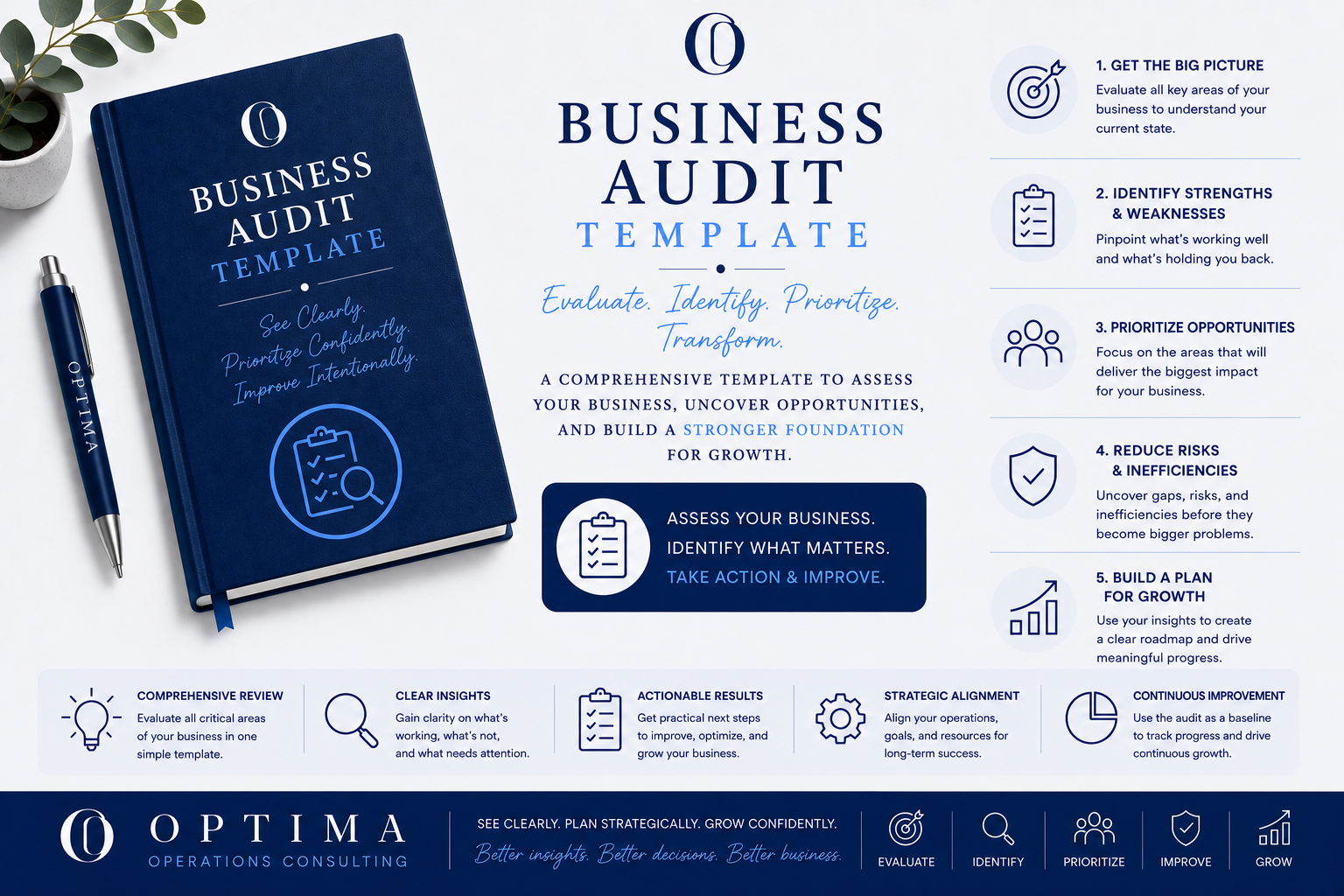
Monthly and quarterly business audits serve different purposes
-
Every quarter is ideal because it provides enough time to measure progress while identifying problems before they become expensive.
-
Vision, operations, processes, leadership, growth, financial performance, customer experience, and personal leadership capacity.
-
Quarterly reviews help identify bottlenecks, improve efficiency, and ensure the business remains aligned with strategic goals before small issues become major problems.
-
A financial audit focuses on numbers and compliance, while a business audit evaluates how effectively the business operates, including people, systems, leadership, and execution.
-
Many business owners hear the word "audit" and assume it's the same process regardless of how often it's completed. In reality, monthly and quarterly business audits serve different purposes, and together they create a rhythm of continuous improvement.
Monthly Business Audit: Stay on Track
A monthly audit is designed to keep your business running smoothly. It's a shorter, tactical review focused on current performance and identifying small issues before they become larger problems.
During a monthly audit, you should review:
Revenue, expenses, and cash flow
Key Performance Indicators (KPIs)
Marketing and sales performance
Customer feedback and satisfaction
Team priorities and workload
Project progress
Immediate operational bottlenecks
Think of a monthly audit as your business health check. It ensures you're making progress toward your goals and allows you to make quick adjustments while they're still easy to implement.