

Working Mom Organization: How to Create a Life That Feels Less Overwhelming
Being a working mom can sometimes feel like running multiple businesses at the same time.
There’s your actual job or business.
Then there’s the family calendar.
School schedules. Sports practices. Appointments. Meals. Laundry. Grocery lists. Emails. Permission slips. Birthdays. Household tasks. And the endless mental list of things you’re trying not to forget.
When everything feels overwhelming, the natural response is often:
I just need to get more organized.
So you buy another planner. Download another app. Create another checklist. Try another morning routine.
But working mom organization isn't really about having the perfect planner.
It’s about creating structure that reduces how much you have to think about every day.
Because the goal isn't to become better at managing chaos.
The goal is to create less of it.
Why Is Staying Organized So Hard for Working Moms?
The challenge isn't necessarily that working moms have poor organization skills.
It's that there are so many moving pieces happening simultaneously.
At any given moment, you might be thinking about:
A work deadline
What you're making for dinner
Whether someone has clean soccer socks
An appointment you need to schedule
A school form sitting on the counter
Groceries you forgot yesterday
A message you haven't responded to
Something your child needs tomorrow
The laundry sitting in the washing machine
And that's before something unexpected happens.
The problem isn't always time.
It's mental load.
When your brain becomes the central storage system for your entire household, even small responsibilities start feeling heavy.
That's why one of the most important principles of working mom organization is simple:
Stop trying to remember everything.
Create systems that remember things for you.
1. Create One Family Command Center
Information becomes difficult to manage when it's scattered everywhere.
One event is in your work calendar.
Another is in a school email.
Sports practices are in an app.
The grocery list is on the refrigerator.
Appointments are in your phone.
And your partner mentioned something important while you were making dinner three days ago.
Choose one central place where the most important family information lives.
This could be a shared digital calendar, family planning app, wall calendar or combination of tools that works for your household.
Your central system should make it easy to answer:
What's happening this week?
Everyone shouldn't have to ask Mom to find out.
2. Do a Weekly Family Reset
One of the best ways to stay organized as a working mom is to stop organizing reactively.
Instead, create a recurring weekly reset.
Choose a consistent day, Sunday works well for many families, and spend 20–30 minutes looking at the week ahead.
Review:
Work commitments
School events
Sports and activities
Appointments
Transportation
Meals
Grocery needs
Household priorities
Anything unusual happening that week
You're essentially running a miniature weekly planning meeting for your household.
It doesn't need to be complicated.
You're simply identifying potential problems before Monday morning arrives.
3. Plan Meals Before the Week Starts
The question:
"What's for dinner?"
shouldn't require a brand-new decision every afternoon.
Meal planning is one of the easiest places to reduce decision fatigue.
You don't need seven elaborate meals.
Start with five.
You can even create recurring themes:
Monday: Crockpot
Tuesday: Tacos
Wednesday: Pasta
Thursday: Leftovers
Friday: Pizza or takeout
The objective isn't culinary creativity.
It's predictability.
Once meals are planned, build your grocery list directly from the plan.
Now you've eliminated multiple decisions from the week.
4. Create Routines Around Your Most Chaotic Times
Don't try to organize your entire life at once.
Instead, identify the parts of the day that consistently feel stressful.
Maybe it's getting everyone out the door in the morning.
Maybe it's coming home after work.
Maybe it's bedtime.
Maybe it's Sunday night when everyone suddenly remembers what they need for Monday.
Start there.
For example, an evening reset could include:
Check tomorrow's calendar
Pack backpacks
Prepare lunches
Set out clothes
Find sports equipment
Put necessary items by the door
Reset the kitchen
Ten intentional minutes at night can prevent thirty frantic minutes the next morning.
5. Give Everything a Home
Physical clutter creates mental clutter.
And one of the biggest sources of household frustration is constantly looking for things.
Where are the keys?
Where's the soccer jersey?
Where did the permission slip go?
Where's the charger?
Create designated homes for frequently used items.
Have a specific location for backpacks, shoes, sports equipment, paperwork, chargers, keys and anything else your family regularly needs.
The system doesn't need to be Pinterest-worthy.
It needs to be obvious.
If everyone knows where something belongs, maintaining organization becomes much easier.
6. Stop Being the Only Person Who Knows the System
This one matters.
Organization shouldn't mean Mom becomes the project manager for everyone else.
A good household system should distribute responsibility.
Children can have age-appropriate responsibilities.
Your partner can own specific areas.
Everyone can check the family calendar.
Everyone can put things back where they belong.
Everyone can participate in resetting the house.
Instead of constantly reminding everyone what needs to happen, create visible routines and expectations.
Because if your organization system only works when you're managing it, you haven't actually reduced your workload.
You've just organized it.
7. Automate What You Can
Automation isn't just for businesses.
It's incredibly useful at home.
Look for repetitive tasks that technology can handle for you.
Consider automating:
Recurring grocery orders
Prescription refills
Bill payments
Calendar reminders
Subscription deliveries
School reminders
Household supply orders
Savings transfers
Every automated task represents one less thing you have to remember.
Individually, these tasks may seem small.
Collectively, they consume a surprising amount of mental capacity.
8. Create Checklists for Repetitive Routines
If you do something repeatedly, stop rebuilding the process from memory.
Create a checklist.
You might have a:
School Morning Checklist
Sports Practice Checklist
Travel Packing Checklist
Sunday Reset Checklist
Cleaning Checklist
School Lunch Checklist
Vacation Preparation Checklist
This is exactly how businesses create consistency.
They document repetitive processes so people don't have to reinvent them every time.
Your household can operate the same way.
9. Use the "Reduce, Automate, Delegate" Method
When your schedule becomes overwhelming, don't immediately ask:
How can I fit everything in?
Ask:
Does everything actually need to be done by me?
Review what's taking your time and put tasks through three filters.
Reduce
What can you eliminate, simplify or do less frequently?
Automate
What can technology handle?
Delegate
What can your partner, children, coworker, employee or outside service take ownership of?
This changes organization from:
"How can I become more efficient at doing everything?"
to:
"What actually requires my time?"
That's a much more powerful question.
10. Decide Your Top Three Priorities
A long to-do list can create the illusion that everything is equally important.
It isn't.
At the beginning of each week, identify your three biggest priorities.
They might include one work priority, one family priority and one personal priority.
For example:
Work: Finish the client proposal.
Family: Prepare for Saturday's tournament.
Personal: Exercise three times.
You will still have smaller responsibilities.
But when the week inevitably gets messy, your priorities help you decide where your limited time should go.
Working Mom Organization Isn't About Doing More
This is the biggest shift.
Organization shouldn't help you fit more into an already overloaded schedule.
It should help you create space.
Space to think.
Space to spend time with your family.
Space to work without constantly remembering household tasks.
Space to rest without feeling like you're forgetting something.
And sometimes the most organized decision you can make is deciding something doesn't need to happen at all.
You don't need a perfectly organized home.
You don't need a color-coded calendar.
You don't need a complicated productivity system.
You need enough structure that your life doesn't require constant mental management.
Start With One System
If you're feeling overwhelmed right now, don't try to implement ten new routines this weekend.
Choose one.
Start with the area creating the most stress.
Maybe that's your calendar.
Maybe it's meal planning.
Maybe it's mornings.
Maybe it's household responsibilities.
Maybe it's your work schedule.
Create one simple system.
Use it.
Adjust it.
Then move to the next area.
Because sustainable organization isn't created through one massive reset.
It's created by building small systems that make everyday life easier.
Structure creates freedom, not because everything becomes perfect, but because everything doesn't have to live in your head anymore.
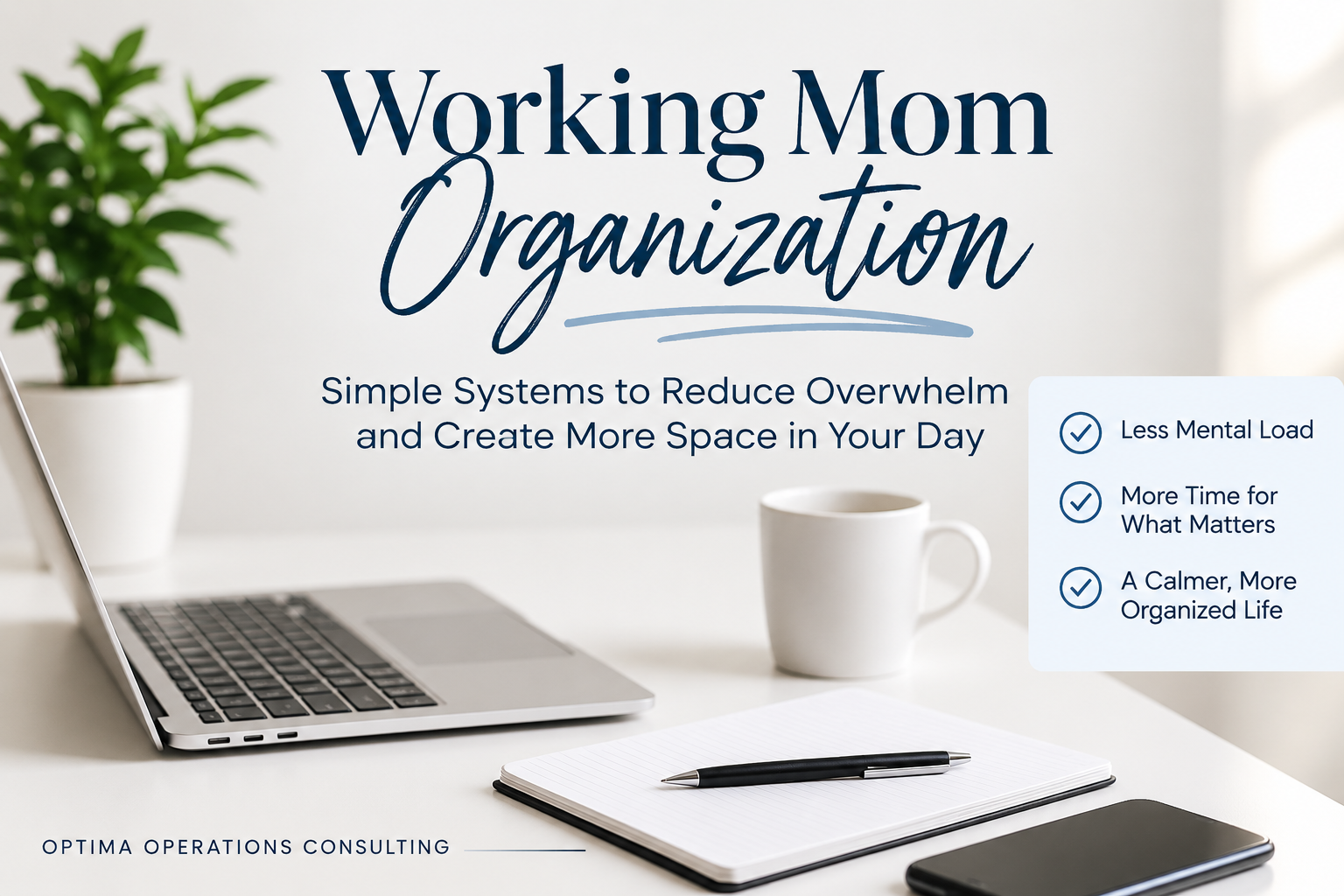
Working mom organization isn’t about fitting more into your day, it’s about creating simple systems that reduce the mental load. With intentional routines, clear priorities, and a little structure, you can spend less time managing the chaos and more time focused on your work, your family, and yourself. Structure creates freedom.
-
The Optima Method looks at organization as more than time management. Using the six foundations: Vision, Operations, Process, Leadership, Growth, and Personal, you can identify where your life or business needs more structure and build simple systems around it.
For a working mom, that might mean clarifying weekly priorities, creating repeatable family routines, automating business tasks, or establishing boundaries around your time. The goal isn't to squeeze more into your schedule. It's to create systems that give you more space for what matters.
Next step: Take the Free Business Foundation Assessment to identify which foundation needs your attention first.
-
Start by getting repetitive responsibilities out of your head. The Optima Method encourages you to look at your work through three questions: What can I reduce? What can I automate? What can I delegate?
Then document the tasks you repeat, establish weekly priorities, create simple workflows, and use templates instead of starting from scratch every time. The same principle from this blog applies to your business: if everything depends on you remembering what happens next, you need a system.
Next step: Explore the Optima Foundation Academy for ready-to-use templates, guides, and resources designed to help you optimize and operationalize your business.
-
Don't try to fix everything at once. Start with the area creating the most friction. The Optima Method helps you assess your foundations so you can identify the real constraint instead of adding another planner, app, or productivity hack.
Your first priority might be your schedule, business processes, weekly planning, family routines, delegation, or simply getting clear about what actually matters right now.
Start with one foundation. Build one system. Create one improvement at a time.
Next step: Use the Optima AI Business Operations Advisor to work through your priorities and turn them into practical next steps.