

Your Calendar Is Telling You What Your Priorities Really Are
You can say your family is a priority.
You can say growing your business is a priority.
You can say you want more time to work on your business instead of constantly working in it.
But there is one place that tells the real story:
Your calendar.
For many entrepreneurs, the calendar becomes a collection of everyone else's priorities. Client meetings get added. Calls get scheduled. Emails turn into tasks. Something unexpected happens. A deadline moves.
Then life gets layered on top of it.
School. Sports. Appointments. Dinner. Activities. Family commitments.
By Wednesday, you're no longer following a plan. You're reacting.
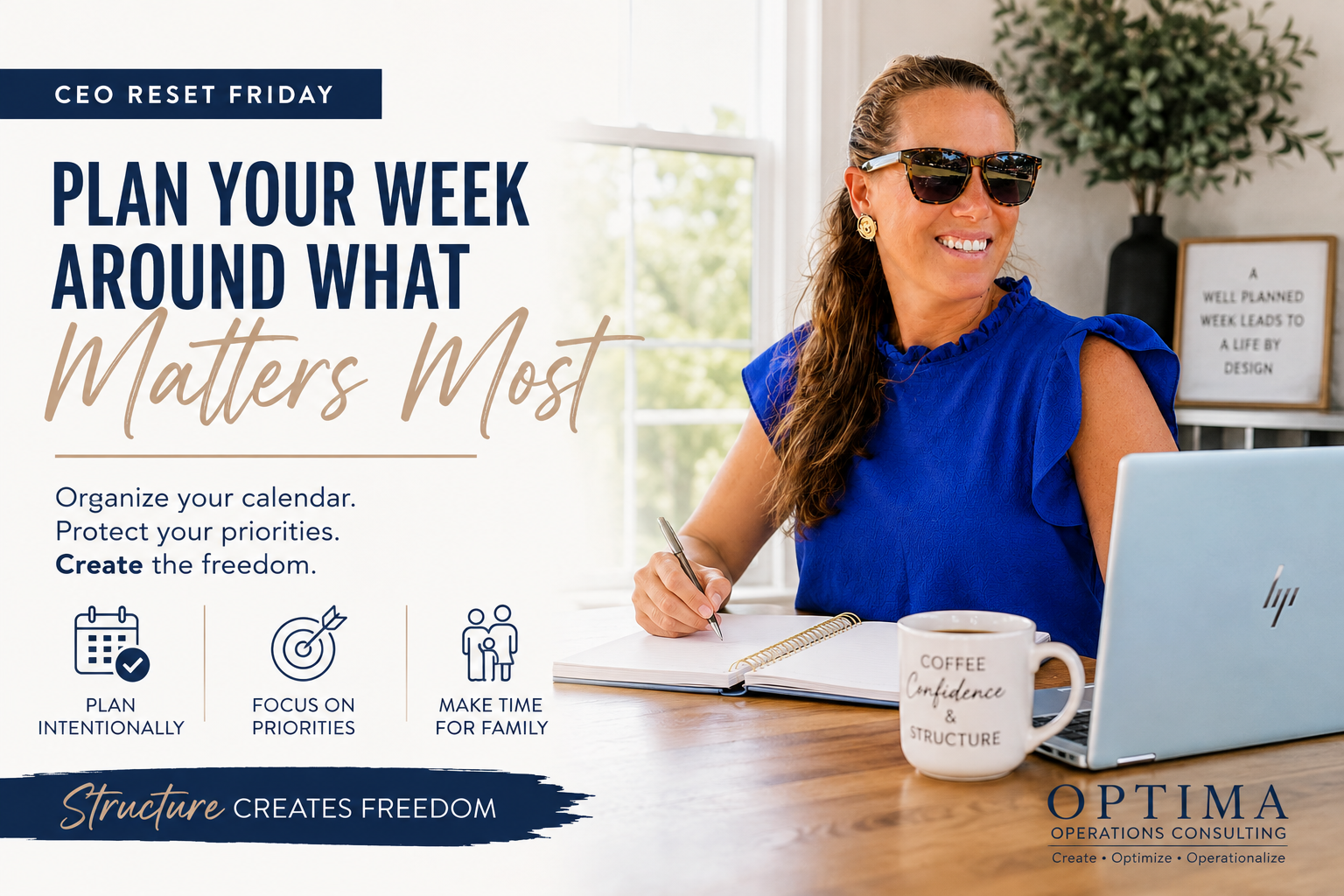
This is exactly why I've started making CEO Reset Friday part of my weekly routine.
Instead of waiting until Monday morning to figure out what needs my attention, I use Friday to intentionally close out one week and prepare for the next.
Last week, the focus was reflection: What worked? What didn't? What didn't get completed? What took significantly longer than expected?
This week, we're taking that information and turning it into action.
We're organizing the calendar around our actual priorities.
Your Calendar Shouldn't Run Your Business
It's incredibly easy to open your calendar and assume everything already scheduled has to stay there.
But as the CEO of your business, even if you're currently a team of one, you have to look at your calendar differently.
Your calendar isn't just where you record meetings.
It's a resource allocation tool.
And one of your most limited resources is your time.
Before adding another task or meeting, start by asking:
Does this actually need my attention?
Does this meeting need to happen?
Could this conversation happen through email?
Could this task be delegated?
Could part of this process be automated?
Is this helping me move toward one of my current business priorities?
The goal isn't to eliminate everything from your calendar.
The goal is to become more intentional about what earns a place on it.
Step 1: Identify Your Top Priorities for the Week
Before you start rearranging your calendar, determine what actually matters.
Choose approximately three to five priorities for the upcoming week.
These aren't every task you need to complete.
They're the things that deserve your focused attention.
Maybe you're working on a client project.
Maybe you need to document a process you've been repeating manually.
Maybe you're focused on sales.
Maybe you need to review your financials.
Maybe you've been saying for three weeks that you're finally going to work on your business strategy.
Whatever they are, identify them first.
Because if everything is a priority, nothing really is.
Step 2: Compare Your Priorities to Your Calendar
Now open next week's calendar.
This is where things get interesting.
If you say your biggest priority is developing a new service, where is the time to work on it?
If improving your operations is important, where is the time dedicated to reviewing those processes?
If generating new business is the priority, where is the time for sales and business development?
If those priorities aren't represented anywhere on your calendar, there's a disconnect.
A priority without protected time is very easy to postpone.
That's how important strategic work gets pushed from Monday to Tuesday, Tuesday to Thursday, and eventually into "I'll get to it next week."
Then next week becomes next month.
Step 3: Protect Time for Focused Work
Once you've identified the gaps, block the time.
Don't simply write "work on processes" on a to-do list.
Put it on your calendar.
Tuesday, 9:00–11:00: Process documentation.
Thursday, 1:00–2:30: Business development.
Friday: CEO Reset.
Creating those blocks gives the work somewhere to live.
It also makes it easier to see when you've overcommitted yourself.
If there are already 30 hours of meetings and commitments on the calendar, you can't realistically add another 30 hours of focused work.
Something has to change.
And seeing it visually can force you to make decisions that a traditional to-do list doesn't.
Step 4: Put Your Personal Priorities on the Calendar Too
This is where business planning and work-life balance have to become part of the same conversation.
I don't believe we should build the entire business calendar first and then try to squeeze our families into whatever time remains.
Your personal priorities are priorities too.
School activities matter.
Your children's sports matter.
Dinner with your family matters.
Your spouse matters.
Your friendships matter.
And having time when you're simply not working matters.
As an entrepreneur, and especially as a parent, there will always be competing demands.
The answer isn't pretending that perfect balance exists every single day.
The answer is creating enough structure that you can make intentional choices about where your time goes.
Structure Creates Freedom
There's a misconception that structure makes life rigid.
I've found the opposite to be true.
Structure creates freedom.
When I know what needs to happen, when I'm going to work on it, and what my priorities are, it's easier to step away.
I don't have to spend family time mentally cycling through everything I might be forgetting.
I don't have to constantly check my laptop.
And I don't have to feel like every available hour should be another working hour.
The systems, processes, and structure inside your business should ultimately help your business become less dependent on you, not more.
That's one of the reasons I focus so heavily on the six foundations of a business:
Vision. Operations. Process. Leadership. Growth. Personal.
They're connected.
You can't build a business that provides freedom if the way you operate it constantly takes that freedom away.
Use AI to Pressure-Test Your Calendar
This is also an opportunity to use AI differently.
Instead of asking AI to simply create another to-do list, use it as a strategic advisor.
Once you've identified your priorities and reviewed your calendar, bring that information into the Optima AI Business Advisor.
Try this prompt:
I'm planning my upcoming week. My top business priorities are [insert priorities]. My existing business and personal commitments are [insert commitments]. Help me identify where my calendar is misaligned with my priorities. Identify what I should protect time for, what could potentially be delegated, eliminated, shortened, or automated, and where I may be overcommitting myself. Ask me questions before making recommendations if you need additional information.
This changes the role of AI.
You're not asking it to make decisions for you.
You're using it to help you identify patterns, challenge assumptions, and make better decisions.
That's where AI can become incredibly valuable for a small business owner.
Your CEO Reset Friday Exercise
Before you close your laptop this Friday, spend 15–30 minutes preparing next week.
Identify your three to five biggest priorities.
Open your calendar and review every existing commitment.
Question the meetings that don't need to happen.
Protect focused time for the work that matters.
Add your personal and family commitments.
Then look at the completed week and ask yourself:
Does my calendar reflect what I say my priorities are?
If the answer is no, don't wait for Monday.
Change it now.
Because building a successful business shouldn't require sacrificing everything outside of it.
The objective is to create a business with enough structure, clarity, and operational discipline that you have room for both.
Build the structure. Protect your priorities. Create the freedom.
That's your CEO Reset Friday.
Ready to Find Where Your Business Needs More Structure?
If your weeks constantly feel reactive, the problem may go deeper than your calendar.
Take the Free Business Foundation Assessment to identify where your biggest opportunities exist across Vision, Operations, Process, Leadership, Growth, and Personal foundations.
Free Business Foundation Assessment:
https://optimaoperationsconsulting.scoreapp.com
Want help thinking through your priorities, processes, and next steps?
Use the Optima AI Business Advisor to get guidance based on your business and where you're currently getting stuck.
Optima AI Business Advisor:
https://www.optimaoperationsconsulting.com/ai-business-advisor
Structure creates freedom.
Find more on the Optima Method Youtube Channel!