
AI Employees vs Virtual Assistants vs Hiring
As your business grows, something eventually becomes obvious:
You cannot keep doing everything yourself.
The emails.
The content.
The follow-ups.
The bookkeeping prep.
The reports.
The customer processes.
The administrative work.
The dozens of repetitive tasks happening behind the scenes.
But recognizing that you need help creates another question:
What kind of help do you actually need?
Do you hire an employee?
Bring in a virtual assistant?
Or build an AI Employee?
The answer isn't necessarily one or the other.
The better question is:
What work needs to be done, and what is the best resource to do it?
That's where business operations matter.
First: Stop Starting With the Person
One of the biggest mistakes I see small business owners make is immediately jumping to:
"I need to hire someone."
Maybe you do.
But before hiring, outsourcing, or automating anything, you need to understand the work itself.
What are you doing repeatedly?
What requires your expertise?
What requires human judgment?
What follows essentially the same process every time?
What could be automated?
And what shouldn't be happening at all?
You don't solve owner dependency simply by giving your workload to another person.
You solve it by building systems around the work.
Then you determine who, or what, should execute those systems.
Option 1: Hiring an Employee
Hiring makes sense when your business needs consistent human ownership of a function.
An employee can manage complexity, make decisions within their role, collaborate with other people, build relationships, adapt to changing circumstances, and eventually take ownership of an entire area of the business.
That is incredibly valuable.
But hiring also requires infrastructure.
Before bringing someone into your business, you should have clarity around:
Their role
Responsibilities
Expected outcomes
Processes
SOPs
Training
KPIs
Decision-making authority
Tools and systems
Management expectations
Otherwise, you haven't really delegated a role.
You've delegated confusion.
And now two people are trying to figure out how your business works.
Hiring works well when:
You need ongoing human judgment, relationship management, leadership, decision-making, creative problem-solving, or ownership that goes beyond executing a defined workflow.
Option 2: Hiring a Virtual Assistant
A virtual assistant can be an excellent bridge between doing everything yourself and hiring a larger internal team.
A VA may help with things like:
Inbox management
Scheduling
Customer follow-up
CRM updates
Research
Data entry
Social media scheduling
Document organization
Administrative support
But there's an important distinction:
A VA still needs a process.
If every task requires you to explain what to do, answer questions, provide missing information, review the result, and correct the work, you may technically have delegated the task, but the task still depends heavily on you.
That's why documentation matters.
The clearer the SOP, inputs, outputs, expectations, and decision points are, the easier it becomes for someone else to execute the work successfully.
A virtual assistant works well when:
The task benefits from human execution but doesn't necessarily require a full-time employee or strategic ownership.
Option 3: Building an AI Employee
This is where small businesses have a completely new opportunity.
An AI Employee isn't a robot sitting at a desk.
It is an AI-powered role designed around specific responsibilities, business knowledge, instructions, processes, and expected outputs.
Instead of opening ChatGPT or Claude and asking random questions every day, you're creating AI around the way your business actually operates.
For example, you might create an:
Operations AI Employee that reviews processes, identifies bottlenecks, creates documentation, analyzes operational gaps, and helps maintain your systems.
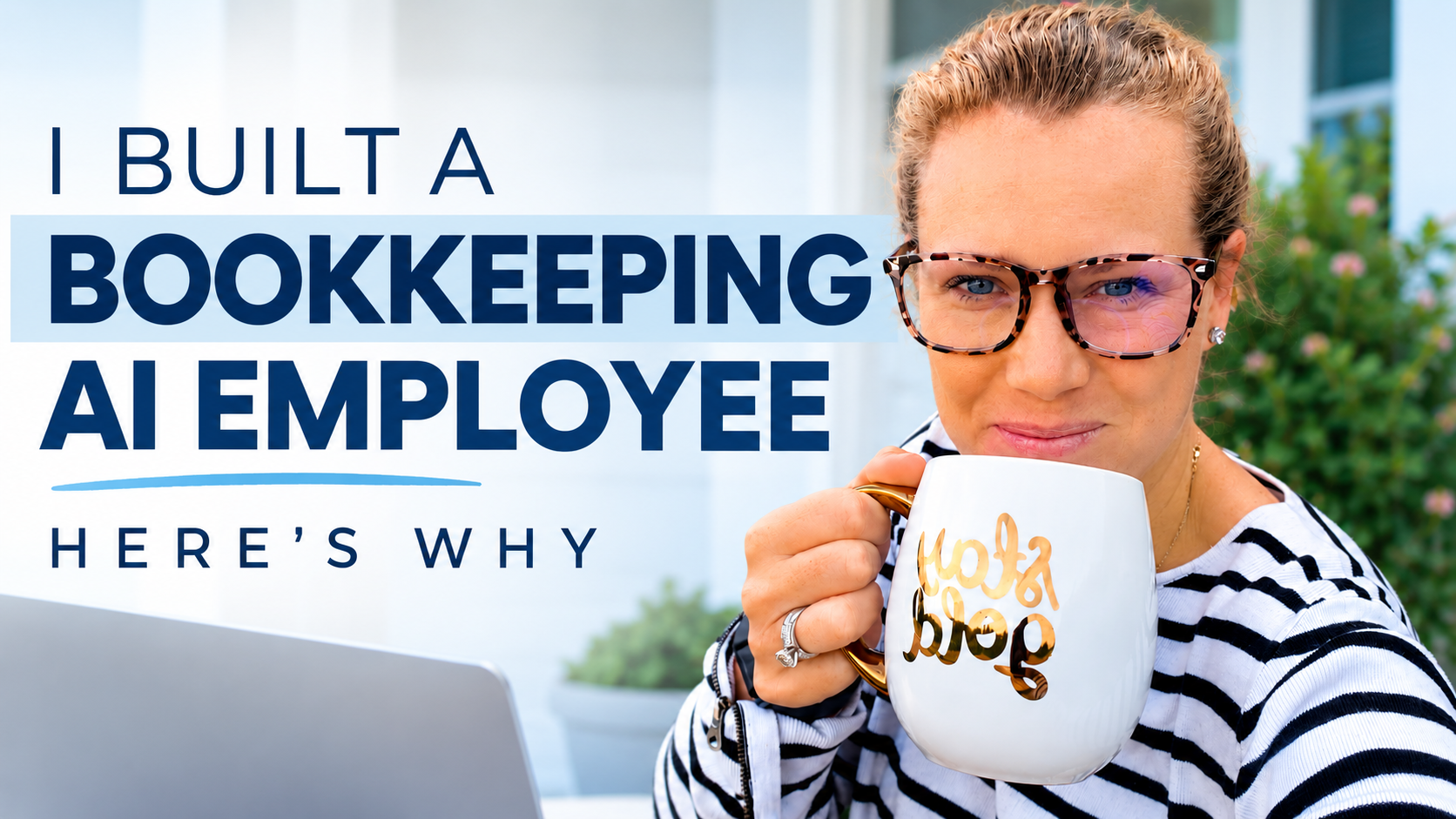
A Bookkeeping AI Employee could help organize financial information, categorize transactions for review, prepare summaries, flag missing information, and support recurring bookkeeping workflows.
A Content AI Employee could work from your brand voice, content strategy, audience, offers, and documented workflow to support content creation.
A Sales AI Employee could help prepare follow-ups, analyze pipeline information, research prospects, and create sales support materials.
The goal isn't:
"Let AI run my entire business."
It's:
"Let AI handle the repeatable work that doesn't need to depend on me."
AI Employees Don't Eliminate the Need for People
This distinction is important.
AI isn't automatically better than a VA.
A VA isn't automatically cheaper or better than an employee.
And hiring an employee isn't automatically the next stage of growth.
They solve different operational problems.
Think about the difference this way:
AI Employee vs. Virtual Assistant vs. Employee
Choose the right resource based on the work your business actually needs.
| Business Need | AI Employee | Virtual Assistant | Employee |
|---|---|---|---|
| Repetitive tasks | ✓ Excellent | ✓ Excellent | ✓ Yes |
| Following documented processes | ✓ Excellent | ✓ Excellent | ✓ Excellent |
| Works anytime | ✓ Yes | Typically scheduled hours | Typically scheduled hours |
| Human interaction | Limited | ✓ Yes | ✓ Yes |
| Customer relationships | Limited | ✓ Yes | ✓ Yes |
| Complex decision-making | Human oversight needed | Depends on experience | ✓ Can own decisions |
| Leadership & people management | No | Role dependent | ✓ Yes |
| Requires training / setup | Initial setup | Training required | Training required |
| Best Use | Repeatable Work Documented, structured tasks that can be supported or executed with AI. | Delegated Execution Human tasks that need coordination, communication, or administrative support. | Ownership & Leadership Work requiring judgment, accountability, relationships, and leadership. |
Use AI for repeatable work. Use a VA for delegated human execution. Hire an employee when you need ongoing ownership, judgment, leadership, or relationship management.
The question isn't:
AI or humans?
The question is:
What combination creates the simplest operating model for your business?
The Best Answer May Be All Three
Imagine a growing business with an operations manager.
The operations manager shouldn't spend hours every week manually creating reports, reorganizing documents, summarizing information, or drafting repetitive communications.
An AI Employee could support that work.
A virtual assistant could manage administrative execution and coordination.
The operations manager could focus on decisions, people, exceptions, improvement, and leadership.
That's a very different model from expecting one employee to do everything.
AI handles appropriate repeatable work.
The VA handles appropriate human execution.
The employee owns the function and higher-level decisions.
And the owner stops being the default solution to every problem.
But There's a Step Before Any of This
Before you build an AI Employee, hire a VA, or post a job opening, document what you're actually doing.
Start with your repetitive work.
For each recurring task, ask:
Does this task need to happen?
If yes:
Does it need me?
If no:
Does it require a human?
If no:
Can it be automated or supported by AI?
If it requires a human:
Does it need an employee, contractor, specialist, or VA?
That simple exercise can completely change the way you think about hiring.
This Is Why I Start With Assess → Act → Build
At Optima Operations Consulting, I don't believe small businesses should start by adding more technology, or more people, to an unclear business.
We start with the foundation.
ASSESS
Identify where the business is dependent on you, where processes are breaking, and where repetitive work is consuming your time.
ACT
Prioritize the one or two areas that will make the biggest operational difference.
Don't try to automate your entire company overnight.
BUILD
Document the process.
Create the SOP.
Define the role.
Then determine whether the work belongs with AI, automation, a VA, an employee, or you.
That's how you build AI around your business instead of forcing your business around AI.
AI Should Sit on Top of Your Business Foundation
This is the part of AI implementation that often gets skipped.
AI needs context.
It needs instructions.
It needs processes.
It needs defined inputs.
It needs expected outputs.
It needs boundaries.
In other words:
AI needs the same operational clarity that people need.
If your process exists entirely inside your head, handing it to AI won't magically create a scalable business.
First, get the process out of your head.
Then document it.
Then optimize it.
Then determine how it should be executed.
Create it → Build it → Optimize it → Automate it.
Before You Hire Your Next Person, Look at the Work
Small businesses now have more options than ever before.
That doesn't mean every role should become AI.
It means we can be much more intentional about how businesses are built.
Instead of asking:
"Who can I hire to take all of this off my plate?"
Start asking:
"What is actually on my plate, and why am I still the person doing it?"
Some of it may need an employee.
Some may belong with a VA.
Some may become an AI Employee.
Some can be completely automated.
And some may not need to happen anymore.
That is how you reduce owner dependency.
That is how you create operational capacity.
And that is how you build a business designed to grow beyond you.
Structure Creates Freedom
AI shouldn't make your business more complicated.
It should help remove repetitive work from your plate, but only after you've created enough structure for AI to understand what needs to happen.
That's the approach behind Optima Operations Consulting.
Assess the business.
Act on what matters.
Build the system.
Then use AI to help it run.
Because the goal isn't to replace people with AI.
The goal is to stop using expensive human time, including your own, for work that no longer requires it.