

Build a Business Designed for Your Life, Not a Life Built Around Your Business
When you started your business, what did you imagine?
More freedom?
More flexibility?
More control over your time?
Maybe you wanted to build something meaningful while still being present for your family. Maybe you wanted the ability to work around school schedules, appointments, vacations, soccer practices, or simply have more control over how you spend your days.
But somewhere between starting the business and trying to grow it, something can shift.
Instead of the business fitting into your life, your entire life starts revolving around the business.
You're answering emails at night.
You're checking notifications while you're with your family.
You're squeezing work into every available pocket of time.
You're constantly thinking about what needs to happen next.
And even when you're technically "not working," the business is still running through your head.
That isn't the freedom most entrepreneurs imagined when they started.
The goal shouldn't simply be to build a successful business.
The goal should be to build a business that supports the life you actually want to live.
Your Business Should Support Your Life
Entrepreneurship often comes with the message that growth requires sacrifice.
Work harder.
Wake up earlier.
Post more.
Sell more.
Add another offer.
Find another marketing strategy.
But more isn't always the answer.
Sometimes the next stage of your business isn't about adding something.
It's about creating structure around what already exists.
Because without structure, the business will naturally consume whatever time you give it.
If you have two hours available, you'll find two hours of work.
If you have eight hours available, you'll find eight hours of work.
And if you don't establish boundaries around your business, there will always be something else that feels urgent.
A business designed for your life starts by deciding what you want your life to look like, and then building the business around those priorities.
Start With the Life You Want
Most business planning starts with revenue.
How much do you want to make?
How many clients do you need?
How many products do you need to sell?
Those questions matter.
But I believe there's another question that should come first:
What do you want your life to look like?
Think beyond revenue.
What time do you want to start working?
What time do you want to finish?
How many days per week do you want to work?
Do you want to be available for school pickup?
Do you want your evenings protected?
Do you want Fridays available for your family?
Do you want the ability to travel without worrying that the business will fall apart?
Your answers become operational requirements for your business.
For example, if you want to stop working at 3:00 PM every day, the question becomes:
What systems need to exist so my business can operate within those hours?
That question changes the way you build.
Stop Building Your Business Around Your Availability
One of the easiest traps for solopreneurs and small business owners is becoming the solution to everything.
A customer needs something?
You handle it.
An email comes in?
You answer it.
Something needs to be posted?
You create it.
A process breaks?
You fix it.
An invoice needs to go out?
You send it.
Eventually, the business becomes completely dependent on you.
And that's when entrepreneurship starts feeling heavy.
Instead of asking:
"How can I get all of this done?"
Start asking:
"How should this work?"
That small shift moves you from constantly completing tasks to intentionally designing operations.
Build Systems Before You Need Them
Systems aren't just for large companies.
They're especially important when you're running a business by yourself.
A system simply answers:
What happens, when does it happen, and how does it get done?
Start with the repetitive areas of your business.
Client onboarding.
Lead follow-up.
Scheduling.
Invoicing.
Content creation.
Customer communication.
File organization.
Weekly planning.
Reporting.
For each one, determine whether the work should be:
Automated, delegated, simplified, standardized, or eliminated.
You don't need complicated technology.
You need repeatability.
The less your business depends on you remembering what needs to happen next, the more mental space you create.
Create a Weekly Operating Rhythm
A business designed for your life needs predictable rhythms.
Instead of waking up every morning and deciding what needs your attention, establish a weekly operating structure.
For example:
Monday: priorities and client delivery
Tuesday: operations and projects
Wednesday: marketing and content
Thursday: growth and business development
Friday: CEO review, planning, and reset
Your schedule doesn't have to look like this.
The important part is creating intentional space for the different responsibilities inside your business.
When everything can happen at any time, everything feels urgent.
When work has a designated place, you reduce decision fatigue.
Define Your Business Priorities
Another reason business owners become overwhelmed is because they're trying to grow everything simultaneously.
More followers.
More clients.
More products.
More content.
More revenue streams.
More platforms.
But every new initiative creates additional operational work.
Before adding something new, ask:
Does this move the business toward the life and company I'm trying to build?
If the answer is no, it may not deserve your time right now.
You don't need 20 priorities.
You need a few priorities that actually move the business forward.
Choose your top three.
Then let those priorities guide your calendar.
Protect Your Personal Foundation
At Optima Operations Consulting, I talk about six foundations of a sustainable business:
Vision. Operations. Process. Leadership. Growth. Personal.
The Personal Foundation matters because you are part of the operating system of your business.
Your capacity matters.
Your schedule matters.
Your family matters.
Your energy matters.
Your definition of success matters.
You can have strong marketing, great processes, and growing revenue, but if the business requires you to operate at maximum capacity indefinitely, the structure isn't sustainable.
Your personal life shouldn't simply receive whatever time is left after the business takes what it needs.
It should be part of the design.
Set Capacity Before Setting Goals
Before committing to another goal, client, product, or project, understand your actual capacity.
Ask yourself:
How many hours do I realistically want to work each week?
How many clients can I support well within those hours?
How much administrative work am I carrying?
What responsibilities could be automated?
What could eventually be delegated?
What am I doing simply because I've always done it?
Capacity should influence strategy.
Otherwise, you can create a business plan that looks successful on paper but feels impossible to maintain in real life.
Create Boundaries Through Systems
Boundaries aren't only about saying no.
Good operations can create boundaries for you.
Online scheduling prevents endless back-and-forth emails.
Automated confirmations reduce manual communication.
Clear client expectations reduce unnecessary questions.
Templates eliminate repeatedly starting from scratch.
Standard operating procedures make delegation easier.
Defined office hours protect personal time.
A CRM keeps follow-ups from living in your head.
A weekly planning process keeps priorities visible.
These aren't just productivity tools.
They're infrastructure for freedom.
Stop Measuring Success Only by Revenue
Revenue matters.
Profit matters.
Growth matters.
But they're not the only measurements of a successful business.
Ask yourself:
Can I step away from my business without everything stopping?
Can I take a vacation?
Can I attend my child's event without checking my phone constantly?
Can I finish work and mentally leave the business behind?
Do I have enough capacity to handle unexpected life events?
Am I building something I still want to operate five years from now?
Those are business metrics too.
Because a business can look successful from the outside while being completely unsustainable for the person running it.
Your Business Doesn't Need More of You
This is one of the biggest mindset shifts I want business owners to make.
When the business feels overwhelming, the answer isn't automatically to become more productive.
You don't necessarily need another planner.
You don't need to wake up at 5 AM.
You don't need to squeeze another hour out of your day.
You may need to change how the business operates.
Look at what's taking your time.
Look at what's repetitive.
Look at what constantly requires your attention.
Look at what could happen without you.
Then start building the systems that remove you from the center of every task.
Build the Business Around What Matters
There will always be seasons when your business requires more from you.
Launching something new may require additional hours.
Growth may temporarily stretch your capacity.
Starting a business often requires wearing multiple hats.
But temporary intensity shouldn't become the permanent operating model.
Keep coming back to the bigger question:
What am I building this business for?
If the answer includes freedom, family, flexibility, impact, financial security, or simply having more control over your time, your operations should support those goals.
That's what intentional business design looks like.
You aren't simply building revenue.
You're building an operating model.
You're building systems.
You're building capacity.
And ultimately, you're building a business designed to support your life, not a life designed to support your business.
Ready to Build More Structure Into Your Business?
Start by looking at the foundation.
Identify where your business is creating unnecessary complexity, where you're carrying too much manually, and where stronger systems could create more space.
Because the goal isn't to fit more work into your life.
The goal is to build a business that gives you more room to live it.
Structure creates freedom.
Optima Operations Consulting, Create. Optimize. Operationalize.
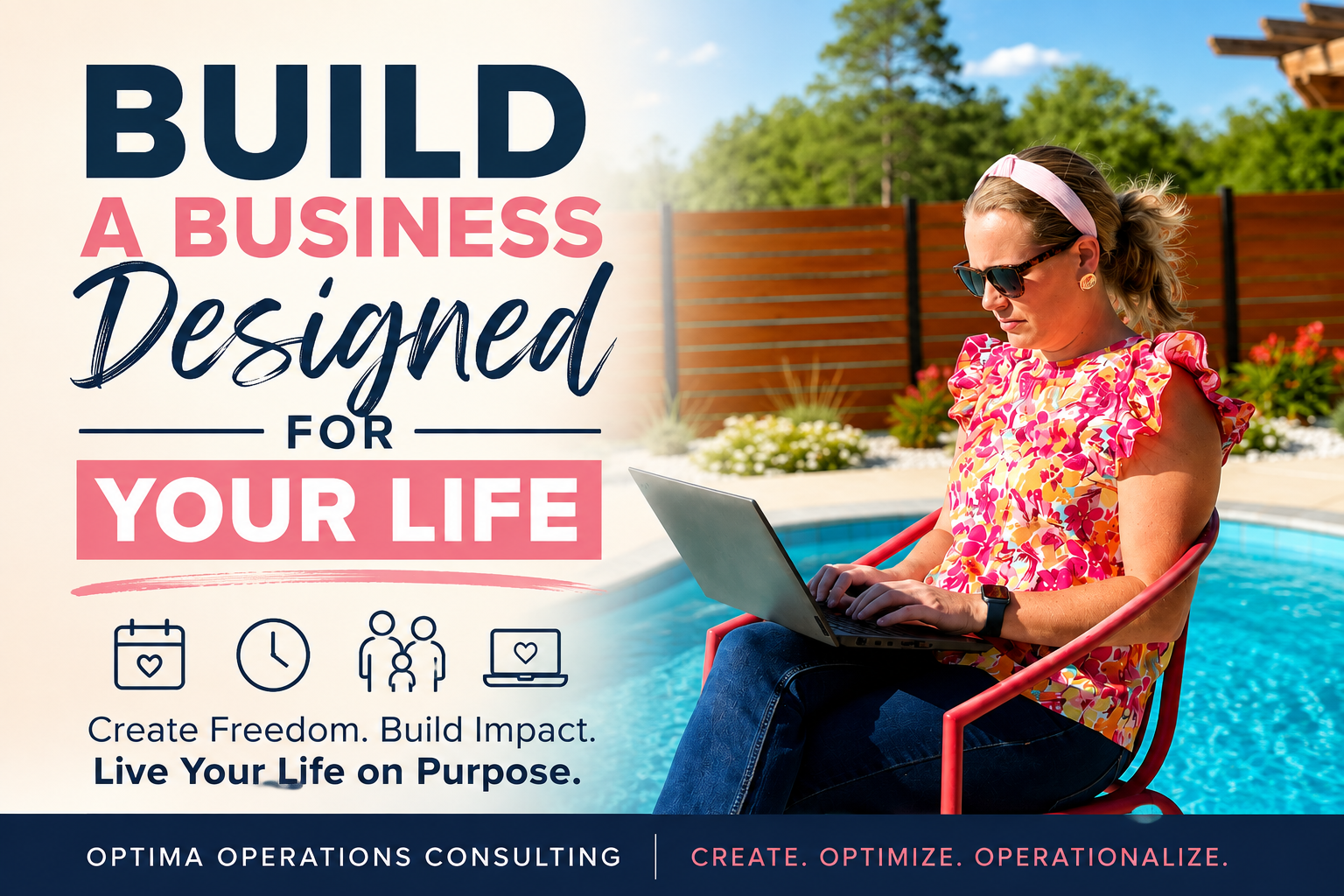
You started your business to create more freedom, not to fill every available hour with more work. Learn how to build a business around your life, priorities, and capacity by creating the systems, structure, and boundaries that allow your business to grow without taking over everything else.
-
Start by defining the time, flexibility, and capacity you want your business to support. Then build your operations around those boundaries using clear priorities, repeatable processes, automation, and systems. The goal isn't simply to become more productive—it's to create a business that can grow without requiring more of you at every stage.
Next step: Take the Free Business Foundation Assessment to identify which area of your business needs more structure.
-
Start with the tasks you repeat most often, especially client onboarding, lead management, scheduling, invoicing, content creation, customer communication, and weekly planning. Document the process, simplify unnecessary steps, and determine what can be automated or delegated.
Next step: Explore the Optima Foundation Academy for ready-to-use templates and guides designed to help you optimize and operationalize your business.
-
AI can help you move beyond simply creating content. It can support business planning, process development, SOP creation, prioritization, workflow improvement, and identifying opportunities to automate repetitive work. Used intentionally, AI becomes another tool for reducing the amount of business knowledge and decision-making that has to live in your head.
Next step: Meet the Optima AI Business Advisor and use the Optima Method to start building a stronger business foundation.