Business Operations Consultant for Small Business Owners: When You Need More Than Another To-Do List
Running a small business often starts with one person doing almost everything.
You are the CEO, salesperson, marketer, customer service team, project manager, administrator, and problem-solver, all at the same time.
At first, that flexibility can be an advantage. You make decisions quickly, know exactly what is happening across the business, and can adjust as you grow.
But eventually, being involved in everything becomes the problem.
Your business may be growing, but behind the scenes you are still relying on memory, scattered processes, manual tasks, and decisions that constantly come back to you.
That is where a business operations consultant for small business owners can help.
Operations consulting is not simply about becoming more organized. It is about building the structure, systems, processes, and accountability your business needs so that growth does not require you to personally carry more and more of the workload.
What Does a Business Operations Consultant Do?
A business operations consultant looks at how your business actually works.
Not just what you sell or how you market it, but everything that needs to happen behind the scenes to consistently deliver your product or service.
That can include:
Business workflows
Standard operating procedures (SOPs)
Roles and responsibilities
Delegation
Automation
Technology and systems
Client onboarding
Project management
Internal communication
Performance metrics and KPIs
Leadership accountability
Strategic planning
Operational bottlenecks
The objective is straightforward:
Make the business easier to operate, manage, and eventually scale.
A strong operational foundation creates clarity around what needs to happen, who owns it, how it gets done, and how you know whether it is working.
Signs Your Small Business May Need an Operations Consultant
You do not have to wait until your business is completely overwhelmed to improve your operations.
In fact, some of the best operational work happens before the next stage of growth.
You may need operational support if you frequently find yourself saying:
“Everything depends on me.”
“I know we need processes, but I don't have time to create them.”
“I keep doing the same administrative work every week.”
“I hired help, but I'm still answering every question.”
“Our information is everywhere.”
“I know we're busy, but I'm not sure whether we're actually making progress.”
“I want to grow, but I don't think our current systems can handle it.”
These problems may look different on the surface, but they often have the same underlying cause:
The business has outgrown its operational foundation.
Small Business Growth Often Creates Operational Complexity
More customers can mean more revenue.
But they can also mean:
More emails.
More projects.
More invoices.
More follow-ups.
More customer questions.
More employees or contractors.
More software.
More decisions.
More things that can fall through the cracks.
Without intentional systems, growth can actually make a business owner feel less successful because every new opportunity creates additional work.
That is why operational maturity matters.
You want the systems supporting your business to develop alongside the business itself.
What Should a Business Operations Consultant Look At?
At Optima Operations Consulting, I approach business operations through six interconnected foundations.
1. Vision
Before optimizing a business, you need to understand what you are building.
Your business vision influences your priorities, resources, systems, team, and growth strategy.
This includes questions such as:
Where is the business going?
What are the priorities?
What should happen this quarter?
What should you stop doing?
What does success actually look like?
Operations without direction can simply help you become more efficient at doing work that does not matter.
Strategy needs to come first.
2. Operations
Next, look at the structure supporting the business.
Where does information live?
How is work tracked?
What tools are being used?
How are priorities managed?
How does work move through the organization?
Small businesses frequently accumulate tools and processes organically. Someone creates a spreadsheet. Another tool gets added. Notes live somewhere else. Client information sits inside email.
Eventually, nobody has one reliable source of truth.
Operational organization creates the infrastructure that supports everything else.
3. Processes
Processes turn knowledge into repeatable ways of working.
Instead of:
“I know how to do it.”
The goal becomes:
“This is how the business does it.”
That may include documenting:
Client onboarding
Lead management
Sales processes
Customer service
Project delivery
Invoicing
Content creation
Hiring
Employee onboarding
Reporting
Recurring administrative tasks
Not every process needs a 20-page SOP.
Sometimes a checklist is enough.
Sometimes you need a workflow.
Sometimes you need automation.
Sometimes you discover the task should simply be eliminated.
The goal is not documentation for the sake of documentation. The goal is creating repeatability and clarity.
4. Leadership
Once other people become involved in the business, operational clarity becomes even more important.
Someone needs to know:
What they own.
What decisions they can make.
What success looks like.
When something needs to be escalated.
What they are accountable for.
Without this structure, delegation often turns into task assignment.
The business owner gives someone work but remains responsible for answering questions, checking progress, fixing problems, and making every decision.
Effective delegation transfers ownership, not simply tasks.
5. Growth
Growth needs measurement.
Small businesses can easily become focused on activity:
How many posts did we publish?
How many emails did we send?
How many projects did we complete?
But activity and progress are not always the same thing.
Your operational system should help you identify the metrics that actually matter.
Depending on the business, those could include:
Revenue
Profitability
Conversion rate
Pipeline value
Client retention
Lead volume
Customer acquisition cost
Project profitability
Capacity
Delivery timelines
Recurring revenue
The goal is to create enough visibility to make better decisions.
6. Personal
This foundation is frequently overlooked.
Your business exists within your life.
If your company's operating model requires you to constantly work nights, answer messages during family time, remember every detail, and personally solve every problem, the system is not truly sustainable.
Especially for solopreneurs, working parents, and small business owners, operational design should consider capacity.
Ask:
What kind of business am I actually trying to build?
Then build systems that support that vision.
What Working With a Business Operations Consultant Can Look Like
Operations consulting does not necessarily mean walking into your business and changing everything.
A good starting point is understanding the current state.
That might involve reviewing your workflows, systems, responsibilities, recurring tasks, documentation, technology, and operational bottlenecks.
Then you can identify three categories:
What needs to be created?
There may be missing processes, SOPs, accountability structures, dashboards, or workflows.
What needs to be optimized?
Existing processes may work but contain unnecessary steps, duplicate work, or bottlenecks.
What needs to be operationalized?
A process may already exist informally but needs to become repeatable, documented, delegated, measured, or automated.
This is the idea behind the Optima approach:
Create. Optimize. Operationalize.
An Operations Consultant Should Not Just Give You More Work
This distinction matters.
Business owners already have enough to do.
The objective of operational consulting should not be handing you another massive list of recommendations.
It should help you determine:
What matters most right now?
Maybe you do not need 25 SOPs.
You need three.
Maybe you do not need another software platform.
You need to properly configure the one you already have.
Maybe you do not need another employee.
You need to eliminate unnecessary work and automate repetitive tasks first.
Maybe you do not have a productivity problem.
You have a prioritization problem.
Good operations work simplifies before it adds.
Automation Is Part of Operations, But It Isn't the Entire Strategy
Automation can save significant time, especially for small businesses.
You might automate:
Appointment reminders
Lead follow-ups
Client onboarding emails
Invoice reminders
Form submissions
Internal notifications
Recurring reporting
Task creation
Customer communications
Data transfers between systems
But there is an important rule:
Do not automate a broken process.
First understand the workflow.
Then remove unnecessary steps.
Then standardize it.
Then determine what should be automated.
Otherwise, automation simply allows an inefficient process to run faster.
SOPs Help Your Business Become Less Dependent on You
SOPs are another important component of small business operations.
But an SOP should not exist simply because someone told you that successful businesses need SOPs.
An SOP should solve a problem.
For example:
Instead of explaining the same task five times, document it once.
Instead of remembering every onboarding step, create a checklist.
Instead of wondering whether something was completed, define ownership and accountability.
Instead of storing critical business knowledge in your head, put it into the business.
This becomes especially important when you start hiring employees, contractors, virtual assistants, or other support.
The Goal Isn't to Remove Yourself From Your Business
The goal is to remove yourself from the work that doesn't require you.
There is an important difference.
Your expertise, leadership, relationships, and strategic decisions may continue to be incredibly important.
But manually sending the same email every week?
Probably not.
Updating the same spreadsheet in three different places?
Probably not.
Answering a question that could have been answered through a documented process?
Probably not.
The more unnecessary operational work you remove from your plate, the more capacity you create for the work where you provide the greatest value.
What Happens When Your Operations Become Stronger?
You begin moving away from:
Reactive → Intentional
Manual → Automated where appropriate
Tribal knowledge → Documented processes
Task assignment → Ownership
Constant decisions → Defined standards
Scattered information → Organized systems
Being busy → Measuring meaningful progress
And ultimately:
Owner-dependent → System-supported
That does not happen overnight.
It happens one process, workflow, system, and decision at a time.
Start by Finding the Biggest Operational Gap
If your business feels disorganized, you do not need to fix everything this week.
Start by identifying the foundation creating the most friction.
Ask yourself:
Where does my business depend too heavily on me right now?
Then ask:
What would need to exist for that work to happen consistently without me managing every step?
That answer may reveal the next system, process, SOP, automation, delegation structure, or operational improvement your business needs.
At Optima Operations Consulting, the goal is to help entrepreneurs and small business owners create the structure behind their business, so growth does not automatically mean more complexity, more manual work, and more pressure on the owner.
Because the goal isn't simply to build a bigger business.
It's to build a business that works better.
Ready to Strengthen Your Business Operations?
Start by identifying which part of your business foundation needs the most attention.
Take the Free Business Foundation Assessment to evaluate your Vision, Operations, Process, Leadership, Growth, and Personal foundations and identify where to focus next.
Or explore the Optima Method for practical tools, templates, and guidance designed to help you create, optimize, and operationalize your business.
Structure creates freedom.
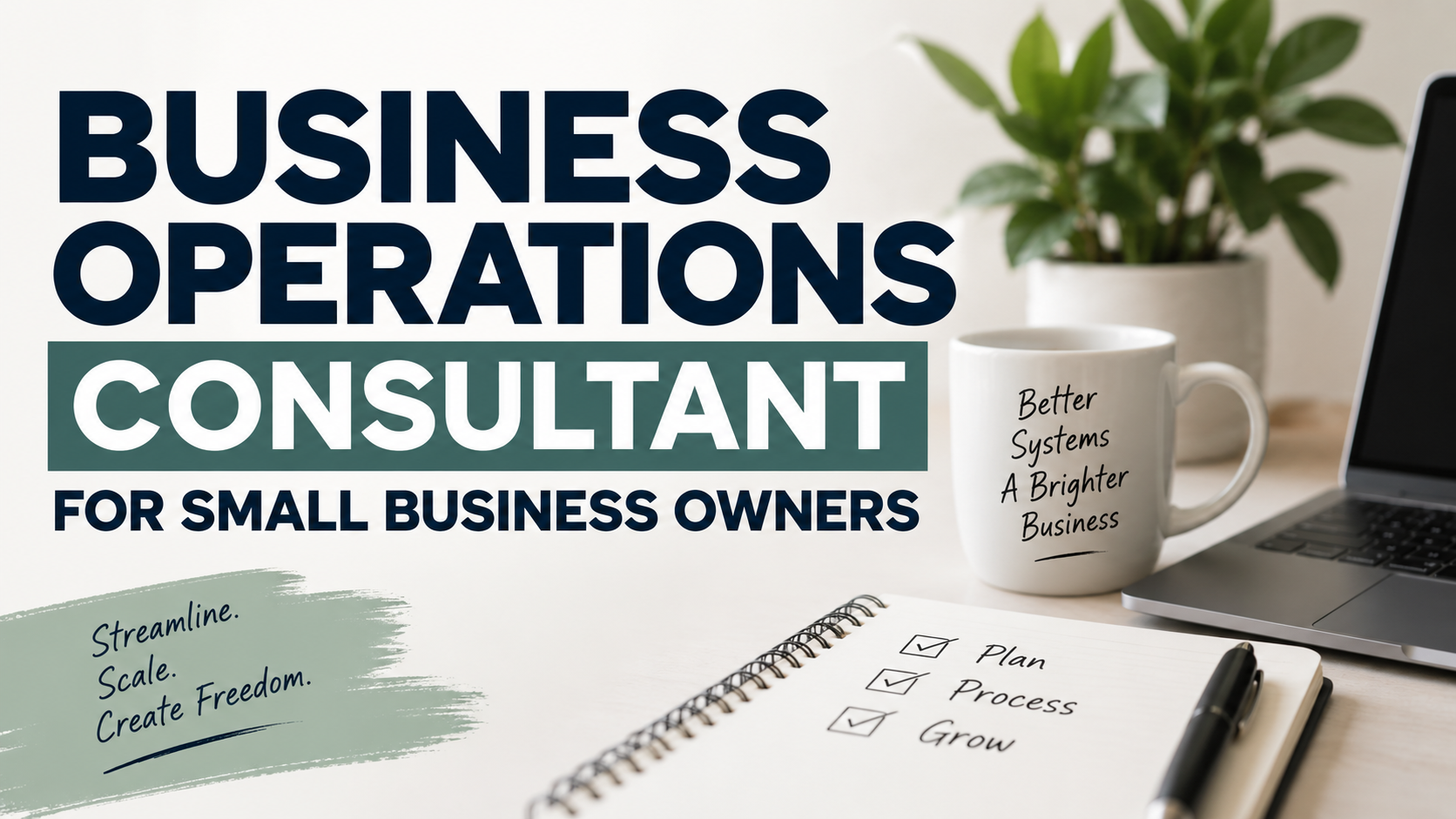
Discover how a business operations consultant can help small business owners simplify workflows, create effective SOPs, automate repetitive tasks, improve accountability, and build scalable systems. Learn how stronger operations can reduce overwhelm, create clarity, and give you more freedom to focus on growing your business.
-
A business operations consultant helps identify where your business is losing time, creating unnecessary work, or relying too heavily on the owner. This can include improving workflows, creating SOPs, defining roles and responsibilities, implementing automation, organizing systems, and establishing KPIs. The goal is to create a business that operates more consistently and is easier to manage and grow.
-
You may benefit from an operations consultant if you feel like everything depends on you, your processes are inconsistent or undocumented, your team frequently needs your input, repetitive tasks consume too much time, or growth is creating more complexity. A good first step is identifying where the biggest operational gaps exist across your Vision, Operations, Process, Leadership, Growth, and Personal foundations.
-
Yes. SOP development and automation are important parts of improving business operations. The process typically starts by reviewing how work is currently completed, eliminating unnecessary steps, standardizing the workflow, documenting the process, and then identifying opportunities for automation or delegation. The objective is not to automate everything, it is to create simpler, repeatable systems that reduce the amount of work that depends directly on you.