The Tools I Use to Run My Business as a Working Mom, Without Making It More Complicated
Running a business as a working mom means I don’t have unlimited hours to figure everything out.
I have a full-time career. I have kids, practices, games, school schedules, appointments, dinner, laundry, carlines, and everything else happening in the background.
And somewhere in between all of that, I’m building and running Optima Operations Consulting.
That means my business systems have to be simple, connected, and easy to maintain.
I’m not interested in using technology just because it exists. I use tools when they help me do one of three things:
Create. Optimize. Operationalize.
The goal isn’t to have the biggest tech stack.
The goal is to create a business that I can actually manage within the life I already have.
My Rule for Business Technology: Every Tool Needs a Job
One of the easiest ways to make a business more complicated is to keep adding software without defining what each tool is responsible for.
Suddenly, customer information is in three places. Tasks are somewhere else. Email lists don’t match. You’re manually moving information between platforms.
Instead of technology saving time, you spend your time managing the technology.
I try to keep it much simpler.
Every tool in my business should have a clear purpose.
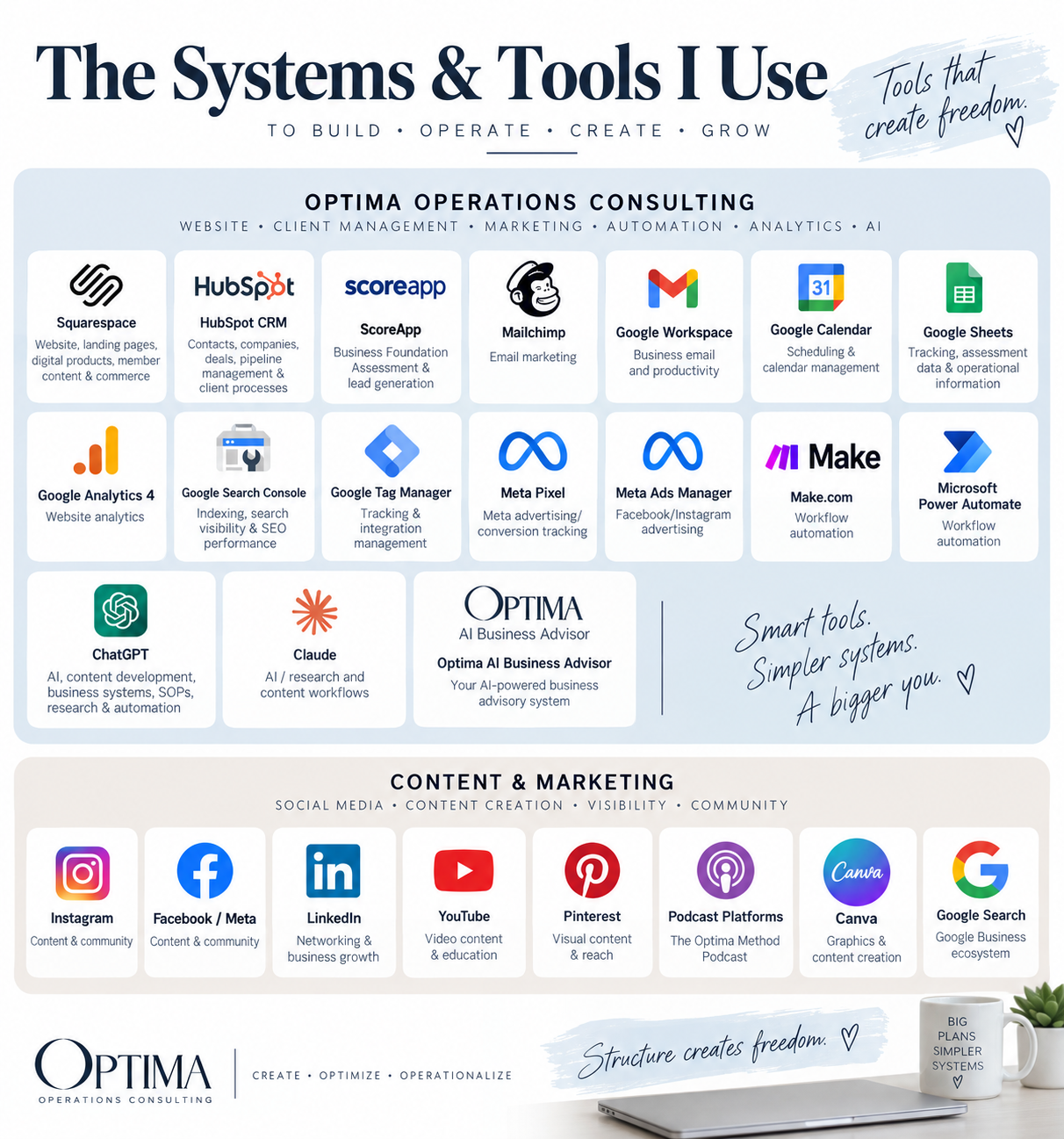
Here’s what that looks like behind the scenes at Optima Operations Consulting.
Squarespace: My Business Home Base
My website is built on Squarespace.
This is where people can learn about Optima Operations Consulting, explore the Optima Method, read the blog, access resources, purchase templates and find ways to work with me.
I intentionally want the website to do a lot of the explaining before someone ever needs to contact me.
That matters because I cannot personally answer every question in real time.
A well-built website becomes part of the operational infrastructure of the business.
HubSpot CRM: Keeping Relationships and Opportunities Organized
As the business grows, I don't want important conversations or potential opportunities living in my memory.
I use HubSpot CRM to organize contacts, companies, opportunities, pipelines and client processes.
The CRM gives information a place to live.
Instead of thinking:
"Wait...when did I last talk to them?"
I can build a process around the relationship.
That is a major distinction between simply staying busy and building a business system.
ScoreApp: Helping People Identify Where They Need to Start
One of the biggest challenges I see with entrepreneurs is that they know something isn't working, but they don't necessarily know what to fix first.
That is why I use ScoreApp for my Business Foundation Assessment.
The assessment helps business owners evaluate where they currently stand across their business foundation and gives them a clearer starting point.
It also makes the process scalable.
Instead of manually walking every person through the same initial discovery questions, technology can help collect information and guide the first step.
Mailchimp: Staying Connected Through Email
Social media is useful, but I don't want my entire business dependent on an algorithm.
Mailchimp helps me manage email marketing and communicate directly with people who have chosen to stay connected with Optima.
Email also gives me another opportunity to create repeatable communication rather than recreating everything from scratch every time.
Google Workspace: The Everyday Operating Layer
Google Workspace handles a lot of the everyday work behind the business.
Google Calendar helps manage time and scheduling.
Google Sheets gives me a flexible way to track information, organize data and build lightweight operational systems.
Business email keeps communication centralized.
These aren't necessarily exciting tools.
But that's the point.
Good operations often aren't exciting.
They're reliable.
Analytics and Search Tools: Understanding What Is Actually Working
I also use several tools behind the scenes to understand how people are finding and interacting with the business.
That includes:
Google Analytics 4
Google Search Console
Google Tag Manager
Meta Pixel
Meta Ads Manager
I don't want to create content, build resources and market the business based entirely on assumptions.
Data helps me see what people are searching for, which pages they're finding, what content they're engaging with and where there may be opportunities to improve.
The purpose isn't to obsess over every metric.
It's to have enough information to make better decisions.
Make.com and Power Automate: Removing Repetitive Work
This is one of my favorite parts of operational design.
Whenever I find myself doing the same thing repeatedly, I start asking:
Does this actually need me?
Sometimes the answer is yes.
Often, it isn't.
Make.com and Microsoft Power Automate allow me to connect processes and automate repetitive steps.
That could mean moving information between systems, triggering actions when something happens or eliminating a manual administrative step.
Automation isn't about removing the human element from a business.
It's about removing unnecessary work from the human.
And as a working mom, that distinction matters.
ChatGPT and Claude: My AI Working Layer
AI has become another important part of how I operate.
I use ChatGPT for content development, research, brainstorming, business systems, SOP development, analysis and automation ideas.
I also use Claude for research and content workflows.
But I don't view AI as something that runs my business for me.
I view it as a tool that helps me move from idea to execution faster.
Instead of staring at a blank page, I can develop the structure.
Instead of manually analyzing information, I can accelerate the first pass.
Instead of recreating the same process repeatedly, I can start identifying how to standardize it.
AI becomes significantly more useful when it's connected to a clear business process.
Optima AI Business Advisor: Bringing the Optima Method Into the Process
I also built the Optima AI Business Advisor around the framework I use within Optima Operations Consulting.
It helps business owners work through business decisions using the Optima Method and the six business foundations:
Vision. Operations. Process. Leadership. Growth. Personal.
This is important to me because technology should not just give you more information.
It should help you determine:
What should I actually do next?
Canva: Creating Without Turning Everything Into a Design Project
I use Canva for graphics, social content, thumbnails and other visual assets.
Again, simplicity matters.
I don't need every piece of content to become a two-hour design exercise.
I need to communicate an idea clearly, create the asset and move forward.
That mindset applies across my business.
Done within a system is more valuable than constantly reinvented.
My Content Ecosystem
Once content is created, I use several platforms to distribute it:
Instagram, Facebook, LinkedIn, YouTube, Pinterest, my podcast, my website and email.
But I don't think about these as completely separate businesses that each need brand-new content.
I think about them as an ecosystem.
One idea can become a podcast conversation.
That conversation can become a blog.
The blog can create several social posts.
A key point can become a short-form video.
A quote can become a graphic.
The content changes format, but I don't have to continuously start from zero.
That is how I make content creation more manageable.
The Tools Aren't the System
This is probably the most important part.
Squarespace isn't my business system.
HubSpot isn't my business system.
ChatGPT isn't my business system.
Make.com isn't my business system.
The process is the system.
The technology simply supports it.
Before asking:
"What software should I buy?"
I recommend asking:
"What am I trying to make easier?"
Maybe you're constantly answering the same customer question.
Maybe leads are falling through the cracks.
Maybe you're recreating emails.
Maybe you're manually transferring information.
Maybe your content process takes hours.
Maybe everything still lives in your head.
Identify the friction first.
Then determine whether you need a process, template, automation or technology to solve it.
I Don't Want to Spend My Life Managing My Business
This is ultimately why I care so much about systems.
I didn't build Optima Operations Consulting because I wanted another giant list of things to manage.
And as a working mom, I know my time has limits.
Some days I have several hours available.
Other days I have a small window between work, carline and a soccer practice.
The business has to function in both situations.
That requires structure.
It requires knowing where information lives.
It requires reusable templates.
It requires documented processes.
It requires automation where automation makes sense.
And it requires technology that supports the way I actually live and work.
Keep Your Business Tech Stack Simple
You do not need every tool I use.
Your business may need five tools.
It may need ten.
As it grows, it may need more.
The number isn't what matters.
What matters is whether you can clearly answer:
What does this tool do?
What process does it support?
What information lives there?
Does it save me time or create more work?
Can I maintain it consistently?
Because the goal isn't to build the most sophisticated business behind the scenes.
The goal is to build a business that works.
For me, that means creating systems that allow me to close the laptop, get in the car, head to practice, be present with my family, and know the business doesn't have to stop functioning just because I'm not sitting in front of it.
That's what Structure Creates Freedom means in practice.
And that's exactly what I'm building through the Optima Method.
Final Thought
You don't need more technology just for the sake of technology.
You need a simple operating system for your business, and the right tools supporting the right processes.
Start with the work you're doing repeatedly.
Document it.
Simplify it.
Then automate or delegate what no longer needs to depend entirely on you.
Because the best business system isn't the one with the most tools.
It's the one you can actually maintain while living the life you built the business to support.
The goal is to have a simple system of tools that work together, reduce the amount I have to manage, and give me more time to actually run my business, and live my life.
-
The best tools are the ones that reduce the amount of information and repetitive work you have to personally manage. Start with the essentials: a website, email platform, calendar, customer relationship management system (CRM), content tools, and a simple way to track your processes. You don't need dozens of platforms, you need a small, intentional tech stack that supports how you actually run your business.
-
Look for tasks you perform repeatedly, especially administrative work such as sending similar emails, transferring information between systems, scheduling, follow-ups, data entry, and recurring content workflows. Before automating anything, document and simplify the process first. Automating a complicated process usually just creates a faster complicated process.
-
No. A business system is the process, not the software. Start by identifying what needs to happen, who or what is responsible for it, where the information lives, and what triggers the next step. Once the process is clear, you can determine whether a template, SOP, automation, or technology would make it easier.
-
Systems reduce the number of decisions you have to make repeatedly. Instead of remembering every task, recreating every document, or manually managing every step, you create repeatable processes that help the business operate consistently. The goal isn't to squeeze more work into your available hours, it's to make the business less dependent on you for every single action.