

You Don’t Need a Perfect Week, You Need a Plan for the Time You Actually Have
There is a version of weekly planning that sounds great in theory.
You sit down on Sunday evening. You map out every hour. You create a perfectly organized to-do list. You know exactly what you are going to accomplish Monday through Friday.
And then Monday happens.
Someone needs you. A meeting runs long. School sends an email. A client has a question. Dinner needs to happen. Your carefully protected two-hour work block suddenly becomes 25 minutes in the car line.
For entrepreneurs, working moms, and business owners building something alongside an already full life, this isn't unusual.
It is the reality.
And it is exactly why your weekly planner shouldn't be built around the perfect week.
It should be built around the time you actually have.
The Problem Isn't Always Time Management
When you only have small windows to work on your business, it is easy to assume you need to get better at time management.
So you download another productivity app.
You make another giant list.
You reorganize your calendar.
You promise yourself that next week you'll be more disciplined.
But the real problem often isn't that you don't know how to manage your time.
It's that too many things are competing for the limited time you have.
When everything feels important, you spend valuable time deciding what to do instead of actually doing it.
And when your available work time comes in short spurts, that decision-making becomes even more expensive.
If you finally get 30 uninterrupted minutes, you shouldn't have to spend 15 of them figuring out where to start.
You should already know.
Your Business Doesn't Need Everything From You This Week
This can be difficult for entrepreneurs to accept.
There will always be more you could do.
You could update your website.
Create another social media post.
Research a new platform.
Rewrite an email.
Organize your files.
Build a new offer.
Listen to another podcast.
Check analytics.
Work on SEO.
Create another SOP.
The list doesn't end because you're running a business.
So the goal of weekly planning isn't to figure out how to finish everything.
The goal is to determine:
What actually needs to move forward this week?
That is a very different question.
Instead of measuring success by how many boxes you checked, you begin looking at whether your actions are moving the business toward the outcomes you actually want.
Start With Your Purpose
Before creating your weekly task list, ask yourself:
What am I trying to accomplish right now?
Maybe you're trying to generate more leads.
Maybe you need to launch an offer.
Maybe your business has become too dependent on you and you need to document a process.
Maybe you're trying to consistently create content.
Maybe you simply need to keep your business moving while navigating an especially busy season at home or work.
Your purpose gives context to your priorities.
Without it, your weekly plan can quickly become a collection of unrelated tasks.
With it, you can look at something on your list and ask:
Does this help me move toward what I'm trying to accomplish?
If the answer is no, it may not need your limited time this week.
Choose 3–5 Priorities That Move the Business Forward
One of the easiest ways to overwhelm yourself is to start Monday with 27 priorities.
Those aren't priorities.
That's a task inventory.
Instead, identify approximately three to five meaningful priorities for the week.
These should be the things that create progress, not simply the things making the most noise.
For example, instead of:
Work on marketing
Fix website
Post on social media
Organize files
Get more specific:
Publish the new service landing page
Follow up with five qualified leads
Document the client onboarding process
Batch three pieces of content
Now you know what "moving forward" actually looks like.
Everything else can fit around those priorities rather than competing equally for your attention.
Plan Around the Time You Actually Have
This is especially important if you're building a business around a full-time job, children, appointments, sports schedules, school activities, household responsibilities, or client work.
Don't plan your week as though those things don't exist.
Look at Monday through Friday and determine where your realistic work windows are.
Maybe Monday gives you an hour.
Tuesday gives you nothing.
Wednesday gives you 30 minutes.
Thursday you can work after bedtime.
Friday you have a two-hour block.
That's your week.
Build from there.
A realistic plan with five available hours is far more useful than an ambitious plan requiring 15 hours you don't actually have.
Small Work Windows Still Count
One of the reasons I created the Free Weekly Planner was because progress doesn't always happen in beautiful, uninterrupted three-hour work sessions.
Sometimes it happens in 20 minutes.
Sometimes it's one task before everyone wakes up.
Sometimes it's sending the email from the parking lot.
Sometimes it's documenting a process while you're waiting at practice.
Sometimes it's finally completing the one thing you've been carrying around in your head all week.
Those small windows can create meaningful momentum, if you already know what to do with them.
Your planner becomes the place you return to instead of starting from zero every time you get a few minutes back.
Stop Restarting Your Business Every Day
Without a simple operating rhythm, every work session can feel like a restart.
You open your laptop and think:
What was I doing?
What needs to happen next?
What should I work on first?
What am I forgetting?
That mental load adds up.
A weekly plan creates continuity.
You decide where you're going before the week gets busy.
Then, when life interrupts, and it probably will, you don't need to redesign your entire business strategy.
You simply return to the plan.
This is one of the simplest forms of operational structure.
And structure is not about making your life rigid.
Structure gives you somewhere to return to when life gets messy.
Give Yourself Permission to Move Tasks
A planner shouldn't become another tool that makes you feel behind.
Didn't finish something Monday?
Move it.
Lost your Wednesday work window?
Adjust.
A family commitment came up Thursday?
Reprioritize.
The objective isn't to follow the plan perfectly.
The objective is to maintain visibility into what matters so you can continue making intentional decisions.
There is a significant difference between changing your plan intentionally and constantly reacting to whatever appears next.
At the End of the Week, Look at What Moved
Before immediately creating another list for next week, take a few minutes to review what happened.
Ask yourself:
What did I actually move forward?
Then consider what didn't get done and why.
Maybe the priority wasn't actually important.
Maybe the task was too large.
Maybe you underestimated how much time it required.
Maybe your week simply changed.
That information matters.
Because good business operations aren't built by creating a perfect system once.
They're built by creating, testing, adjusting, and optimizing how you work.
Your Weekly Planner Is a Tool, Not Another Obligation
You don't need another complicated productivity system to maintain.
You need something simple enough that you'll actually use it.
Something that helps you identify what matters.
Something that shows you when you're going to work on it.
Something you can come back to when your week inevitably changes.
That's why I created the Free Weekly Planner.
It's designed to help you take the priorities in your head, put them somewhere visible, and decide when you're realistically going to work on them.
Because your business doesn't need you doing everything.
It needs you consistently moving the right things forward.
Download the Free Weekly Planner
If your work happens between meetings, school schedules, client needs, family responsibilities, or whatever else your week throws at you, start by simplifying the plan.
Choose your priorities.
Look at the time you actually have.
Decide where those priorities fit.
And then focus on the next thing that moves the business forward.
Download the Free Weekly Planner and create a week that works with your real life, not an imaginary perfectly productive one.
Structure creates freedom.
Create • Optimize • Operationalize.
-
The Free Weekly Planner is a simple one-page planning tool designed to help busy entrepreneurs identify their most important priorities, decide when they will work on them, and keep their business moving forward—even when they only have short windows of time.
-
Start with the time you actually have instead of building a schedule around an ideal week. Choose 3–5 priorities that will meaningfully move your business forward, then assign them to realistic work windows throughout Monday–Friday. The Free Weekly Planner gives you one simple place to map this out.
-
Yes. The Weekly Planner is a free downloadable resource from Optima Operations Consulting. It's designed to give you a simple starting point for creating more structure without adding another complicated system to your business.
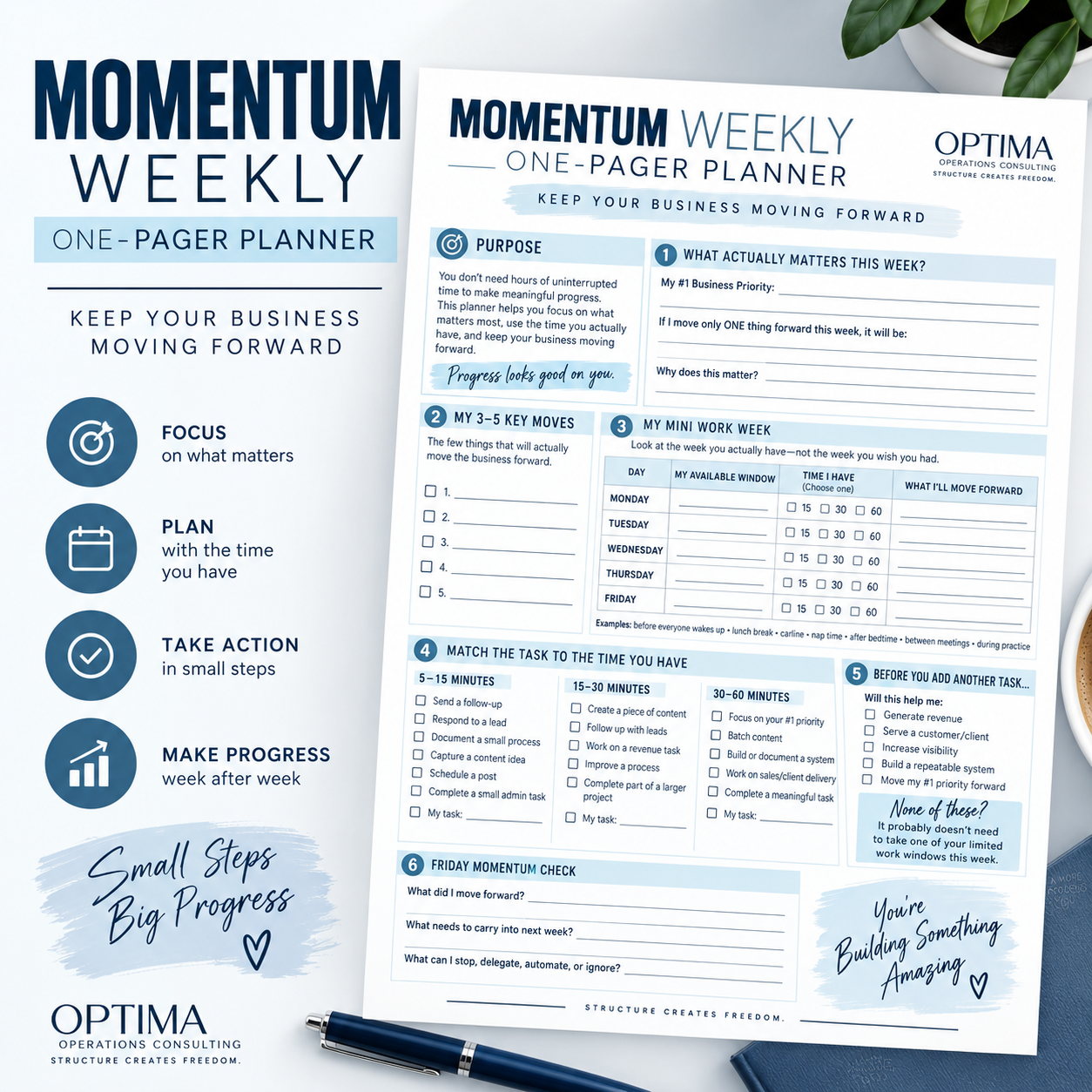
Plan your week in 15 minutes, so you can focus on what actually moves your business forward.
When you're balancing your business with clients, family, work, and everything else competing for your attention, planning can feel like another task you don't have time for. Without clear priorities, those small pockets of available time can quickly disappear into emails, admin, and whatever feels most urgent.
The Free Momentum Weekly Planner gives you a simple framework to step back, choose what matters most, and map out your business priorities for the week, in just 15 minutes.
What This Helps You Do
Create a focused weekly plan around the time you actually have available, helping you prioritize meaningful work, break larger goals into manageable actions, and make progress even when your schedule isn't perfect.
What's Included
Weekly priority planning
Top business focus areas
Weekly goals and outcomes
Monday–Friday planning
Priority task identification
Available-time planning
Key action steps
Important reminders
Progress and completion tracking
End-of-week reflection and reset
Best For
Entrepreneurs, solopreneurs, mompreneurs, and small-business owners who don't have unlimited hours to work on their business and need a simple way to stay focused during the time they do have.
Time to Complete
Just 15 minutes each week to identify your priorities, map out your available time, and decide what needs your attention next.
Format
FREE editable digital planner | Simple one-page format | Ready to use | Instant access
You Don't Need More Hours. You Need Clarity on What to Do With the Hours You Have.
Stop starting the week with an endless to-do list. Choose what matters, protect the time you have, and create consistent momentum—one focused week at a time.
15 MINUTES → CLEAR PRIORITIES → FOCUSED ACTION → MOMENTUM