Documentation Isn’t an SOP: Why Teams Struggle Without True Operational Structure
One of the biggest operational misconceptions organizations make is believing they have Standard Operating Procedures simply because they have documentation.
But documentation and SOPs are not the same thing.
And that distinction matters far more than many businesses realize.
At Optima Operations Consulting, one of the most common operational gaps we encounter is organizations believing they are structured because processes exist “somewhere.”
There may be:
Notes in a shared drive
Checklists
Screenshots
Training documents
Tribal knowledge
Random process steps
Old workflows
Verbal instructions
Department-specific shortcuts
But none of those automatically create operational consistency.
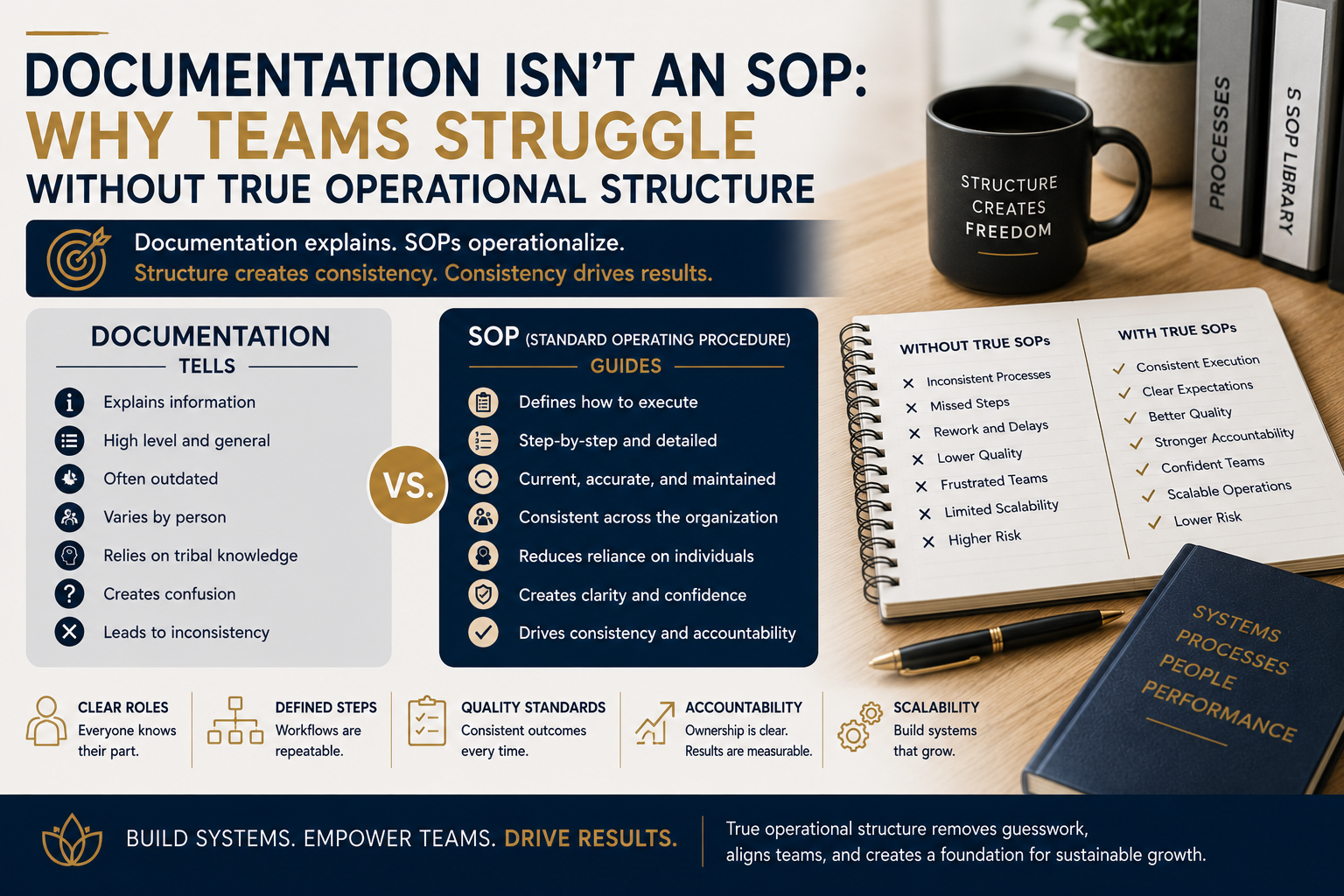
Because documentation explains information.
A true SOP operationalizes execution.
And without true operational structure, teams begin operating differently, inconsistently, and emotionally — even when everyone believes they are following the “same process.”
Documentation Tells. SOPs Guide.
Most documentation is informational.
It explains:
What something is
General expectations
High-level process summaries
Broad instructions
But true SOPs go much deeper.
A strong SOP defines:
Purpose
Scope
Roles and responsibilities
Required systems/tools
Step-by-step execution
Decision points
Escalation paths
Quality expectations
Timing requirements
Governance and accountability
That level of structure removes ambiguity.
Because when people are forced to “figure it out as they go,” inconsistency becomes unavoidable.
Inconsistency Is Born in Unclear Processes
One employee performs a task one way.
Another employee performs it differently.
A manager approves something inconsistently.
A department develops its own workaround.
Over time, organizations begin experiencing:
Process drift
Communication breakdowns
Accountability confusion
Training inconsistency
Leadership frustration
Quality issues
Delays
Operational inefficiency
And leadership often responds by assuming:
Employees are not paying attention
Teams are underperforming
People need more training
But many times, the real problem is this:
The structure itself was never clearly defined operationally.
Because people cannot execute consistently against vague expectations.
Tribal Knowledge Is Not a System
One of the biggest risks organizations face is relying on tribal knowledge instead of operational documentation.
There is usually “that person” who knows how everything works.
The problem?
When processes only exist inside someone’s head:
Training becomes inconsistent
Scaling becomes difficult
Turnover becomes risky
Accountability weakens
Cross-functional support suffers
And suddenly the organization becomes dependent on individuals instead of systems.
That is not scalability.
Scalable organizations build operational structure that allows processes to function consistently regardless of who performs the work.
Because systems should support people — not depend entirely on them.
SOPs Create Operational Confidence
One of the most overlooked benefits of true SOPs is confidence.
Employees perform better when they understand:
What is expected
How to complete the task
Where to find answers
What quality looks like
Who owns decisions
When escalation is required
Clarity reduces hesitation.
And when employees feel operationally supported, confidence improves significantly.
Strong SOPs also reduce:
Micromanagement
Repetitive questions
Leadership bottlenecks
Process inconsistencies
Training confusion
Because structure creates visibility.
And visibility creates accountability.
Why Organizations Resist True SOP Development
Many organizations avoid building real SOPs because they believe:
“Everyone already knows the process.”
“We do not have time.”
“It changes too often.”
“We are too small.”
“We move too fast.”
But the reality is this:
The faster an organization grows, the more operational structure matters.
Without SOPs:
Growth creates chaos
Scaling becomes reactive
Teams become disconnected
Communication weakens
Leadership becomes overwhelmed
Operational maturity requires operational consistency.
And consistency does not happen accidentally.
SOPs Are More Than Checklists
A checklist alone is not an SOP.
Checklists are helpful operational tools.
But they are only one piece of the operational framework.
A true SOP explains:
Why the process exists
What outcomes are expected
How the process should function
What standards apply
What decisions require escalation
How success is measured
Without that structure, employees often complete tasks without understanding the operational purpose behind them.
That disconnect creates execution gaps quickly.
AI and Automation Require Structured SOPs
This conversation becomes even more important as organizations adopt AI and automation tools.
AI cannot fix operational chaos.
Automation cannot repair undefined processes.
In fact, poorly structured processes automated through AI often create larger problems faster.
Because AI amplifies structure.
It does not replace it.
Organizations attempting to implement automation without:
Defined workflows
Clear SOPs
Decision ownership
Governance
Operational clarity
often create more confusion instead of efficiency.
Strong SOPs create the foundation AI needs to operate effectively.
Structure Creates Freedom
One of the core beliefs at Optima Operations Consulting is this:
Structure creates freedom.
Not rigidity.
Not bureaucracy.
Not unnecessary complexity.
Freedom.
Because when employees understand expectations clearly:
Teams move faster
Training improves
Accountability strengthens
Leadership gains visibility
Operations become scalable
Stress decreases
Consistency improves
And ultimately, organizations stop relying on reactive management to survive daily operations.
That shift changes everything.
Final Thoughts
Documentation alone does not create operational excellence.
True SOPs create:
Clarity
Consistency
Accountability
Scalability
Confidence
Operational maturity
Without operational structure, organizations eventually begin operating through assumptions, tribal knowledge, and inconsistency.
And that is where chaos begins.
Because successful businesses are not built on people constantly “figuring it out.”
They are built on systems that create repeatable success.
Documentation explains.
SOPs operationalize.
And operational structure is what allows organizations to scale intentionally instead of reactively.
Because structure creates freedom.