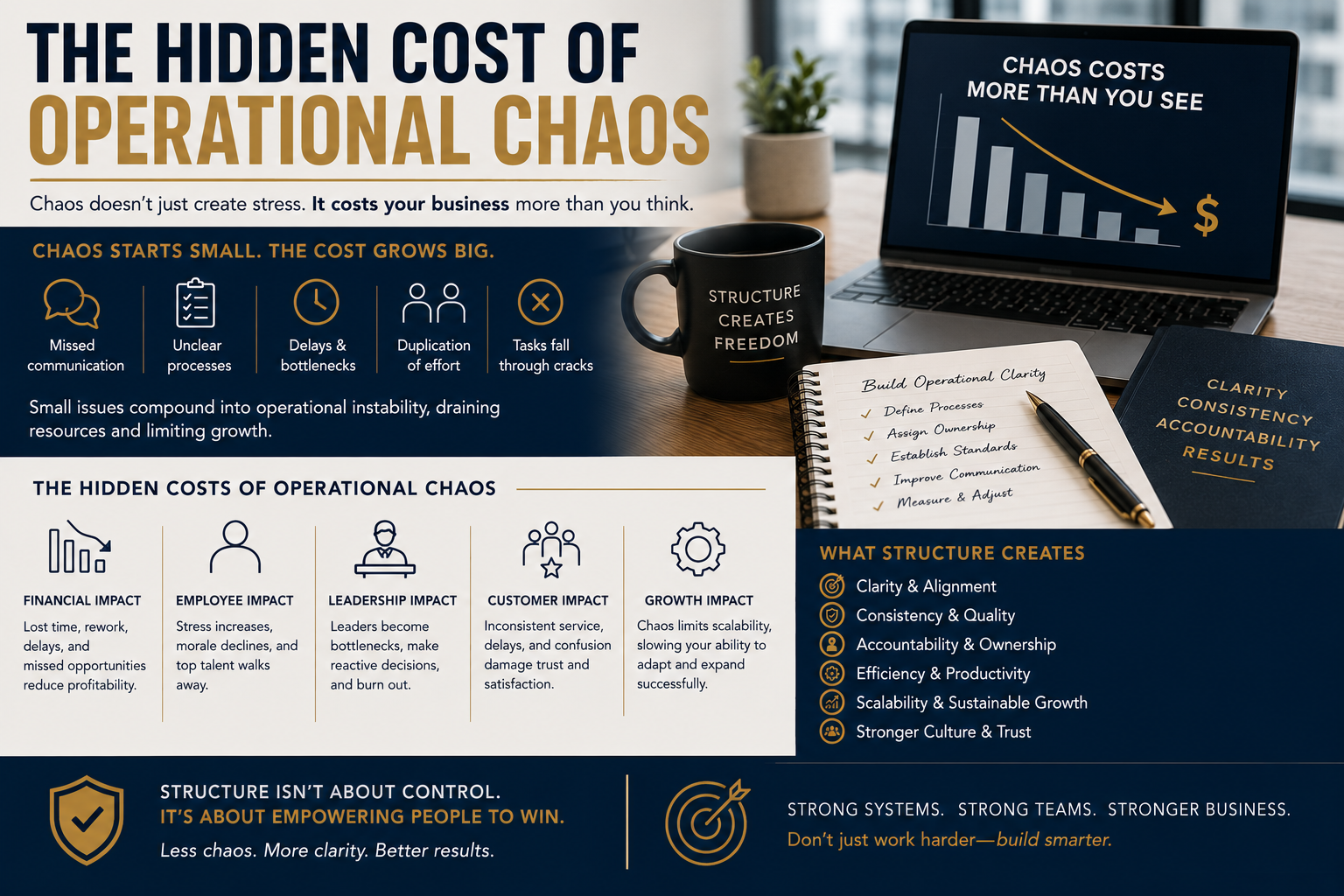
The Hidden Cost of Operational Chaos
Operational chaos rarely announces itself immediately.
It does not usually begin with a catastrophic failure.
Instead, it starts quietly.
A missed communication.
An unclear process.
A delayed approval.
A forgotten task.
A duplicated effort.
A meeting that solved nothing.
An employee constantly asking questions because expectations were never clearly defined.
And over time, those small moments compound into something much larger:
Operational instability.
At Optima Operations Consulting, one of the biggest misconceptions we see organizations make is assuming chaos is simply “part of growth.”
It is not.
Growth may expose operational gaps.
But unmanaged chaos eventually becomes expensive.
Very expensive.
Because the hidden cost of operational chaos is not just inefficiency.
It impacts:
Revenue
Employee morale
Leadership effectiveness
Customer experience
Scalability
Accountability
Retention
Mental bandwidth
Decision-making
Organizational trust
And many organizations do not fully recognize the impact until the stress becomes unsustainable.
Chaos Creates Invisible Operational Debt
One of the most dangerous things about operational chaos is that it often becomes normalized.
Teams adapt.
Employees compensate.
Leaders work longer hours.
Processes become reactive.
People “figure it out.”
Until eventually the organization begins relying on survival mode instead of operational structure.
This creates operational debt.
Operational debt looks like:
Constant firefighting
Repeated mistakes
Miscommunication
Employee burnout
Leadership bottlenecks
Delayed decisions
Inconsistent execution
Frustrated customers
Reactive management
And while organizations may still function temporarily, the inefficiency underneath continues growing.
Chaos always costs more than structure.
The Financial Cost of Chaos
Many leaders underestimate how much operational chaos impacts profitability.
Every unclear process creates:
Lost time
Rework
Delays
Missed opportunities
Duplicated effort
Increased labor costs
When employees spend hours searching for answers, clarifying expectations, correcting avoidable mistakes, or navigating inconsistent processes, the business loses operational efficiency continuously.
And unlike obvious expenses, operational chaos often hides inside:
Meetings
Communication breakdowns
Turnover
Slow approvals
Poor handoffs
Training gaps
Lack of ownership
Organizations may believe they have a productivity issue when in reality they have a structure issue.
Because without operational clarity, efficiency becomes almost impossible to sustain.
Leadership Burnout Is Often a Structure Problem
One of the clearest signs of operational chaos is leadership exhaustion.
Leaders become trapped in:
Constant escalation
Endless approvals
Repetitive questions
Problem-solving everything manually
Following up constantly
Carrying operational knowledge personally
And eventually leadership becomes the bottleneck.
Not because leaders are incapable.
But because the systems are underdeveloped.
When operational structure is missing, organizations unintentionally create dependency on people instead of systems.
That is not scalability.
Scalable organizations create systems that support execution consistently without requiring leadership involvement in every decision.
Because sustainable growth requires operational maturity.
Employees Struggle in Unclear Environments
One of the biggest myths in leadership is assuming employees resist structure.
Most employees actually want clarity.
They want to know:
What is expected
How success is measured
Who owns decisions
What process to follow
Where accountability exists
How communication should happen
Without structure:
Anxiety increases
Accountability weakens
Performance becomes inconsistent
Morale declines
Team frustration grows
Employees cannot execute confidently inside operational confusion.
Clarity creates confidence.
And confident teams perform better.
Chaos Weakens Accountability
Operational chaos makes accountability difficult because unclear systems create unclear ownership.
When responsibilities are undefined:
Tasks fall through the cracks
Decisions become delayed
Teams blame one another
Priorities become misaligned
Follow-through weakens
This is where many organizations begin experiencing operational drift.
Everyone feels busy.
But measurable progress slows down.
Why?
Because activity without alignment creates noise, not results.
Strong organizations create operational clarity through:
Defined SOPs
Decision ownership
RACI structures
Governance frameworks
Communication standards
Escalation paths
Defined accountability
Because accountability requires visibility.
And visibility requires structure.
Operational Chaos Impacts Culture
Culture is not built only through values written on a wall.
Culture is built operationally through:
Communication
Leadership consistency
Process clarity
Accountability
Trust
Expectations
Daily operational experiences
When chaos becomes constant, organizational culture eventually feels:
Reactive
Frustrating
Emotionally draining
Disorganized
Unpredictable
Employees stop feeling supported.
Leaders stop feeling effective.
Teams stop feeling aligned.
And over time, high performers often leave environments where operational instability becomes the norm.
Because talented people want clarity too.
AI Cannot Fix Operational Chaos
This conversation becomes even more important as organizations adopt AI and automation.
Many businesses believe automation will solve inefficiency automatically.
But AI amplifies structure.
It does not replace it.
If processes are:
Undefined
Inconsistent
Poorly documented
Misaligned
Emotionally driven
Operationally unclear
then automation often accelerates the chaos instead of fixing it.
Strong operational systems must exist before automation becomes truly effective.
Otherwise organizations simply create faster confusion.
Structure Creates Freedom
One of the core beliefs at Optima Operations Consulting is this:
Structure creates freedom.
Not rigidity.
Not bureaucracy.
Not unnecessary complexity.
Freedom.
Because operational structure:
Reduces stress
Improves communication
Strengthens accountability
Creates visibility
Improves scalability
Protects leadership energy
Builds team confidence
Supports sustainable growth
Organizations function better when people no longer have to rely on memory, assumptions, or constant reactive problem-solving to survive the workday.
That operational peace matters.
Final Thoughts
Operational chaos is expensive.
Not only financially.
But mentally, emotionally, and culturally.
And the most dangerous part is that many organizations normalize the dysfunction because they have operated that way for so long.
But chaos is not a growth strategy.
Strong organizations are not built through constant firefighting.
They are built through:
Clarity
Structure
Accountability
Communication
Operational consistency
Intentional systems
Because businesses scale successfully when systems support people, not when people are forced to compensate for broken systems constantly.
Operational chaos may feel manageable temporarily.
But eventually, the hidden costs always surface.
And that is why structure matters.
Because structure creates freedom.