

How Do I Stop Being the Bottleneck in My Small Business?
You started your business because you had an idea, a skill, a passion, or a vision for something bigger.
In the beginning, doing everything yourself probably made sense.
You answered the emails.
You managed the clients.
You created the invoices.
You handled the marketing.
You made every decision.
You fixed every problem.
You became the person who knew how everything worked.
And that worked, until it didn't.
Eventually, the very thing that helped you build your business can become the thing preventing it from growing:
Everything still depends on you.
If work stops when you step away, decisions constantly wait for your approval, or your team needs you to explain how things should be done, you may have become the bottleneck in your small business.
The solution isn't simply working harder or hiring more people.
It's building a business that can operate without requiring you to personally move every task forward.
What Does It Mean to Be the Bottleneck in Your Business?
A business bottleneck happens when work, decisions, information, or approvals repeatedly have to flow through one person.
For many small businesses, that person is the owner.
It can look like:
Employees waiting for you to answer questions.
Clients needing you personally involved in every step.
Projects sitting unfinished because they need your approval.
Processes existing primarily in your head.
You being the only person who knows how certain tasks are completed.
Your inbox becoming the unofficial project management system.
Your team asking the same questions repeatedly.
Vacations turning into working vacations.
You spending most of your week solving operational problems instead of leading the business.
The problem isn't necessarily that you're controlling.
Often, the business simply grew faster than its operational structure.
You created processes as you needed them, made decisions on the fly, and kept moving.
Now those informal systems are struggling to support the business you've built.
The Bottleneck Test: What Happens If You Disappear for a Week?
Here's one of the simplest questions I use when thinking about business operations:
What happens if you're unavailable for one week?
Not checking email.
Not answering Slack messages.
Not approving things from your phone.
Actually unavailable.
Would your business continue operating?
Or would you return to a long list of questions, delayed projects, missed follow-ups, and decisions nobody felt comfortable making?
This isn't about creating a business that never needs its owner.
Your business should need your leadership.
It just shouldn't need your involvement in every operational detail.
There is a significant difference between being important to your business and being required for everything in your business.
Why Small Business Owners Become Bottlenecks
Most entrepreneurs don't intentionally design businesses that depend entirely on them.
It happens gradually.
You know how to complete something, so it's faster to do it yourself.
A team member asks a question, so you answer it.
A process isn't documented, so you explain it again.
Someone makes a mistake, so you take the task back.
A decision needs to be made, so everyone asks you.
Each individual moment feels small.
But over time, you've accidentally trained the business to operate like this:
Question → Owner
Decision → Owner
Approval → Owner
Problem → Owner
Client issue → Owner
Exception → Owner
Eventually, your business can only move as quickly as you can respond.
That is the bottleneck.
How Do I Stop Being the Bottleneck in My Small Business?
You don't fix this by disappearing from your business overnight.
You gradually move operational dependency away from yourself and into clear systems, processes, ownership, and accountability.
Start with these six steps.
1. Identify What Is Actually Flowing Through You
Before you delegate anything, understand where you're currently involved.
For one week, pay attention every time someone:
asks you a question,
requests an approval,
needs information,
asks how to complete something,
sends you a problem,
waits for your decision,
or requires you to complete a recurring task.
Keep a simple list.
You are looking for patterns.
If you're answering the same question three times, you probably don't have a people problem.
You have a documentation problem.
If you're repeatedly approving routine decisions, you may have an authority problem.
If you're constantly reminding people what needs to happen next, you may have an accountability problem.
If you're doing repetitive administrative work, you may have an automation or delegation opportunity.
Don't immediately fix everything.
First, identify where the business depends on you.
2. Use the 4D Time Audit
Once you know what's consuming your time, put your recurring work into four categories:
Do: Work that genuinely requires your expertise, leadership, or decision-making.
Delegate: Work someone else can own with the right instructions and authority.
Automate: Repetitive work that technology can handle consistently.
Delete: Work that no longer creates enough value to justify doing it.
This is where many entrepreneurs discover something important:
Their workload isn't necessarily too large.
They're simply doing too many things that should no longer belong to them.
Your goal isn't to become more efficient at doing everything.
Your goal is to determine what you shouldn't be doing anymore.
3. Document What Currently Lives in Your Head
Delegation becomes extremely difficult when the instructions are:
"Just ask me if you're unsure."
That sentence quietly keeps you at the center of the process.
Instead, start documenting recurring activities as Standard Operating Procedures, or SOPs.
An effective SOP should answer questions such as:
What is the process?
Why does it matter?
Who owns it?
When should it happen?
What systems or tools are used?
What are the individual steps?
What does successful completion look like?
What happens when something goes wrong?
When should the owner or manager actually be involved?
You don't need to spend six months creating a giant operations manual before you delegate anything.
Start with the processes creating the most interruptions.
Every documented recurring process removes another piece of operational knowledge from your head and places it into the business.
4. Delegate Ownership, Not Just Tasks
This is one of the biggest differences between delegation that creates freedom and delegation that creates more management.
Task delegation sounds like:
"Can you send this invoice?"
Ownership sounds like:
"You own our client invoicing process. Here is the SOP, timeline, system, expected outcome, and escalation criteria."
The second approach changes your role.
Instead of being responsible for initiating every action, you're creating clear ownership.
A useful delegation structure includes:
Owner: Who is accountable?
Outcome: What needs to happen?
Process: How should it be completed?
Authority: What can they decide independently?
Escalation: When should they involve you?
Measurement: How will you know it's working?
That last part matters.
Delegation without accountability can create confusion.
Delegation with clear ownership creates operational capacity.
5. Stop Being the Default Decision-Maker
Not every business decision needs CEO-level involvement.
Ask yourself:
What decisions am I making today that someone else should be capable of making?
Create decision boundaries.
For example:
Your team may be able to resolve a client issue independently up to a certain dollar amount.
A manager may approve purchases below a defined threshold.
A virtual assistant may reschedule appointments without asking permission.
A project owner may adjust internal deadlines within established parameters.
Your team doesn't need unlimited authority.
They need defined authority.
When people understand what they can decide without you, fewer decisions accumulate in your inbox.
6. Build a Business Operating System
Individual SOPs are valuable.
But ultimately, you need more than a collection of documents.
You need an operating system for your business.
At Optima Operations Consulting, I think about this through the six foundations of the Optima Method:
Vision: Where are we going?
Operations: How is the business organized?
Process: How does the work get done?
Leadership: Who owns what?
Growth: How do we measure and intentionally grow?
Personal: How does the business support the life we're building?
These foundations work together.
You can have documented processes but still struggle because nobody owns them.
You can delegate work but still struggle because expectations aren't clear.
You can automate tasks but still struggle because the underlying process is broken.
You can grow revenue but still feel overwhelmed because your personal capacity hasn't changed.
That's why solving the owner-bottleneck problem requires more than downloading one SOP.
You're shifting the business from:
Owner-dependent → System-dependent.
What Should You Document First?
Don't try to document your entire business this weekend.
Start with the processes that create the most dependency on you.
Ask:
What do I explain repeatedly?
What do people constantly ask me?
What recurring tasks am I still personally completing?
What falls apart when I'm unavailable?
Where are mistakes happening repeatedly?
What process would I need to explain tomorrow if I hired someone?
Those are your priorities.
Your first SOPs might include:
Lead management
Client onboarding
Invoicing
Customer service
Scheduling
Content publishing
Sales follow-up
Project management
Vendor management
Reporting
Employee onboarding
Document the processes that give you the most time and mental capacity back first.
Your Business Shouldn't Require You to Remember Everything
One of the hidden costs of being the bottleneck isn't just time.
It's mental load.
Remembering who needs what.
Remembering which client needs a follow-up.
Remembering what happens after someone signs a contract.
Remembering whether an invoice was sent.
Remembering the next step in every project.
Remembering what you told someone three weeks ago.
That's exhausting.
And it's not scalable.
Your brain shouldn't be your company's project management system, knowledge base, calendar, and operations manual.
Put information where the business can access it.
Put tasks into systems.
Put recurring processes into SOPs.
Put accountability with clearly defined owners.
Put important metrics into dashboards.
Create structure outside of yourself.
The Goal Isn't to Make Yourself Irrelevant
Some business owners resist this work because they worry:
"If the business doesn't need me, what exactly am I supposed to do?"
The goal isn't to make yourself irrelevant.
It's to make your contribution more valuable.
Instead of spending your day:
answering routine questions, fixing scheduling issues, chasing invoices, approving minor decisions, or explaining the same process again...
you can focus on:
strategy, relationships, leadership, innovation, growth, partnerships, financial decisions, and the future of the company.
You move from being the person who runs every process to the person who leads the business.
Start With One Bottleneck This Week
You don't need to completely redesign your business today.
Choose one recurring activity that currently depends on you.
Then ask:
Can I document it?
Can I delegate it?
Can I automate part of it?
Can I eliminate it?
Can someone else make the decisions associated with it?
Fix one bottleneck.
Then another.
Then another.
Eventually, something changes.
You stop building a business that only works because you're constantly holding it together.
And you start building a business with the structure to operate, grow, and support you.
Because structure creates freedom.
And your business should be designed to give you more of it, not require more and more of you just to keep moving.
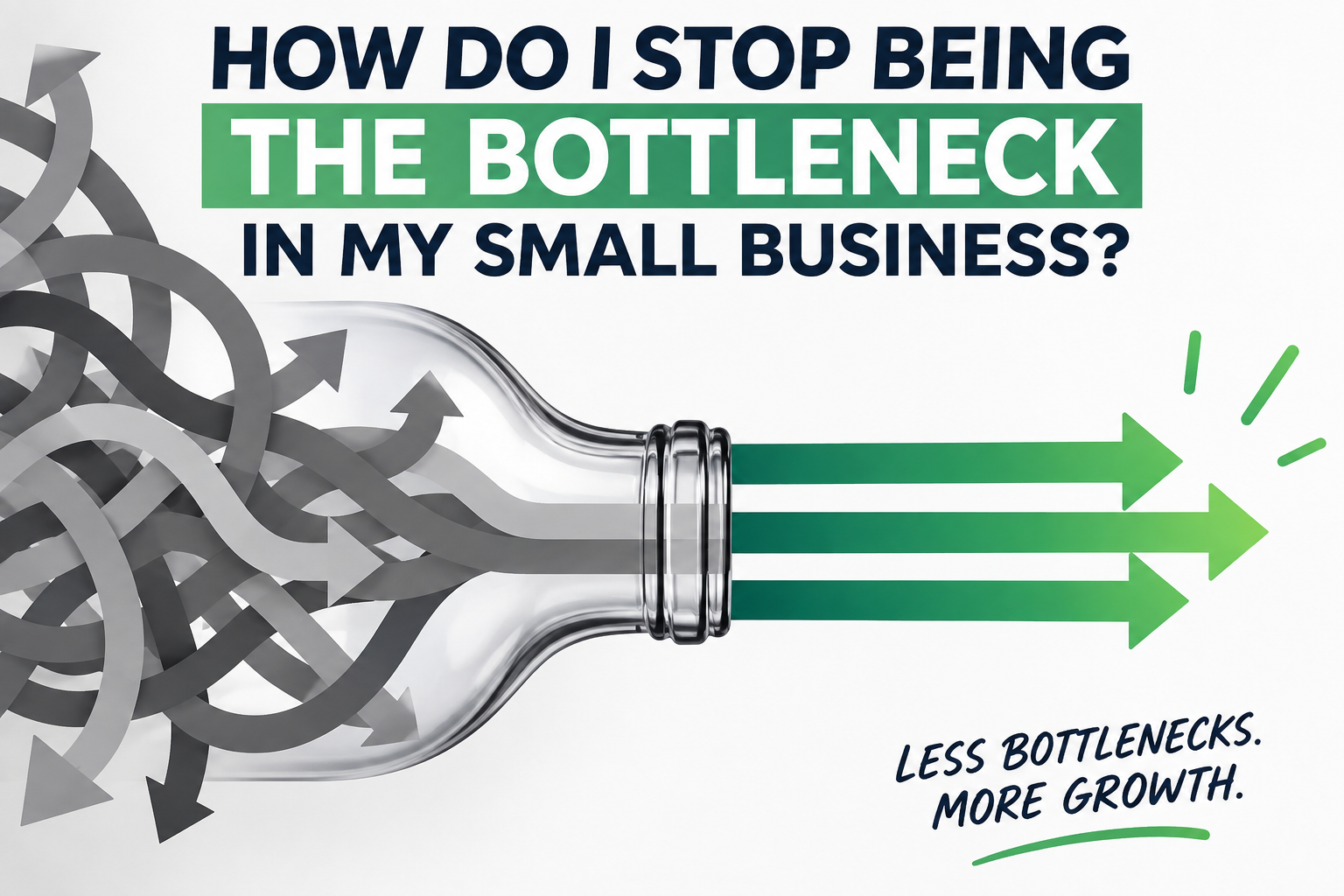
You may be the bottleneck if employees or contractors constantly wait for your approval, recurring tasks depend on you, processes live mostly in your head, or the business slows down whenever you step away. A good test is to ask: What would stop moving if I were unavailable for a week?
-
You may be the bottleneck if employees or contractors constantly wait for your approval, recurring tasks depend on you, processes live mostly in your head, or the business slows down whenever you step away. A good test is to ask: What would stop moving if I were unavailable for a week?
-
Start with repetitive, time-consuming tasks that don't require your unique expertise or leadership. Look at administrative work, scheduling, invoicing, customer follow-up, content publishing, reporting, and other recurring activities. Document the process first, then delegate clear ownership instead of simply handing someone another task.
-
Yes. SOPs document how recurring work should be completed, who owns it, what tools are required, and what successful completion looks like. They reduce the amount of information that lives only in your head and make it easier to delegate, train team members, maintain consistency, and eventually scale.
-
Focus on moving your business from owner-dependent to system-dependent. Document recurring processes, establish clear roles and decision-making authority, delegate ownership, automate repetitive work, track important KPIs, and eliminate unnecessary tasks. The goal isn't for your business to never need you, it's for the business to need your leadership instead of your constant involvement.