Create, Optimize, Operationalize: The Framework Behind the Optima Method
Starting a business and building a business are two very different things.
You can create an offer, build a website, sign your first client, open your social media accounts and officially call yourself a business owner.
But eventually, something changes.
There are more clients to manage.
More emails to answer.
More decisions to make.
More tasks competing for your attention.
More responsibilities outside of your business.
And suddenly, the business you created for more freedom starts requiring more and more of you.
That is exactly why I built the Optima Method around three simple principles:
Create. Optimize. Operationalize.
These three stages help entrepreneurs move from simply doing the work to intentionally building the structure, systems and processes their business needs to grow.
And when they are applied across the Six Foundations of the Optima Method, they create something even more important:
A business that can support the life you are trying to build.
Because at Optima Operations Consulting, I believe one thing very strongly:
Structure creates freedom.
What Does Create, Optimize, Operationalize Mean?
Create, Optimize and Operationalize represent three different stages of building a stronger business.
CREATE
Build what your business needs.
OPTIMIZE
Improve what already exists.
OPERATIONALIZE
Turn what works into a repeatable way of operating.
Most entrepreneurs are naturally very good at the first stage.
We create constantly.
We create offers.
We create content.
We create services.
We create processes.
We create spreadsheets.
We create client experiences.
We create new ideas.
But creation alone doesn't build an operational business.
Eventually, you have to stop asking:
"What else should I create?"
And start asking:
"How can I make what I've already created work better?"
That is where optimization begins.
And once something works well, the next question becomes:
"How do I make sure this happens consistently without relying on me to remember every step?"
That is operationalization.
Step 1: CREATE
Every business starts with creation.
You are turning an idea into something real.
But creation inside the Optima Method isn't about endlessly adding more things to your business.
It is about intentionally creating the foundational structure your business needs.
That might mean creating your:
Business vision
Annual goals
Quarterly priorities
Client onboarding process
Master SOP
Weekly planning system
KPI dashboard
Delegation structure
Content process
Family calendar
CEO schedule
The important question isn't:
"What else could I create?"
It is:
"What does my business actually need?"
There is a significant difference.
One creates more work.
The other creates structure.
Step 2: OPTIMIZE
Once something exists, we don't immediately build something new.
We look at what is already there.
Optimization means asking:
Does this still make sense?
Is there a simpler way to do this?
Does this task actually need to happen?
Could something be automated?
Could someone else own this?
Are we creating unnecessary steps?
Is this process supporting the goal it was designed to achieve?
This is where many entrepreneurs can reclaim significant time.
You don't necessarily need another productivity app.
You don't always need another employee.
You don't necessarily need another SOP.
Sometimes you simply need to examine how the work is currently being done.
One of the frameworks I use for this is the 4D Time Audit:
Do. Delegate. Automate. Delete.
Every recurring task shouldn't automatically become another item on your calendar.
Instead, determine whether you should continue doing it, delegate ownership, automate part or all of it, or eliminate it completely.
Optimization isn't about squeezing more work into your day.
It's about making the work itself better.
Step 3: OPERATIONALIZE
This is where a business begins becoming less dependent on the person who created it.
Once you know something works, you build the structure around it.
You document it.
You define ownership.
You establish expectations.
You create workflows.
You implement templates.
You introduce automation.
You establish KPIs.
You determine how and when the process should be reviewed.
You turn knowledge that currently lives inside your head into a system that can actually be repeated.
This is operationalization.
For example, maybe you already have a way of onboarding new clients.
You know what email to send.
You know what documents they need.
You know when to schedule the kickoff call.
You know what information needs to be collected.
But if all of that exists only in your head, you don't really have a client onboarding system.
You have a process that depends on you.
Operationalizing it could mean creating:
A documented onboarding workflow
A client onboarding checklist
Email templates
Automated reminders
Defined ownership
A standardized kickoff agenda
A client folder structure
An SOP documenting the entire process
Now onboarding isn't something you have to recreate every time a client signs.
It becomes part of how your business operates.
How Create, Optimize, Operationalize Connects to the Optima Method
Create, Optimize and Operationalize tell us how we improve the business.
The Six Foundations tell us where we apply that process.
The Optima Method is built around six areas:
1. Vision: Know Where You're Going
Your business needs direction before it needs more activity.
This foundation focuses on your vision, priorities, goals, roadmap and strategic direction.
Create: Define the vision and priorities.
Optimize: Review whether your current work actually supports those priorities.
Operationalize: Build planning and review rhythms that keep the business aligned.
2. Operations: Organize How the Business Runs
This is the structure behind the day-to-day business.
Your calendar, meetings, responsibilities, tools, planning routines and operating cadence all live here.
Create: Establish the operational structure.
Optimize: Remove unnecessary work, meetings and administrative friction.
Operationalize: Create repeatable weekly, monthly and quarterly operating rhythms.
3. Process: Build Repeatable Systems
Processes turn repeated work into consistent execution.
This includes workflows, SOPs, automation, checklists and documentation.
Create: Identify and document your core processes.
Optimize: Simplify the workflow and eliminate unnecessary steps.
Operationalize: Implement SOPs, automation, templates and ownership so the process happens consistently.
4. Leadership: Stop Owning Everything
Growth eventually requires ownership beyond the founder.
Even if you are currently a solopreneur, learning how to delegate and define accountability prepares the business for growth.
Create: Define responsibilities and expectations.
Optimize: Identify where the owner is unnecessarily involved.
Operationalize: Build delegation, accountability and communication systems.
5. Growth: Measure What Moves the Business Forward
Growth should not depend entirely on instinct.
You need visibility into what is working.
Create: Define meaningful goals and KPIs.
Optimize: Focus resources on the strategies producing results.
Operationalize: Establish dashboards, reporting and recurring performance reviews.
6. Personal: Build a Business That Supports Your Life
This foundation is especially important to me.
Because your business doesn't exist in isolation.
There are school schedules.
Family responsibilities.
Appointments.
Soccer practices.
Dinner.
Relationships.
Your health.
Your energy.
And your own definition of success.
The goal isn't simply to create a business that can generate more revenue.
It is to create a business that works within the life you actually want.
Create: Define what you want your life and business to look like.
Optimize: Identify where your business is unnecessarily consuming your time and energy.
Operationalize: Build boundaries, routines and systems that protect what matters outside the business.
The Optima Method Is a Cycle, Not a One-Time Project
One of the most important things to understand about this framework is that you never completely "finish" it.
Your business changes.
Your responsibilities change.
Your team changes.
Your technology changes.
Your family changes.
Your goals change.
Something you created six months ago may need to be optimized today.
Something you optimized last quarter may now be ready to operationalize.
And sometimes an operationalized process no longer serves the business and needs to be redesigned completely.
So the cycle continues:
CREATE → OPTIMIZE → OPERATIONALIZE → REVIEW → IMPROVE
That is how operational maturity develops.
Not through one massive overhaul.
Through intentional improvement over time.
What This Looks Like for an Overwhelmed Entrepreneur
Imagine you are running your business and constantly thinking:
"I know I need better systems, but I don't even know where to start."
Instead of trying to fix everything, start with one foundation.
Maybe your biggest problem is that everything feels disorganized.
Start with Operations.
Ask:
CREATE
What structure is currently missing?
Maybe you need a weekly CEO planning process.
OPTIMIZE
What is taking more time than it should?
Maybe you're jumping between tasks all day without clear priorities.
OPERATIONALIZE
How can this become repeatable?
Maybe every Friday you review the previous week, establish three priorities for the next week and block the necessary time on your calendar.
You didn't rebuild your entire company.
You fixed one operational problem.
Then you move to the next.
That is how the Optima Method is designed to work.
You Don't Need to Fix Everything at Once
This is especially important for entrepreneurs who already feel overwhelmed.
When your business feels chaotic, the natural reaction is often to try to overhaul everything.
New CRM.
New planner.
New automation platform.
New SOP library.
New project management system.
New morning routine.
And suddenly "getting organized" becomes another full-time job.
That isn't the goal.
The goal is to identify the area creating the most friction and improve that first.
One foundation.
One process.
One system.
One improvement at a time.
Small operational improvements compound.
A 30-minute task that becomes a five-minute automated workflow saves time every single time it runs.
A documented process eliminates repeated questions.
A clear owner removes unnecessary decisions from your plate.
A weekly planning routine reduces reactive work.
Eventually, those improvements become the infrastructure of your business.
Templates Help You Move From Knowing to Implementing
This is also why the Six Foundations include ready-to-use and customizable templates, guides and tools.
Knowing that you need an SOP is different from having a framework for creating one.
Knowing you should track KPIs is different from having a dashboard ready to customize.
Knowing you need to delegate is different from having a delegation framework and accountability tracker.
Knowing you need a weekly planning process is different from having one ready to implement.
The templates within the Optima Method are designed to shorten the distance between:
"I know I need this."
and
"This is now part of how my business operates."
You don't need to build every operational tool from scratch.
Start with the structure, customize it for your business and put it into practice.
The Ultimate Goal: A Business That Doesn't Depend on You for Everything
Creating systems isn't about turning your business into a rigid corporate machine.
Operational structure should do the opposite.
It should create space.
Space to think strategically.
Space to grow.
Space to lead.
Space to spend time with your family.
Space to take a day off without wondering whether everything will fall apart.
Space to actually enjoy the business you worked so hard to create.
That's why I teach:
Create what you need.
Optimize what exists.
Operationalize what works.
And apply that process across the six foundations of your business:
Vision. Operations. Process. Leadership. Growth. Personal.
That is the Optima Method.
And the principle behind all of it remains simple:
Structure Creates Freedom.
The goal isn't to build more systems for the sake of having systems.
It's to build a business that can operate more intentionally, grow more sustainably and require less of you to hold everything together.
Because you didn't start a business just to create another job for yourself.
You started it to build something.
Now it's time to build the structure that allows it, and you, to grow.
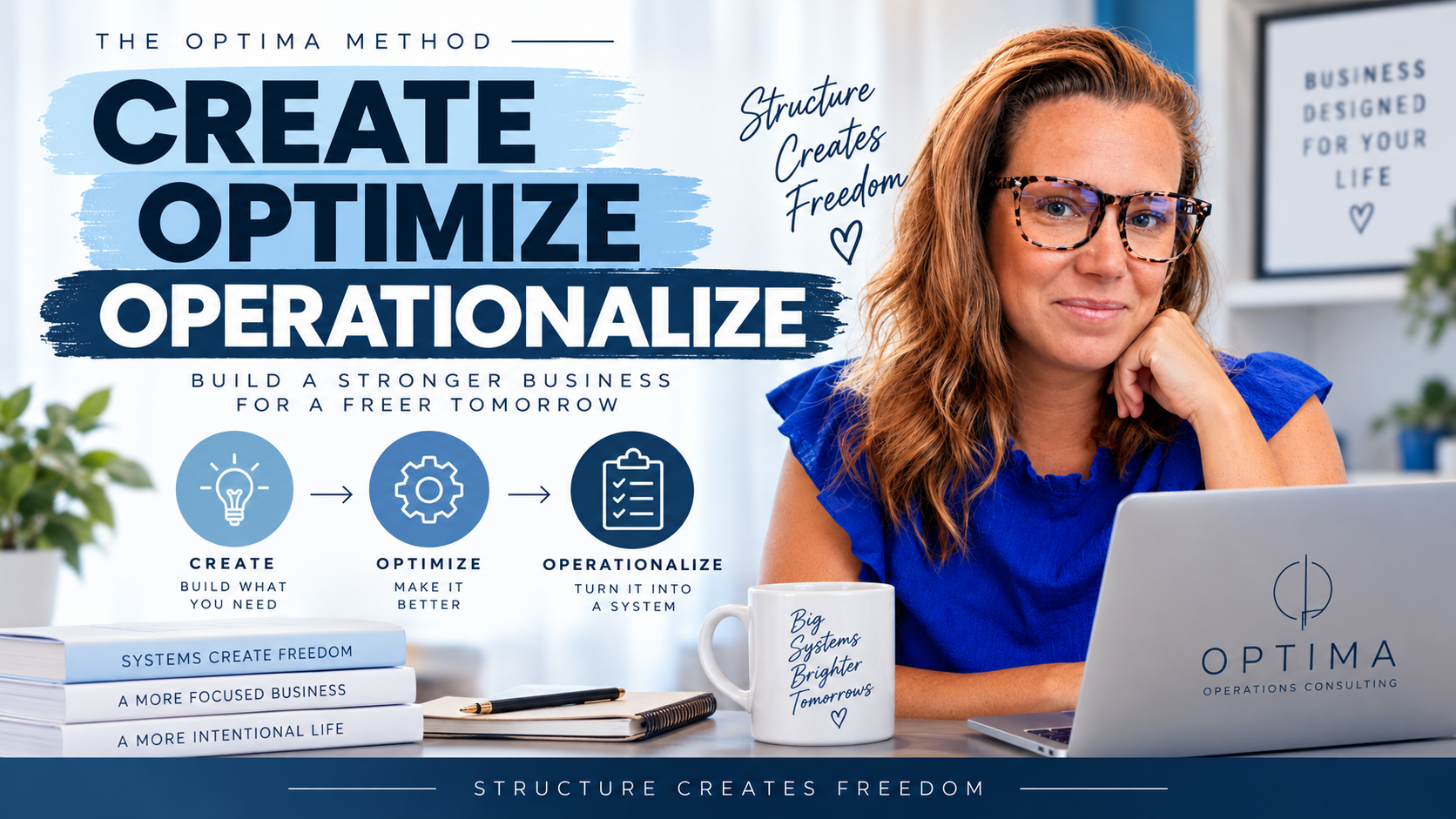
Create. Optimize. Operationalize. is the process at the heart of the Optima Method. Learn how to build what your business needs, improve what already exists, and turn what works into repeatable systems across the Six Foundations, so your business can grow with more structure, less overwhelm, and greater freedom.
-
The Optima Method is a business framework designed to help entrepreneurs and small business owners build stronger businesses through six core foundations: Vision, Operations, Process, Leadership, Growth, and Personal. Across each foundation, the goal is to Create, Optimize, and Operationalize the structure your business needs so it can grow without depending on you for everything.
-
Create means building the structure, process, or system your business is currently missing. Optimize means improving what already exists by simplifying, delegating, automating, or eliminating unnecessary work. Operationalize means turning what works into a documented, repeatable system with clear ownership, tools, templates, and expectations.
-
Start with the area creating the most friction, overwhelm, or dependency on you. The Six Foundations of the Optima Method help you assess whether the biggest opportunity is within your Vision, Operations, Processes, Leadership, Growth, or Personal foundation, then you can focus on improving one area instead of trying to fix your entire business at once.
-
No. The Optima Method is designed for solopreneurs, mompreneurs, entrepreneurs, and growing small business owners, including businesses without employees. Creating systems, SOPs, automation, clear priorities, and repeatable processes early helps you reclaim time now while creating the infrastructure you'll need if you decide to delegate, hire, or scale later.