

Everything Lives in My Head: Why Your Business Needs a Master SOP
If you have ever said:
“Everything in my business lives in my head.”
You are not alone.
You know how clients are onboarded.
You know when invoices need to go out.
You know which email template to use.
You know how to fix the website when something breaks.
You know where every file lives, which subscription renews next month, how leads are followed up with, what needs to happen before a client project starts, and the twenty tiny steps required to keep your business moving.
And when someone asks you how something works?
You explain it.
Again.
The problem isn't that you don't know how to run your business.
The problem is that you are the operating system of your business.
And eventually, that becomes one of the biggest constraints on your ability to grow.
This is exactly why I teach business owners to build a Master SOP.
What Is a Master SOP?
When most people hear the term SOP, Standard Operating Procedure, they think about a document explaining how to complete one task.
How to onboard a client.
How to send an invoice.
How to publish a blog.
How to process a refund.
Those individual procedures are important, but they are only pieces of a much larger operational system.
A Master SOP gives you the bigger picture.
I teach the Master SOP as the central operating document for your business, the place where you organize how your company actually works.
Instead of having information scattered across your brain, inbox, Google Drive, sticky notes, project management software, text messages and random documents, your Master SOP creates one structured operational reference point.
Think of it as the bridge between:
“I know how my business works.”
and
“My business knows how my business works.”
That distinction matters.
The Real Problem With “Everything Lives in My Head”
In the beginning, keeping everything in your head can work surprisingly well.
You are probably doing most of the work yourself.
You know every customer.
You make most of the decisions.
You built the processes.
And because you created the business, you understand how all the pieces fit together.
But growth changes the equation.
More customers create more communication.
More revenue creates more administrative work.
More offers create more processes.
More team members create more questions.
More marketing creates more follow-up.
Eventually, your ability to remember, manage and personally execute everything becomes the limiting factor.
And that's when you start saying things like:
“Nobody knows how to do this except me.”
“It's faster if I just do it myself.”
“I don't have time to train someone.”
“I can't take time off because something always comes up.”
“I need help, but I don't even know what I would hand off.”
These aren't simply time-management problems.
They are often operational structure problems.
Your Business Shouldn't Depend on Your Memory
Your brain is incredibly valuable.
But it shouldn't be your company's filing cabinet.
When important business knowledge exists primarily in your head, your company becomes dependent on your availability.
You become the person everyone needs for answers.
Where is this file?
What happens after this?
Who handles that?
When do we follow up?
Which system do we use?
What happens if the client doesn't respond?
How do I know when this is complete?
Every question seems small.
Collectively, they make you the bottleneck.
And even if you don't have employees yet, the same problem exists.
You're constantly forcing yourself to remember what needs to happen next instead of relying on documented systems.
Structure reduces the amount of remembering your business requires from you.
That creates capacity.
What Goes Into a Master SOP?
Your Master SOP shouldn't become a 300-page document nobody wants to open.
The goal isn't documentation for the sake of documentation.
The goal is to create a usable operating system for your business.
Depending on your business, your Master SOP might include:
Business overview and organizational structure
Roles and responsibilities
Core business systems and software
Client or customer journey
Lead management
Sales processes
Client onboarding
Service delivery
Financial and administrative processes
Marketing and content workflows
File management standards
Communication expectations
Recurring operational activities
Key performance indicators
Individual SOP references
Automation and system information
Important business resources
The Master SOP provides the structure.
Your detailed SOPs provide the instructions.
Together, they create a documented business instead of a business dependent on tribal knowledge.
“But I'm a Solopreneur. Do I Really Need This?”
I would argue that documenting your business before you hire can make hiring significantly easier.
One of the biggest mistakes solopreneurs make is waiting until they're completely overwhelmed before documenting anything.
Then they finally hire someone.
But there's a problem.
The new person needs to know what to do.
So now the already-overwhelmed business owner has another responsibility:
Training someone while simultaneously trying to figure out what to delegate.
That's when you hear:
“It would honestly be faster if I just did it myself.”
And at that moment, it probably would be.
But that's a short-term calculation.
If you spend 20 minutes completing a task every week because training someone would take an hour, you haven't saved an hour.
You've committed yourself to spending 20 minutes every week indefinitely.
Your Master SOP helps you start separating the business from the person running the business.
That person currently might be you.
It doesn't always have to be.
The Master SOP Is More Than Documentation
This is where the Master SOP connects directly to the Optima Method.
At Optima Operations Consulting, I teach business owners to:
Create → Optimize → Operationalize
Create
First, we identify and document what currently exists.
What do you actually do?
What systems are you using?
What processes keep the business moving?
Who is responsible for what?
What information currently exists only in your head?
You can't improve a system you haven't clearly defined.
Optimize
Once the business is visible, you can evaluate it.
What should be simplified?
What is duplicated?
What can be automated?
What doesn't need to happen anymore?
What should be delegated?
Where are you creating unnecessary work?
This is where documentation becomes much more powerful.
You're not simply writing down a broken process.
You're improving it.
Operationalize
Finally, you turn that knowledge into a repeatable way of working.
Responsibilities are clear.
Processes are documented.
SOPs are accessible.
Automation handles appropriate repetitive work.
People know what happens next.
Your business becomes less dependent on you remembering and personally managing every detail.
That's operationalization.
Your Master SOP Should Grow With Your Business
You do not need to document your entire company this weekend.
In fact, trying to document everything at once is one of the easiest ways to never finish.
Start with what matters most.
Ask yourself:
What do I repeatedly have to remember, explain, fix or personally handle?
Start there.
Maybe it's client onboarding.
Maybe it's invoicing.
Maybe it's your content process.
Maybe it's your weekly CEO responsibilities.
Maybe it's lead follow-up.
Document the process.
Then optimize it.
Then determine whether it should remain with you, be automated or eventually be delegated.
Over time, your Master SOP becomes the operational knowledge base of your company.
The Goal Isn't to Remove Yourself From Your Business
This distinction is important.
The goal isn't to create a business where you are completely unnecessary.
You started your business for a reason.
Your ideas matter.
Your leadership matters.
Your relationships matter.
Your expertise matters.
But there is a difference between your business benefiting from you and your business being completely dependent on you.
You should be spending your time where your involvement creates the most value.
Not answering questions someone could find in an SOP.
Not searching for information you documented six months ago.
Not manually completing repetitive administrative work.
Not constantly reminding people what happens next.
Not carrying your entire company's operational knowledge in your head.
Structure Creates Freedom
When I talk about structure, systems and SOPs, I'm not talking about turning a small business into a rigid corporation.
I'm talking about creating enough structure that your business doesn't consume every available hour of your life.
Because when everything lives in your head, your business follows you everywhere.
Into dinner.
Into weekends.
Into vacations.
Into family time.
Into the middle of the night when you suddenly remember something you forgot to do.
Documenting your business isn't simply an operational exercise.
It's a capacity exercise.
You're creating a business that can eventually function without requiring your constant attention.
And that is where structure begins creating freedom.
Start Getting Your Business Out of Your Head
If you're reading this thinking:
“This is exactly my problem. Everything lives in my head.”
Don't try to fix everything today.
Start by creating the place where your business knowledge can live other than your brain.
That's what your Master SOP is designed to become.
Document what you do.
Organize how your business works.
Optimize what's inefficient.
Operationalize what needs to become repeatable.
Because the next stage of your business shouldn't require you to remember more.
It should require your business to depend on you less.
That is the shift from simply running a business to intentionally building one.
Ready to Start Building Your Master SOP?
You don't have to start with a blank document.
The Optima Master SOP Template gives you a ready-to-use structure to begin documenting and organizing how your business operates.
And if you're not sure where your biggest operational gap is yet, start with the Free Business Foundation Assessment to identify which area of your business needs structure first.
Create. Optimize. Operationalize.
Build the structure today that gives you more freedom tomorrow.
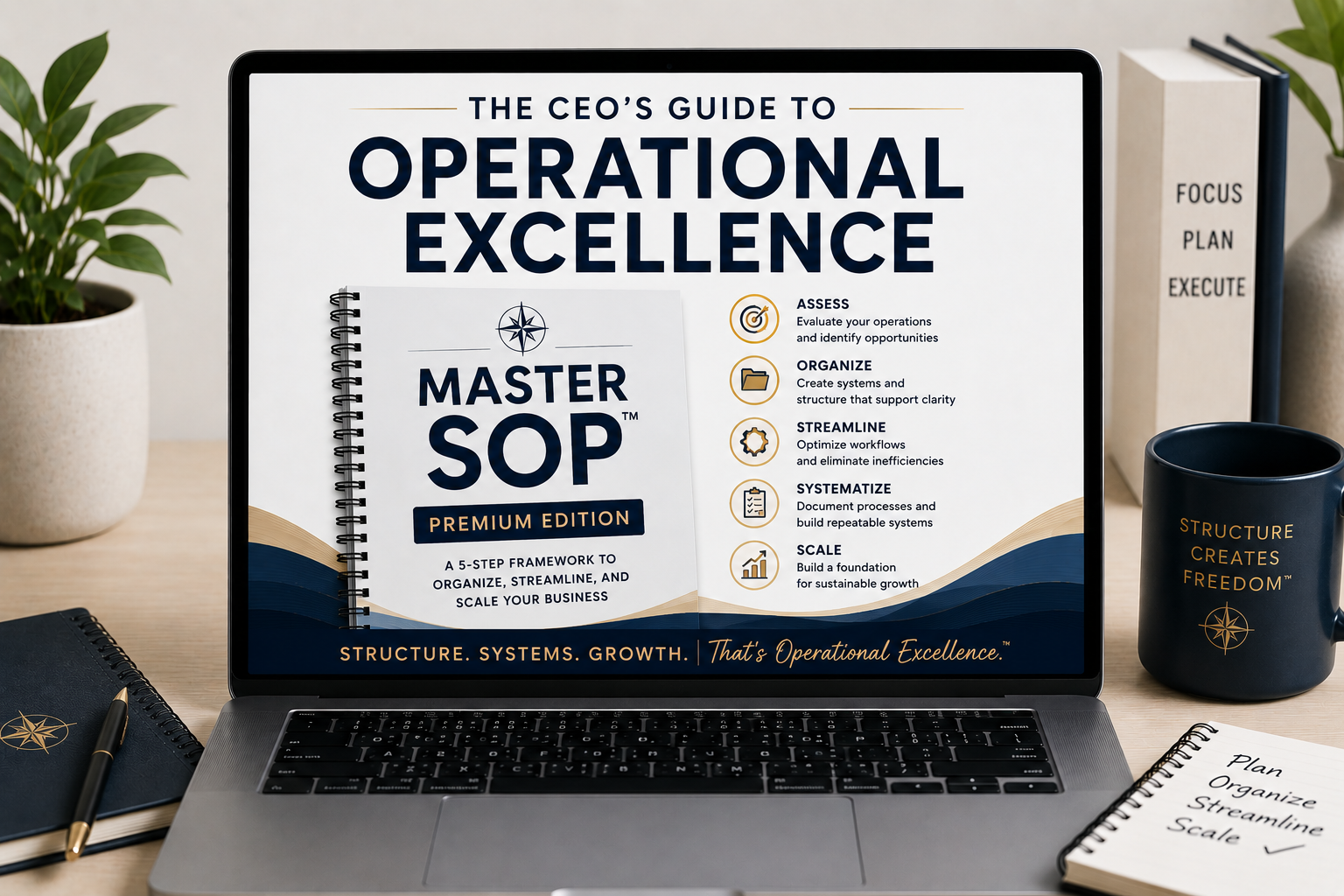
When everything in your business lives in your head, you become the bottleneck. Learn how a Master SOP helps you document what you know, organize how your business operates, and create repeatable systems so you can spend less time managing every detail and more time growing your business.
-
A Master SOP is a central operating document that organizes how your business works, including key processes, responsibilities, systems, workflows, and individual SOPs. It helps move important business knowledge out of your head and into a structure you and your team can consistently follow.
-
Yes. Creating a Master SOP before you hire helps you identify what you do repeatedly, improve inefficient processes, and prepare tasks for future delegation or automation. It allows you to build operational structure before growth makes documentation more difficult.
-
Start with the processes that you repeatedly perform, explain, or have to remember. Your Master SOP can include client onboarding, sales, invoicing, marketing, service delivery, administrative processes, roles and responsibilities, business systems, recurring tasks, and links to detailed SOPs.
-
A Master SOP creates a reliable source of information so every decision, process, and next step doesn't depend on you. Using the Optima Method, Create, Optimize, Operationalize, you can document how work gets done, improve it, and turn it into repeatable systems that allow your business to operate with less day-to-day dependence on you.