

Why Entrepreneurs Stay Stuck: It’s Usually Not a Motivation Problem
You started your business because you had an idea.
Maybe you wanted more freedom. More flexibility. More control over your time. More income. Or simply the opportunity to build something that was yours.
But somewhere between starting the business and trying to grow it, things got complicated.
Your days became filled with emails, client work, content, invoices, follow-ups, decisions, administrative tasks, family responsibilities, and an endless list of things you should be doing.
You are working.
You are trying.
You are constantly thinking about the business.
But somehow, you still feel stuck.
And when that happens, it is easy to assume the problem is you.
Maybe you need to work harder.
Maybe you need another productivity system.
Maybe you need to wake up earlier.
Maybe you need a better marketing strategy.
Maybe you just aren't disciplined enough.
But after years of working in business operations, I have seen the same pattern repeatedly:
Entrepreneurs often don't stay stuck because they lack motivation. They stay stuck because their business lacks structure.
That is an entirely different problem.
What Does “Stuck” Actually Look Like in a Business?
Being stuck doesn't always mean your business isn't making money.
You can have clients, revenue, followers, opportunities, and even a growing business, and still feel completely stuck.
It can look like:
Everything in the business still depends on you.
You have 25 priorities and don't know which three actually matter.
You keep recreating the same processes.
You know you need to delegate, but everything “lives in your head.”
You buy templates, courses, software, and tools but struggle to implement them.
You spend most of your time reacting instead of leading.
You are constantly busy but rarely feel like you are moving forward.
You don't know what you should automate, delegate, document, or eliminate.
Taking a day off creates more work for you when you return.
Your business has grown, but your operating structure hasn't grown with it.
Eventually, entrepreneurship begins to feel like one giant game of catch-up.
That isn't necessarily a time-management problem.
It is often an operations problem.
7 Reasons Entrepreneurs Stay Stuck
1. Everything Lives in Their Head
This is one of the biggest operational problems I see with entrepreneurs.
You know how everything works.
You know how a client gets onboarded.
You know where documents are stored.
You know when invoices need to go out.
You know how leads should be followed up with.
You know what needs to happen before a project launches.
The problem?
You are the system.
And as long as you remain the system, the business cannot operate independently of you.
Your first step isn't creating hundreds of complicated SOPs.
Start by documenting the processes that happen repeatedly.
Ask yourself:
If someone had to run this part of my business tomorrow without asking me a question, could they?
If the answer is no, you have found an operational gap.
2. Everything Feels Like a Priority
Entrepreneurs rarely struggle because there isn't enough to do.
They struggle because everything feels important.
Build the website.
Create content.
Follow up with leads.
Update the offer.
Send the invoice.
Create the course.
Start YouTube.
Fix the email funnel.
Post on Instagram.
Research Pinterest.
Update the SOP.
And suddenly your Monday morning contains 37 priorities.
But 37 priorities aren't priorities.
They are a task list.
A business needs a way to distinguish between activity and progress.
Instead of asking:
What do I need to get done?
Start asking:
What are the three things that would meaningfully move my business forward right now?
That shift alone can dramatically change how you operate.
3. They Keep Adding Instead of Optimizing
Entrepreneurship constantly tells us to add something.
Another platform.
Another offer.
Another funnel.
Another software tool.
Another strategy.
Another lead magnet.
Another course.
But growth doesn't always require more.
Sometimes growth requires looking at what already exists and asking:
How can this work better?
This is why my approach to business operations follows three stages:
Create → Optimize → Operationalize
Create what the business actually needs.
Optimize it so it becomes simpler, more efficient, and repeatable.
Operationalize it so the process can function consistently without relying entirely on you.
Entrepreneurs often get trapped in the Create stage.
They keep building.
But they never stop long enough to optimize what they have built.
Eventually, complexity becomes the bottleneck.
4. They Are Solving Symptoms Instead of the Real Problem
You might think:
“I need better time management.”
But the actual problem might be that you haven't established priorities.
You might think:
“I need to hire someone.”
But the actual problem might be that your processes aren't documented.
You might think:
“I need more sales.”
But the actual problem might be that you don't know which marketing activities are actually converting.
You might think:
“I need another automation.”
But the actual process might need to be simplified, or eliminated entirely.
This is why operational improvement starts with diagnosis.
Before asking “What should I do?”, ask:
“What problem am I actually trying to solve?”
Otherwise, you can spend enormous amounts of time improving something that shouldn't exist in the first place.
5. They Don't Have a Business Operating System
Many entrepreneurs have pieces of a business.
A business plan.
A Google Drive.
A project management tool.
Some SOPs.
A CRM.
A calendar.
A financial spreadsheet.
A content planner.
But none of those pieces necessarily work together.
That's why I believe every business needs an operating system, a central structure that explains how the business actually runs.
I call this your Master SOP.
Your Master SOP shouldn't simply be a giant binder of instructions.
It should become the operational hub of your business.
It can connect your:
organizational structure
roles and responsibilities
recurring business processes
SOPs
systems and technology
KPIs
meeting rhythms
reporting
decision-making structure
important resources
Instead of everything living in your head, it begins living inside the business.
That is how you start building something that can eventually operate beyond you.
6. They Build Around the Business Instead of Their Life
This one matters deeply to me, especially for entrepreneurs who are also parents.
You can build a successful business and still create a life you don't enjoy living.
You can hit revenue goals while constantly missing dinner.
You can grow your audience while answering emails from the soccer field.
You can build something that looks successful from the outside while privately wondering why entrepreneurship feels so exhausting.
That isn't the goal.
Build the business you dreamed of, not one that looks successful but costs you the life you wanted.
Your business should support the life you're trying to create.
That means your personal priorities belong in your business planning.
Family.
Health.
Time.
Energy.
Relationships.
Rest.
Your calendar should reflect those priorities just as intentionally as it reflects your business goals.
Because success isn't simply about what your business produces.
It is also about what your business allows you to experience.
7. They Don't Have a Framework for Deciding What Comes Next
This may be the biggest reason entrepreneurs stay stuck.
They know something isn't working.
They just don't know where to start.
So they jump between problems.
Marketing this week.
Productivity next week.
SOPs the following week.
Then sales.
Then automation.
Then another offer.
Then back to marketing.
There is plenty of movement, but no sequence.
You don't necessarily need more information. You need a framework for deciding what matters next.
That is exactly why I created the Optima Method.
The Six Foundations of the Optima Method
I organize a business around six interconnected foundations:
1. Vision
Where are you going, why are you building this business, and what are your priorities?
2. Operations
How is the business organized and managed day to day?
3. Process
What should be documented, standardized, automated, delegated, or eliminated?
4. Leadership
Who owns what, how are expectations communicated, and how does accountability work?
5. Growth
What numbers matter, what is actually driving results, and where should you invest your resources?
6. Personal
Does the business support your life, priorities, time, family, and energy?
These foundations give you a way to stop randomly fixing problems and start identifying where the business actually needs attention.
And you don't need to rebuild everything at once.
You find the weakest foundation.
Then you strengthen it.
Then you move to the next constraint.
Structure Creates Freedom
Structure can sound restrictive.
Especially to entrepreneurs.
We left traditional workplaces because we wanted flexibility. The last thing most of us want is to create another corporate bureaucracy inside our own businesses.
But good structure isn't bureaucracy.
Good structure removes unnecessary decisions.
A documented process means you don't have to remember every step.
A clear priority means you don't have to decide what to work on every morning.
An automation means you don't have to complete the same manual task every week.
A defined role means someone else knows what they own.
A KPI means you don't have to guess whether something is working.
A protected calendar means your family doesn't automatically receive whatever time is left after the business takes everything it wants.
That is why I believe:
Structure creates freedom.
The goal isn't to systemize every minute of your life.
The goal is to create enough structure that your business no longer requires your constant attention just to keep moving.
If You Feel Stuck, Don't Add More Yet
Before buying another course, downloading another planner, adding another tool, or creating another offer, stop and assess what you already have.
Ask yourself:
Where is the friction?
What keeps requiring my attention?
What am I repeatedly doing manually?
What only works because I remember to do it?
Where am I the bottleneck?
Which processes exist only in my head?
What am I doing that could be delegated, automated, simplified, or deleted?
And is the business I'm building actually supporting the life I want?
Those questions will tell you far more than another 50-item to-do list.
You Don't Need to Fix Your Entire Business This Weekend
You need to identify the right problem.
Then solve that problem intentionally.
That's the difference between being busy and building operationally.
Start with one foundation.
One process.
One bottleneck.
One improvement.
Document it.
Simplify it.
Optimize it.
Operationalize it.
Then move forward.
Because the goal isn't simply to become better at carrying everything.
The goal is to build a business that doesn't require you to carry everything forever.
That is how you stop being stuck.
And start building a business designed to grow beyond you.
Create. Optimize. Operationalize.
Structure creates freedom.
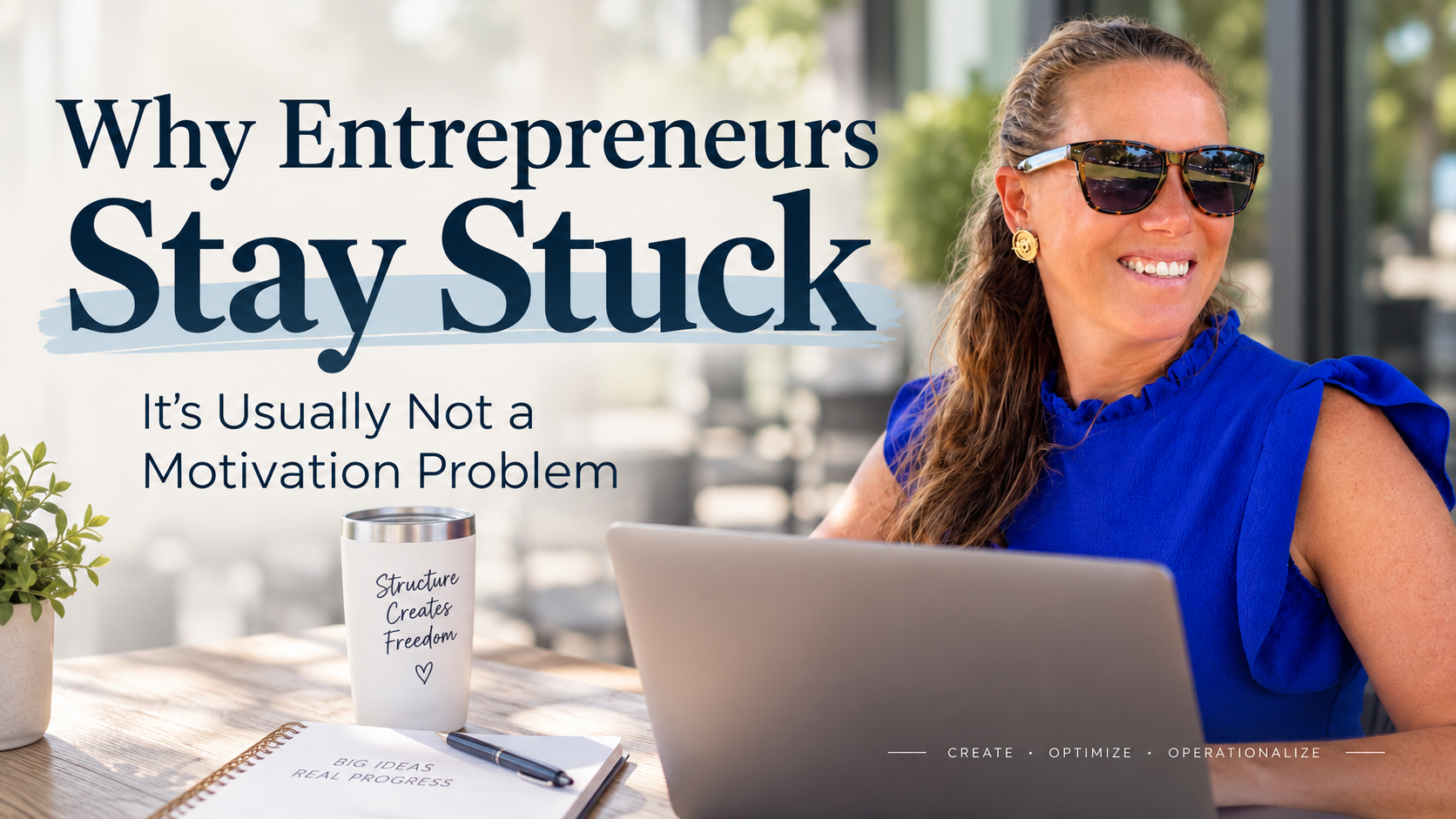
Entrepreneurs often stay stuck not because they lack motivation, ambition, or ideas, but because their business lacks structure. This blog explores the common operational gaps that keep business owners overwhelmed and shows how clear priorities, documented processes, intentional systems, and the Optima Method’s six foundations can help you move from constantly doing to intentionally building a business that works for you.
-
Entrepreneurs often feel stuck because being busy does not always mean the business is moving forward. When priorities are unclear, processes aren't documented, and everything depends on the owner, most of the day is spent reacting instead of intentionally growing the business.
-
Common signs include everything “living in your head,” constantly repeating the same tasks, struggling to delegate, not knowing what to prioritize, and feeling like the business cannot function without you. These are often operational gaps rather than motivation or productivity problems.
-
Start by identifying the biggest source of friction rather than trying to fix everything at once. The Optima Method evaluates six foundations; Vision, Operations, Process, Leadership, Growth, and Personal; to help you identify where your business needs structure most and determine your next priority.
-
Systems and SOPs move important business knowledge out of your head and into repeatable processes. Once work is documented and organized, it becomes easier to simplify, automate, delegate, and scale, giving you more capacity to lead the business instead of carrying every task yourself.