

I Know I Need Systems in My Business, But I Don’t Know Where to Start
You know your business needs systems.
You know you probably need SOPs.
You know there are things you should automate, delegate, document, organize, and streamline.
But every time you sit down to actually build those systems, you get stuck on the same question:
Where do I even start?
Your client onboarding needs work.
Your inbox is overflowing.
Your processes live in your head.
You're manually doing things that probably could be automated.
Your calendar is packed.
You have documents scattered across different folders.
And if someone asked you to explain exactly how your business operates from beginning to end, you might not even know where to begin.
So instead of creating systems, you keep running the business the way you've been running it.
You figure it out as you go.
And that works, until it doesn't.
The good news is that you don't need to systemize your entire business this weekend.
You just need to know where to start.
First: You Probably Already Have Systems
One of the biggest misconceptions about business systems is that you have to create them from scratch.
You probably don't.
If you perform a task repeatedly, you already have some type of process.
Think about what happens when:
A new lead contacts you.
Someone purchases your service.
You onboard a client.
You send an invoice.
You create content.
You respond to a customer question.
You complete a project.
You follow up with a prospect.
You prepare for your week.
You already have a way of doing these things.
The problem is that the process may exist entirely inside your head.
And when everything lives in your head, you become the operating system of the business.
Every question comes back to you.
Every decision requires you.
Every process depends on you remembering the next step.
Every mistake requires you to fix it.
That's why systems aren't simply about becoming more organized.
Systems are how you make the business less dependent on you.
Where Do You Start When Your Business Needs Systems?
Not with 50 SOPs.
Not with a complicated automation platform.
And definitely not by trying to document every single thing you do.
Start by understanding how your business actually operates today.
Here's the process I recommend.
Step 1: Identify What You Do Repeatedly
Before creating systems, start noticing repetition.
For the next week, pay attention to the tasks you perform over and over again.
Write them down.
For example:
Sales
Responding to inquiries
Scheduling discovery calls
Following up with leads
Sending proposals
Updating your CRM
Client Management
Sending welcome emails
Collecting client information
Creating project folders
Scheduling kickoff calls
Providing project updates
Offboarding clients
Finance
Sending invoices
Following up on overdue payments
Recording expenses
Reviewing monthly financials
Marketing
Creating social media content
Publishing blogs
Sending emails
Creating graphics
Reviewing analytics
Administration
Managing your inbox
Scheduling meetings
Organizing files
Planning your week
Don't worry about fixing anything yet.
You're simply creating visibility.
You can't optimize a process you haven't identified.
Step 2: Find the Process Creating the Most Friction
Now look at your list and ask:
Which process causes me the most frustration, wasted time, mistakes, or unnecessary decisions?
That's where you start.
Maybe you're constantly answering:
"What happens after someone signs the contract?"
Then client onboarding may need a system.
Maybe you repeatedly forget to follow up with leads.
Start with lead management.
Maybe invoicing happens differently every month.
Start there.
Maybe you're spending hours every week recreating the same content workflow.
That's your starting point.
Your first system doesn't need to be the most important process in your entire company.
It should be the process where structure would immediately make running the business easier.
Step 3: Document What You're Doing Now
This is where many entrepreneurs make systemization unnecessarily complicated.
Your first SOP doesn't need to describe the perfect process.
Document the process you actually use today.
Ask:
What triggers this process?
Then:
What happens next?
And then:
What happens after that?
Continue until the process is complete.
For example:
New Client Onboarding
Trigger: Client signs agreement and submits payment.
Confirm payment.
Send welcome email.
Send intake questionnaire.
Create client folder.
Create project in project management system.
Schedule kickoff meeting.
Review questionnaire.
Conduct kickoff meeting.
Confirm deliverables and timeline.
That's already the beginning of an SOP.
It doesn't need to be complicated.
It needs to be clear enough that someone other than you could understand what happens next.
Step 4: Use the 4D Test
Once you can see the process, don't immediately turn every step into an SOP.
First ask whether each activity should exist at all.
I use four questions:
Do
Does this genuinely require you?
Some activities require the business owner because they involve strategy, leadership, relationships, or specialized expertise.
Keep those.
Delegate
Could someone else complete this task if they had clear instructions?
If yes, the process needs documentation.
Automate
Could technology handle all or part of this?
Appointment confirmations, reminders, intake forms, payment notifications, task creation, lead follow-ups, and recurring reports are common examples.
Delete
Does this activity actually need to happen?
This is the step entrepreneurs often skip.
Sometimes the best system isn't a better workflow.
It's eliminating unnecessary work entirely.
Step 5: Turn the Process Into an SOP
Once you've simplified the workflow, document the final process.
Your SOP should answer questions such as:
What is this process?
Why does it exist?
Who owns it?
When does it happen?
What triggers it?
What tools are required?
What are the steps?
What does successful completion look like?
What happens when something goes wrong?
This is where your business begins moving from:
"I know how to do it."
to:
"This is how our business does it."
That distinction becomes increasingly important as your business grows.
Step 6: Build One Master SOP Before Building 100 Separate Documents
Eventually, businesses can end up with dozens, or hundreds, of processes.
That's why I recommend creating a Master SOP that acts as the operating hub for your business.
Instead of having random instructions scattered between Google Docs, notebooks, emails, Slack messages, and your brain, your Master SOP gives your operational knowledge a home.
Think of it as the beginning of your company's operating system.
Your Master SOP can organize areas such as:
Company information
Roles and responsibilities
Sales
Marketing
Client onboarding
Service delivery
Customer service
Finance
Administration
Technology
Recurring processes
Policies
Department procedures
You don't have to complete all of it immediately.
Build it as your business grows.
Every time you document a new process, you're transferring another piece of operational knowledge out of your head and into the business.
Step 7: Don't Systemize Chaos
There's an important distinction between creating a system and documenting a bad process.
If your current process requires 14 steps but should require six, creating an SOP for all 14 steps doesn't solve the problem.
It simply makes the inefficient process easier to repeat.
That's why my approach is:
Create → Optimize → Operationalize
Create
Understand and document what currently exists.
Optimize
Simplify it.
Ask what can be eliminated, automated, consolidated, standardized, or delegated.
Operationalize
Turn the improved process into a repeatable system with clear ownership, documentation, expectations, and accountability.
That's how systems should support your business rather than adding another layer of administrative work.
What Systems Should a Small Business Create First?
There isn't one universal answer because every business has different bottlenecks.
But if you're starting from scratch, look closely at these areas:
Lead Management → Sales → Client Onboarding → Service Delivery → Customer Communication → Billing → Financial Management → Marketing → Weekly Planning → Team Management
Then ask one question:
Where does the business currently depend on me the most?
That's usually where you'll find your highest-priority systems.
Systems Are Only One Part of Your Business Foundation
Another reason entrepreneurs struggle with systems is that they sometimes try to fix an operational problem without looking at the rest of the business.
You can have beautiful SOPs and still feel overwhelmed if you don't know your priorities.
You can automate processes and still struggle if responsibilities aren't clear.
You can delegate tasks and still become the bottleneck if your team doesn't have accountability.
That's why the Optima Method looks at your business across six foundations:
1. Vision
Where are you going, and what are you actually building?
2. Operations
How is the business organized and managed?
3. Process
What needs to be standardized, documented, automated, or improved?
4. Leadership
Who owns what, and how are delegation and accountability handled?
5. Growth
What are you measuring, and how are you intentionally growing?
6. Personal
Is the business structured around the life you're trying to build?
Together, these foundations help you move beyond simply having a business and start building one that can operate intentionally.
Because the goal isn't more systems.
The goal is more freedom because the right systems exist.
If You're Thinking, "Okay...But I Still Don't Know Where to Start"
Start smaller.
Don't ask:
"How do I systemize my business?"
That's too big.
Ask:
"What is one thing I repeatedly do that I don't want to keep managing this way?"
Choose it.
Write down what happens.
Simplify the process.
Document it.
Assign ownership.
Automate what makes sense.
Then move to the next process.
One system becomes five.
Five become ten.
Eventually, something important starts to change.
Your business stops depending on your memory.
You stop reinventing the wheel.
You stop answering the same questions.
You stop carrying every process around in your head.
And you begin creating something much bigger than organization.
You're creating a business that knows how to operate.
Structure Creates Freedom
Systems aren't about turning your small business into a giant corporation.
They're not about creating unnecessary policies or hundreds of pages of documentation.
They're about making your business easier to run.
They create clarity.
They make delegation possible.
They make automation possible.
They reduce unnecessary decisions.
They protect your time.
And ultimately, they help you build a business that doesn't require you to personally hold everything together.
That's the philosophy behind the Optima Method:
Create. Optimize. Operationalize.
Start with one process.
Build from there.
Because you don't need to systemize your entire business today.
You just need to stop letting everything live in your head.
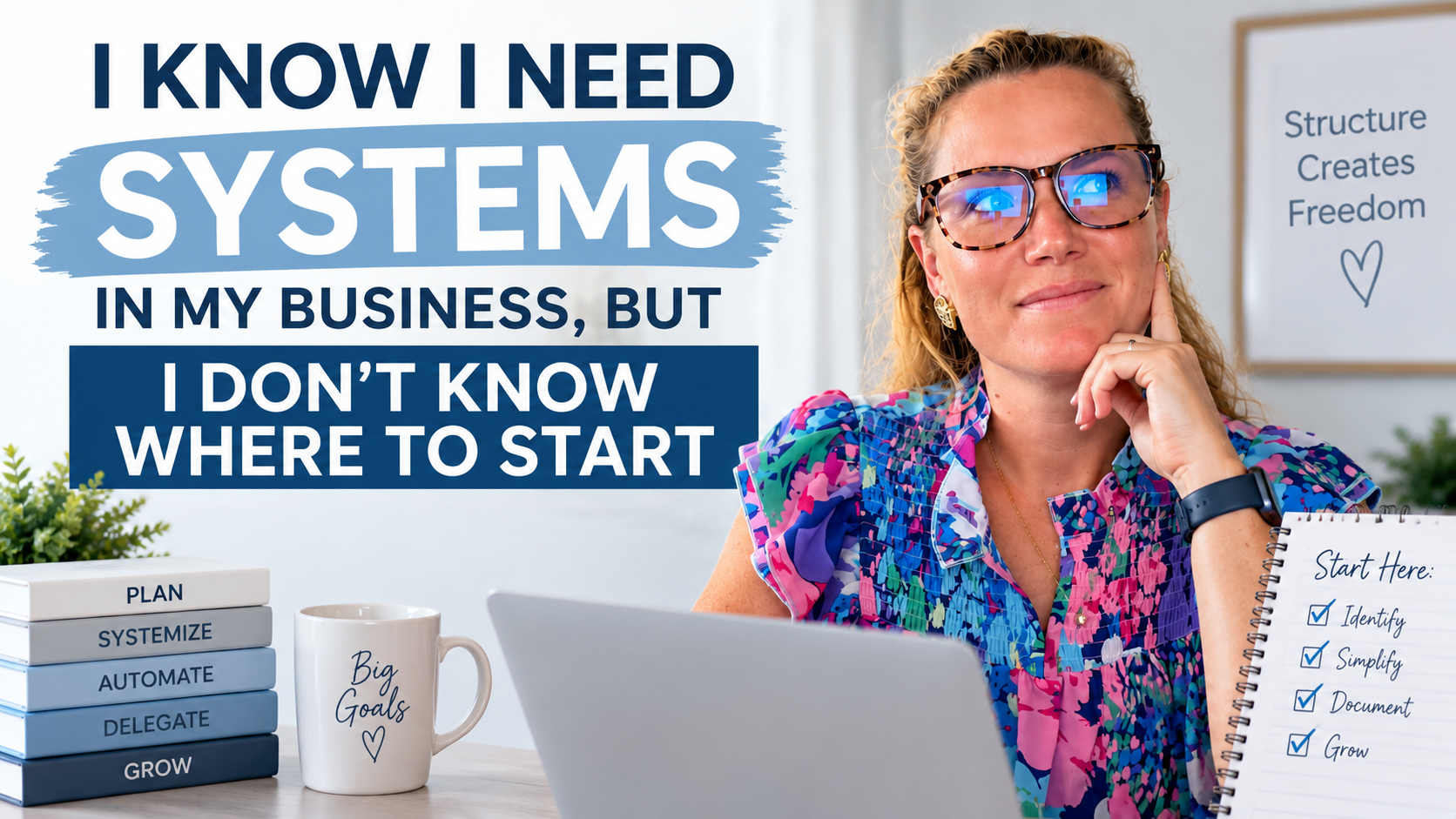
Starting a business is exciting, but figuring out how to actually organize and run it can quickly become overwhelming. If you’re a new business owner who knows you need better systems, processes, and structure but aren’t sure where to begin, this guide will help you identify what to systemize first and build a strong operational foundation from the start.
-
Start with the processes you repeat most often, such as managing leads, onboarding clients, invoicing, customer communication, and completing your core service. You do not need to systemize everything at once. The goal is to create structure around the areas that take the most time or currently live entirely in your head.
Explore the Getting Started & SOP Essentials collection for ready-to-use templates and guides to help you build your first systems.
-
Yes. SOPs aren't only for businesses with employees. Documenting your processes as a solopreneur helps you work more consistently, identify opportunities to automate, and prepare your business for future delegation or growth.
Instead of starting from a blank page, use the Getting Started & SOP Essentials resources to begin documenting how your business operates.
-
Choose one recurring process and document exactly how you complete it today. Then look for steps you can simplify, automate, delegate, or eliminate before turning the improved process into a repeatable SOP. You don't need to build your entire operational structure at once—start with one process and build from there.
The Getting Started & SOP Essentials collection gives you the templates and tools to help you Create → Optimize → Operationalize your first business systems.