My Offer Hasn’t Changed. I’ve Just Continued to Make It Easier to Use.
AI is everywhere.
Small business owners are using ChatGPT. They’re experimenting with Claude. They’re generating captions, rewriting emails, brainstorming ideas, and asking AI to help them save a little time.
And that is a great start.
But there is a much bigger opportunity sitting underneath all of that.
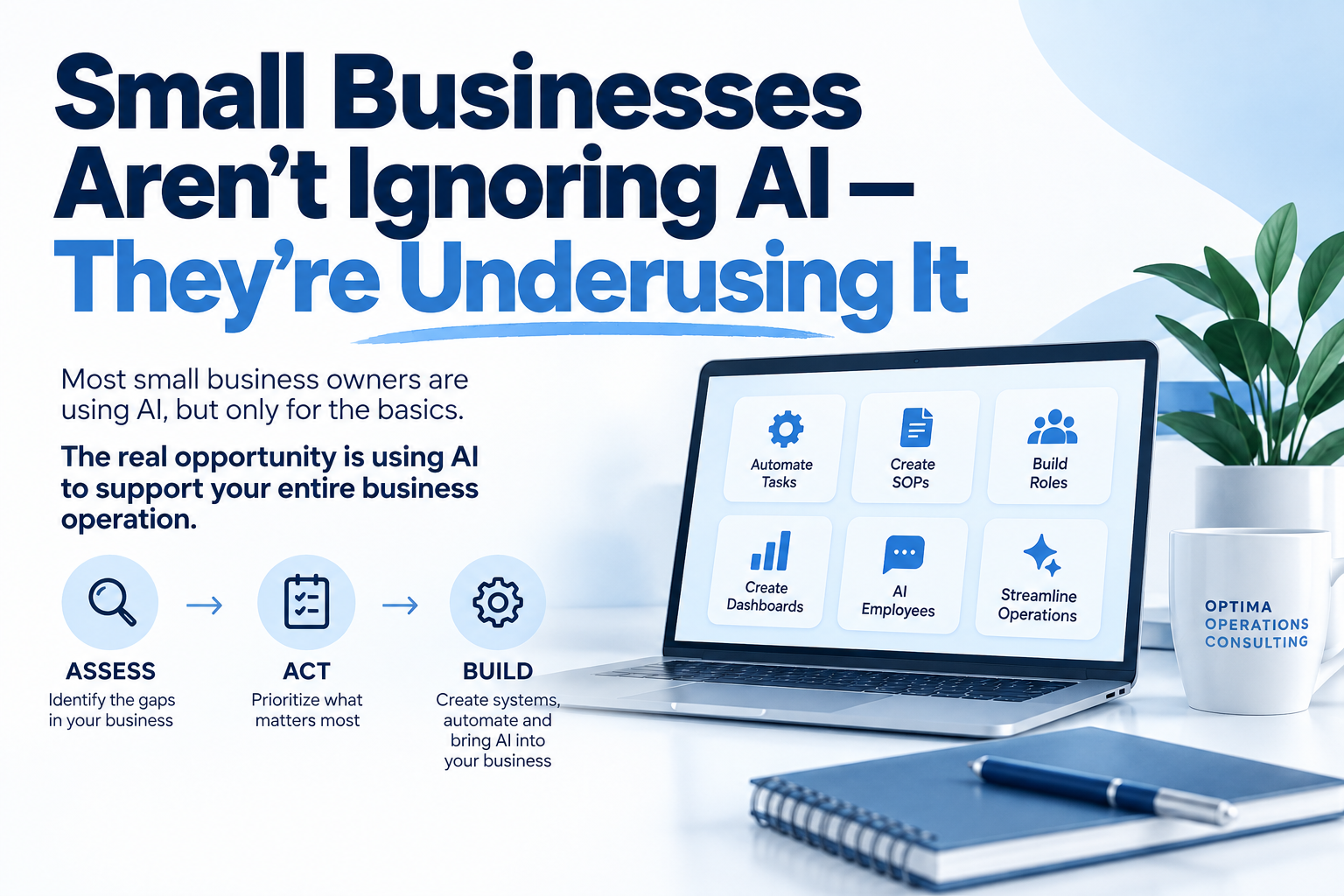
Small businesses aren't necessarily behind on AI. They're underusing it.
The real opportunity isn't simply using AI to create content faster.
It's building AI around the way your business actually operates.
And that is exactly the problem I am building Optima Operations Consulting to solve.
The Problem Isn't Access to AI
Small business owners have access to incredibly powerful AI technology.
The problem is knowing what to do with it.
Most entrepreneurs aren't AI developers.
They don't have dedicated operations teams, automation specialists, or technology departments sitting around figuring out how AI should integrate into their businesses.
They're running the business.
They're answering emails.
They're managing clients.
They're selling.
They're creating content.
They're handling administrative work.
They're onboarding people.
They're solving problems.
And somewhere in between all of that, they're being told:
"You need to use AI."
So they open an AI tool and ask it to write an Instagram caption.
That's useful.
But it's barely scratching the surface.
AI Should Do More Than Help You Write
Imagine moving beyond:
"Write this email for me."
And instead having AI understand:
how your business communicates
how your processes work
what your roles are responsible for
what standards need to be followed
what recurring tasks happen every week
what your SOPs require
how clients move through your business
where the owner is still the bottleneck
Now AI isn't just answering questions.
It is supporting the operation of the business.
That is the shift I believe small businesses need to make.
From using AI to building AI into the business.
But There's a Problem: Most Small Business Owners Don't Know How to Build That
This is the gap I kept seeing.
A business owner might know they need an SOP, but they don't know how to document the process.
They might know they need to delegate, but they haven't clearly defined the role.
They might have dozens of repetitive tasks but haven't identified which ones could be automated.
They might have templates sitting in folders that still require them to manually complete the work every single time.
They might want an AI employee but have no idea what information AI needs to actually perform a role effectively.
And telling that person to "use AI more" doesn't solve the problem.
We have to make AI easier to operationalize.
That's what I'm building through Optima.
Optima Is Building the Bridge Between Operations and AI
Optima Operations Consulting has always been about simplifying business operations.
The goal hasn't changed:
Help small business owners create the structure, systems, processes, and documentation that allow the business to operate without everything depending on the owner.
AI gives us an entirely new way to accomplish that.
So instead of handing a business owner a blank template and saying, "Fill this out," I'm increasingly building tools that help guide them through the process.
Instead of simply telling someone they need an SOP, the goal is to help them identify the repetitive task, document the process, and determine what portions could potentially be handled by AI.
Instead of giving someone a generic job description, we can help them define the role, responsibilities, recurring tasks, expected outputs, and then determine whether those responsibilities belong to a human employee, an AI employee, or a combination of both.
That is where operations and AI become incredibly powerful together.
This Is Why I'm Building AI Tools for Small Businesses
The tools I'm building through Optima are designed around actual operational problems.
Not AI for the sake of AI.
AI with a job to do.
For example:
SOP Builder
Take the repetitive work happening inside your business and turn it into documented processes.
Then go one step further.
Identify which parts of those processes could potentially be automated or supported by an AI employee.
Role Builder
Define what a role actually needs to accomplish.
Create the responsibilities, recurring tasks, outputs, documentation, and expectations associated with that role.
Then use that structure to build support for either a human employee or an AI employee.
Brand Voice Avatar Builder
AI shouldn't make every business sound exactly the same.
Your AI should understand your business, your audience, your voice, your positioning, and the way you communicate.
Instead of constantly telling AI how you want something written, you create the foundation it can consistently work from.
Owner Dependency Audit
One of the biggest barriers to growth is often invisible:
The owner is still required for everything.
By identifying recurring work and evaluating how dependent each task is on the owner, you can begin determining what should stay with you, what should be delegated, what should be automated, and what shouldn't be happening at all.
Client Journey Mapper
Your customer experience isn't one interaction.
It's a series of handoffs, communications, decisions, processes, and touchpoints.
Mapping that journey helps identify where things break, where documentation is missing, and where automation could create a more consistent experience.
These aren't generic AI prompts.
They're designed to solve operational problems.
Start With the Business, Not the AI
This is one of the most important principles behind what I'm building.
AI isn't the strategy.
Your business is the strategy.
AI should support it.
Before we automate something, we need to understand what we're automating.
Before we create an AI employee, we need to understand the role.
Before AI starts communicating for your business, it needs to understand your brand.
Before we delegate work, we need to understand the process.
Before we build more technology, we need to understand the problem.
That's why Optima starts with the foundation.
Assess. Act. Build.
Assess where the business is today.
Act on the priorities creating the biggest gaps or bottlenecks.
Then build the systems, documentation, automation, and AI support around those priorities.
The Goal Isn't to Replace the Small Business Owner
It's to stop requiring the owner to do everything.
There's a difference.
Small business owners don't need another complicated technology stack.
They don't need hundreds of prompts they have to remember.
They don't need to become AI engineers.
They need practical tools that help them take what already exists inside their heads and businesses and turn it into something repeatable.
Document it.
Structure it.
Automate what makes sense.
Build AI around the business instead of forcing the business around AI.
That's where I believe the biggest opportunity exists for small businesses.
AI Should Reduce the Weight of Running a Business
When I think about the future of Optima, this is what excites me most.
A small business owner should be able to say:
"This task happens every week."
And have a clear path for documenting it and determining whether AI can help execute it.
They should be able to say:
"I need help with this role."
And have a framework for defining the role before deciding whether to hire, delegate, automate, or build AI support.
They should be able to take the processes, templates, SOPs, knowledge, voice, and expectations already inside their business and turn them into tools AI can actually use.
Because the future of small business AI isn't about having the fanciest technology.
It's about making powerful technology practical enough for a small business owner to actually use.
That's What Optima Is Building
I'm continuing to build Optima around a simple idea:
Small business owners should have access to the operational capabilities that once required bigger teams, bigger budgets, and specialized expertise.
AI makes more of that possible.
Optima's job is to make it usable.
To take the complexity out.
To connect AI to actual business operations.
And to help small business owners move from:
"I use AI sometimes."
to:
"AI is helping me run my business."
Because AI shouldn't create another thing for an overwhelmed business owner to figure out.
It should remove the work, friction, and dependency that were overwhelming them in the first place.
Ready to See Where AI Could Support Your Business?
Don't start by asking, "What AI tool should I use?"
Start by asking:
"Where is my business still depending on me to repeatedly do work that could be documented, delegated, or automated?"
That's where the opportunity begins.
Start with the Optima Business Foundation Assessment to identify the gaps in your business, then use the Optima tools to turn those gaps into clearer processes, stronger systems, and practical AI support.
Assess → Act → Build.
Build the business first.
Then build AI around it.
Not Sure Where to Start?
You don’t need more tools, you need to know what your business needs first.
Start with the Optima Path to Assess where you are, Act on your biggest priorities, and Build the systems, processes, and AI support that make running your business easier.
Start here →
https://www.optimaoperationsconsulting.com/start-here