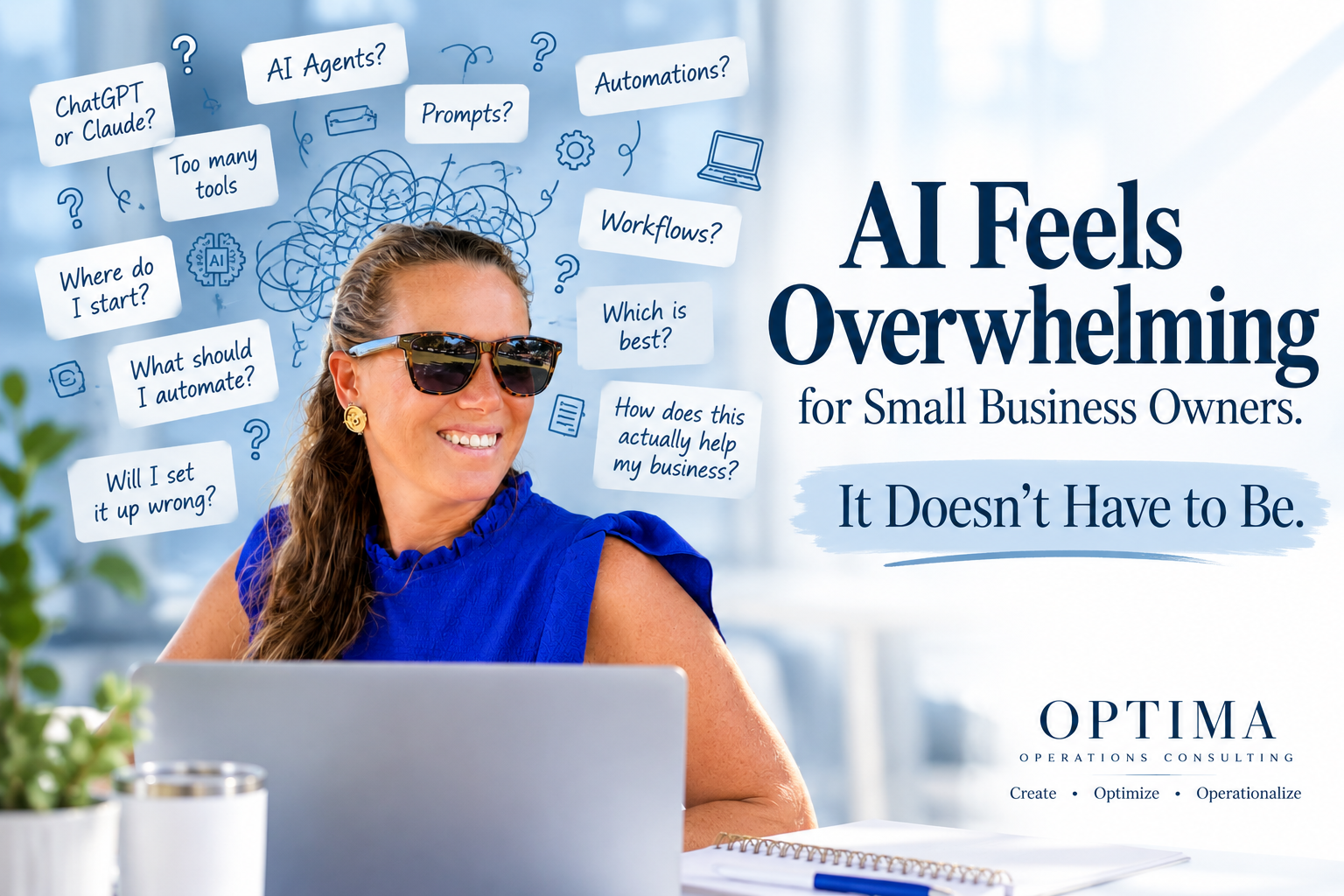
AI Feels Overwhelming for Small Business Owners. It Doesn’t Have to Be.
AI is everywhere.
Use AI to create content.
Build an AI agent.
Automate your business.
Create an AI employee.
Learn prompting.
Connect your tools.
Build workflows.
For a small business owner already trying to manage customers, marketing, finances, operations, employees, and everything else that comes with running a business, AI can quickly feel like one more thing you're supposed to figure out.
And that is the problem.
Small business owners don't necessarily need more AI tools.
They need a simpler way to understand where AI actually belongs in their business.
The AI Opportunity Is Huge. So Is the Implementation Gap.
Small businesses are increasingly experimenting with AI, but using an AI tool and actually integrating AI into business operations are two very different things.
A business owner might already use ChatGPT to write an email, create a social media caption, brainstorm ideas, or summarize information.
That's useful.
But there is another level of AI adoption that can have a much bigger operational impact:
Using AI to help execute the repetitive work that keeps your business running.
That could mean helping you:
Document a recurring process.
Create an SOP.
Organize client onboarding.
Define roles and responsibilities.
Build repeatable workflows.
Analyze business information.
Create consistent documents.
Identify tasks that can be delegated.
Automate repetitive administrative work.
Build AI employees around documented business processes.
The challenge is figuring out what to automate, what to document, and what AI should actually do.
That's where many small business owners get stuck.
Why AI Feels So Overwhelming
The conversation around AI often starts with technology.
Which AI platform should you use?
Which model is best?
Should you use ChatGPT or Claude?
Do you need an AI agent?
Should you build an automation?
What exactly is a Skill?
Do you need another subscription?
But those aren't necessarily the first questions a business owner needs to answer.
The better questions are:
What am I doing repeatedly?
What work still depends entirely on me?
What information is living in my head?
What processes should be documented?
Where am I losing time?
What could AI realistically help me execute?
When you start with the business instead of the technology, AI becomes much easier to understand.
You Don't Need to Become an AI Expert
This is one of the biggest misconceptions I want to help small business owners move past.
You do not need to become an AI expert to benefit from AI.
You don't need to spend weeks learning prompt engineering.
You don't need to understand every new AI platform.
And you certainly don't need to automate your entire business overnight.
You need to understand your business well enough to identify one process, one repetitive task, or one operational bottleneck at a time.
Then you can determine whether AI can help.
That might look like:
Repetitive Task → Document the Process → Create the SOP → Identify the AI Opportunity → Build the Tool → Automate Where Appropriate
Suddenly, "implement AI" becomes something much more manageable.
AI Should Reduce Your Work, Not Create More of It
This is the philosophy behind what I'm building at Optima Operations Consulting.
I don't want small business owners spending hours trying to figure out how to build complicated AI systems.
The goal is the opposite.
AI shouldn't become another thing on your to-do list. It should take things off your to-do list.
But effective AI implementation starts with understanding how the business operates.
That's why Optima combines operations, documentation, processes, templates, and AI.
We're not starting with:
"What cool thing can AI do?"
We're starting with:
"What is creating unnecessary work in your business, and how can we simplify it?"
How Optima Operations Helps Reduce AI Overwhelm
I've been building Optima tools specifically to close the gap between knowing AI exists and knowing how to apply it to your actual business.
Instead of handing you an empty template and expecting you to figure everything out, the goal is to create tools that guide you through the thinking and help produce the operational output you need.
For example:
Identify What Actually Needs Attention
Before adding another tool or automation, understand where the gaps are.
The Free Business Foundation Assessment helps business owners assess areas including Vision, Operations, Process, Leadership, and Growth so they can identify what deserves attention first.
You don't need to fix everything.
You need to know what to work on next.
Find the Work That Depends on You
One of the biggest barriers to growth is owner dependency.
If every decision, task, process, approval, and customer interaction still requires the owner, the business becomes increasingly difficult to scale.
Optima tools can help identify recurring tasks, determine how dependent they are on the owner, and evaluate what should be:
Kept → Documented → Delegated → Automated → Eliminated
That gives AI a purpose before you ever start building anything.
Turn Repetitive Tasks Into SOPs
You probably already have processes.
They just might not be documented.
They're in your head.
You know how to onboard the customer.
You know what happens when someone submits an inquiry.
You know how you prepare an invoice.
You know how you complete the weekly administrative work.
The problem is that you're the system.
The Optima SOP Builder helps turn repetitive work into documented processes and then helps identify opportunities to use AI to support or execute portions of that work.
Instead of starting with AI, we start with how the work actually gets done.
Build Clear Roles, For Humans and AI
As a business grows, the owner shouldn't continue wearing every hat.
Optima's role-building tools help define roles, responsibilities, recurring tasks, expected outputs, and performance expectations.
Then we can ask another important question:
Does this work require a human, or could some of it be performed by an AI employee?
That is a much more practical way to approach AI than simply deciding, "I need an AI agent."
Build AI Around Your Business
Your AI shouldn't sound and operate like everyone else's.
It should understand your:
Business
Vision
Brand
Voice
Processes
Expectations
Documentation
Roles
Outputs
That's why Optima is developing tools such as the Brand Voice Avatar Builder, Role Builder, SOP Builder, Owner Dependency Audit, Client Journey Mapper, Website Audit, and AI Employee tools.
Each solves a specific business problem.
The objective isn't to give you more technology.
It's to make the technology useful.
Start Small
If AI currently feels overwhelming, don't start by asking:
"How do I use AI in my entire business?"
That's too big.
Instead, ask:
"What is one thing I repeatedly do that I wish I didn't have to do anymore?"
Write it down.
Then ask:
How often do I do it?
What steps do I follow?
Does it require my judgment?
Could the process be documented?
Could someone else follow those instructions?
Could AI complete or assist with part of it?
That's how AI implementation becomes manageable.
One process at a time.
One SOP at a time.
One automation at a time.
One AI employee at a time.
Your Business Comes Before the AI
AI is incredibly powerful.
But AI without structure can simply create faster chaos.
Your business still needs a foundation.
It still needs processes.
It still needs clear expectations.
It still needs documented knowledge.
It still needs someone deciding what should happen and why.
That's why my approach at Optima isn't AI first.
It's:
Business first. Process second. AI where it makes sense.
The technology supports the business, not the other way around.
You Don't Need More Overwhelm. You Need a Starting Point.
If you've been watching everything happening with AI and thinking:
"I know I should be doing more with this, but I don't even know where to begin."
You're exactly who I'm building these tools for.
You don't have to understand everything AI can do.
You don't have to implement everything at once.
And you don't need another complicated system to manage.
Start with your business.
Find the gap.
Document the work.
Simplify the process.
Then let AI help you execute it.
That's how we move from AI overwhelm to AI that actually works for your business.
Start With Optima
Not sure where to begin?
Start by assessing where your business needs the most support, then choose the tools that help you document, simplify, and automate the work that's slowing you down.
Assess → Act → Build → Automate
Visit Optima Operations Consulting to explore the free Business Foundation Assessment, operational tools, SOP builders, role-building tools, and AI-powered resources designed specifically to make running a small business simpler.
Structure creates freedom. And AI should help create more of it, not more overwhelm.
Not Sure Where to Start With AI?
AI doesn’t have to mean more tools, more learning, or more overwhelm. Optima Operations Consulting helps you start with your business first, identify what’s slowing you down, document your processes, and determine where AI and automation can actually make your work easier.
Assess → Act → Build → Automate.