Think Your Business Is Too Small for Automation? That’s Exactly Why You Need It.
When small business owners hear the word automation, they often picture large companies with big teams, complicated software, and massive budgets.
So they immediately think:
“That’s not for me. My business is too small.”
But being small isn’t a reason to avoid automation.
It may actually be one of the biggest reasons to start.
Because when you’re running a small business, you don’t have an entire team to absorb repetitive work.
You are the team.
You’re answering inquiries.
Following up with leads.
Creating content.
Sending emails.
Onboarding clients.
Updating spreadsheets.
Managing projects.
Creating documents.
Checking that things actually got done.
And eventually, growth creates a problem:
More customers = more work.
Unless you change the way the work gets done.
The Problem Isn’t That Your Business Is Too Small
The problem is that too much of your business may still depend on you manually doing everything.
That works when you have five customers.
It becomes harder with 10.
Then 20.
Then 50.
The business grows, but your available hours don’t.
That’s when many small business owners find themselves saying:
“Everything is in my head.”
“I’m constantly repeating the same things.”
“I don't have time to hire someone yet.”
“I know I need systems, but I don’t know where to start.”
“I’m busy all day, but I’m not actually moving the business forward.”
The goal of automation isn’t to make your small business operate like a giant corporation.
It’s to stop using your limited time on work that doesn’t require you.
Automation Doesn't Have to Mean Complicated Technology
You don't need to automate your entire business.
Start with one question:
What am I doing repeatedly that follows roughly the same process every time?
Maybe every new client receives the same welcome information.
Maybe you create the same type of proposal every week.
Maybe you repeatedly turn meeting notes into follow-up tasks.
Maybe you're creating similar social media content over and over.
Maybe every employee or contractor needs the same onboarding information.
Maybe you answer the same customer questions every day.
Those are processes.
And once you can identify the process, you can:
Document it → Standardize it → Automate parts of it.
That is where AI can become incredibly useful for a small business.
Instead of simply asking AI random questions, you can build AI around your actual business processes, SOPs, templates, roles, brand voice, and expectations.
Now AI isn't another tool you have to figure out.
It's helping execute work you've already defined.
This Is How Automation Helps You Scale
Scaling doesn't simply mean getting bigger.
It means increasing what your business can handle without increasing your workload at the same rate.
Imagine you currently spend five hours every week completing repetitive administrative work.
As your business grows, that could become eight hours.
Then 12.
Then 20.
Eventually, you have two choices:
Add more of your time or change the system.
Automation gives you another option.
If a repetitive process can be documented and parts of it can be handled through templates, workflows, or AI, your capacity starts to change.
Instead of asking:
“How am I going to find more time?”
You start asking:
“Does this actually need me?”
That is a much more scalable question.
You Don't Need to Wait Until You're Bigger
One of the worst times to figure out your systems is when you're already overwhelmed by growth.
You don't need 50 employees before you document how work should happen.
You don't need hundreds of customers before you streamline repetitive tasks.
And you don't need an enterprise-sized technology budget to start using AI and automation.
You can build the infrastructure before you desperately need it.
Start small.
Identify three tasks you repeat every week.
Document how you currently complete them.
Determine what requires your judgment and what doesn't.
Then look at what could be templated, delegated, automated, or supported by AI.
You don't automate because you're already a big business.
You automate so your small business has the capacity to become one.
Build the Business Before the Growth Arrives
This is exactly why I continue building tools through Optima Operations Consulting for small business owners.
Not to add more technology.
Not to give you another complicated system to manage.
But to help you take what already exists in your business, your processes, knowledge, templates, recurring tasks, roles, and ideas, and turn it into something structured enough to scale.
Because automation shouldn't start with software.
It should start with understanding how your business actually works.
Assess what needs attention.
Document the process.
Build the system.
Then automate where it makes sense.
Your business doesn't have to be big enough for automation.
Automation can help your business become ready for what comes next.
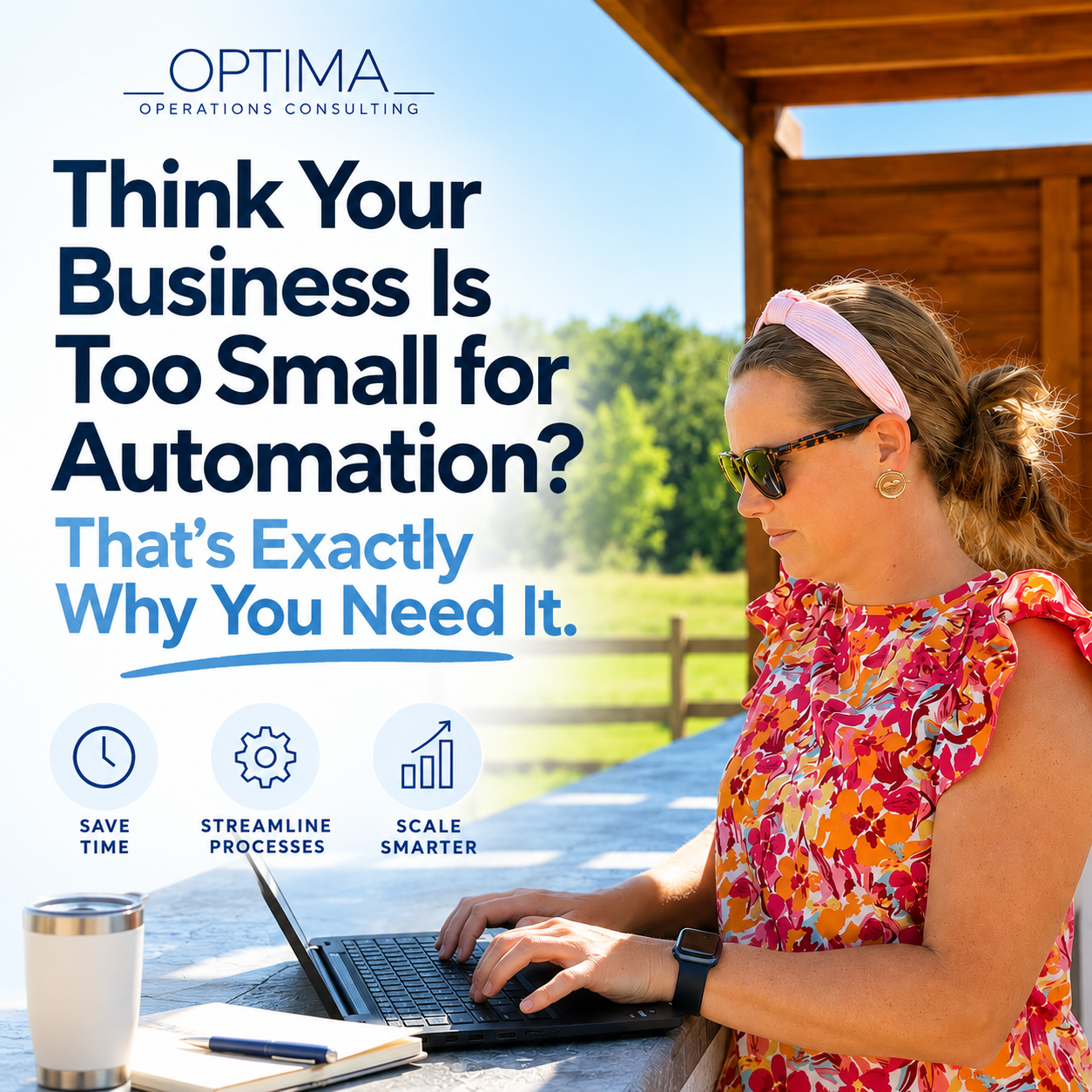
Think your business is too small for automation? That’s exactly when you should start. Identify what’s slowing you down, simplify repetitive tasks, build better systems, and use AI to create more capacity as your business grows.
Not sure where to begin? Start with the Optima Path →
Start Here with Optima Operations Consulting