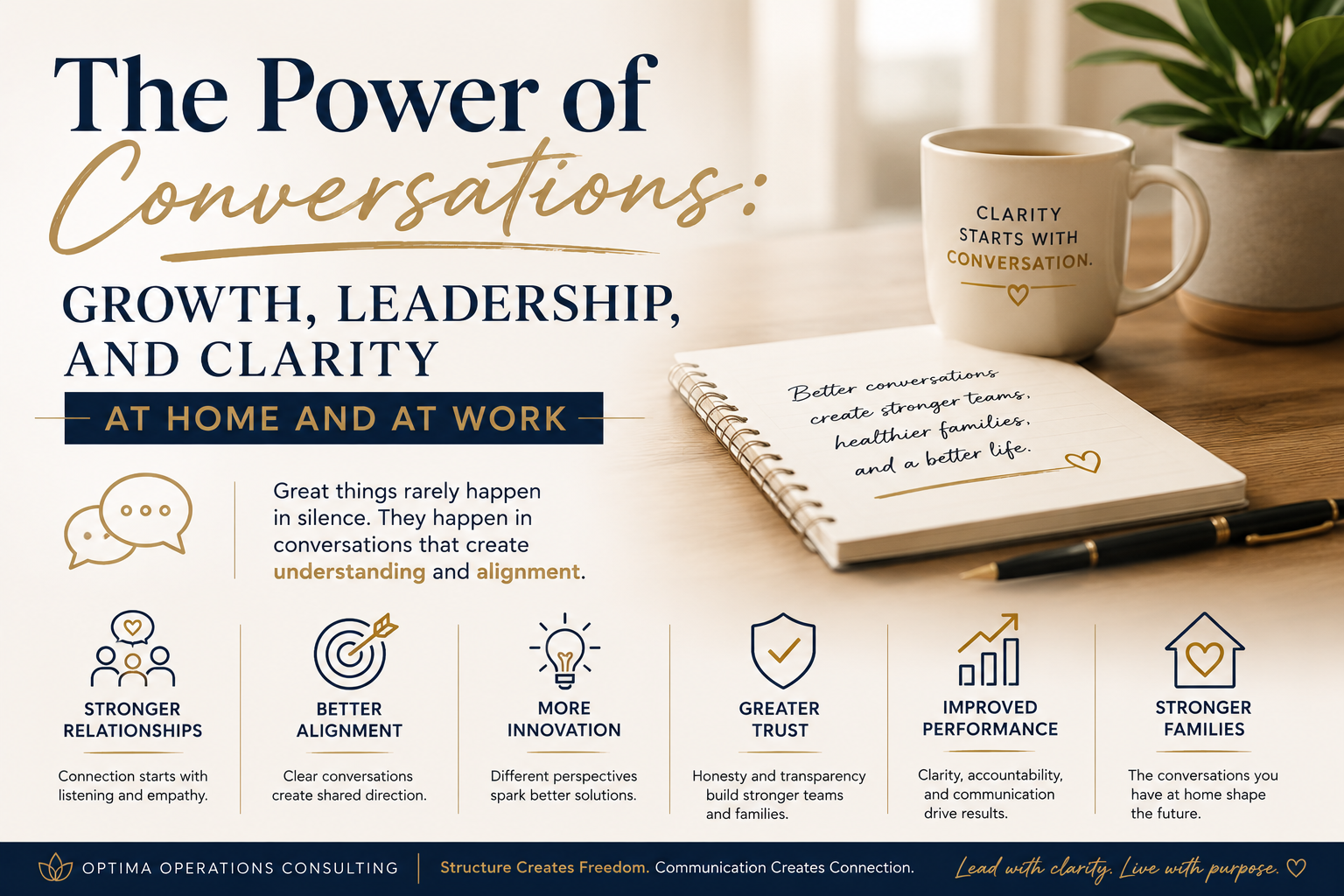

The Power of Conversations: Growth, Leadership, and Clarity at Home and at Work
One of the most underestimated operational tools in leadership is conversation.
Not software.
Not automation.
Not dashboards.
Not even process documentation.
Conversation.
Because clarity is built through communication.
And whether it is within a business, a leadership team, a marriage, a family, or a partnership, the quality of the conversations often determines the quality of the outcomes.
Over the years, one thing I have continued to appreciate deeply is the conversations I have with my husband as he continues to grow as a leader. We think differently in many ways. We process situations differently. We solve problems differently. Yet somehow, we often arrive at the same outcome through communication, honesty, perspective sharing, and mutual respect.
And honestly, that is where growth happens.
Not in silence.
Not in assumptions.
Not in avoidance.
Growth happens in conversation.
Leadership Is Not About Having All the Answers
One of the biggest misconceptions about leadership is believing that leaders must always have the answer immediately.
Strong leadership is not built on knowing everything.
It is built on listening, creating clarity, asking questions, welcoming ideas, and allowing space for honest dialogue.
Some of the best leaders are not the loudest people in the room.
They are the people who know how to create conversations where others feel heard.
Because when people feel safe enough to communicate openly:
Problems surface faster
Solutions improve
Innovation increases
Accountability becomes clearer
Relationships strengthen
And perhaps most importantly, trust grows.
Trust is one of the foundational systems behind every successful team, business, and relationship.
Conversations Create Alignment
One of the biggest operational breakdowns organizations face is not always process failure.
It is communication failure.
Teams become disconnected because assumptions replace conversations.
Departments operate in silos because clarity was never established.
Expectations become inconsistent because leadership believed everyone interpreted the message the same way.
But clarity rarely happens accidentally.
It requires intentional communication.
That is why conversations matter so much in leadership.
A simple conversation can:
Prevent unnecessary conflict
Clarify priorities
Realign expectations
Strengthen accountability
Improve morale
Reduce confusion
Create operational consistency
Conversation creates alignment.
And alignment creates momentum.
The Importance of Welcoming Different Perspectives
One of the things I appreciate most in both leadership and marriage is understanding that different perspectives are valuable.
You do not need everyone to think identically.
In fact, some of the strongest teams are built from people who approach situations differently while remaining aligned around the same mission.
At home and at work, there have been many moments where conversations shifted perspective completely.
Sometimes what felt frustrating initially became clearer after listening longer.
Sometimes the best solution came from someone with a completely different viewpoint.
Sometimes growth required uncomfortable honesty.
And honestly, those moments matter.
Because leadership is not about protecting ego.
It is about creating understanding.
Difficult Conversations Are Necessary
Avoiding difficult conversations does not eliminate problems.
It usually delays them.
And delayed conversations often create:
Misalignment
Resentment
Frustration
Confusion
Broken trust
Operational inefficiency
One of the most important leadership skills anyone can develop is learning how to communicate clearly, respectfully, and honestly — even when conversations are uncomfortable.
That applies professionally and personally.
At home, difficult conversations create stronger partnerships.
At work, they create stronger teams.
The key is approaching conversations with the intention to understand, not simply react.
Listening matters.
Patience matters.
Tone matters.
Clarity matters.
Because sometimes the difference between conflict and growth is simply how the conversation is handled.
Leadership at Home and Leadership at Work Are Connected
One thing I have learned over the years is this:
Leadership does not stop when the workday ends.
The same skills that create healthy organizations also create healthy families:
Communication
Clarity
Structure
Accountability
Trust
Partnership
Emotional awareness
Families thrive in visibility and communication just like businesses do.
Children watch how conversations happen.
Teams observe how leaders communicate under pressure.
People remember how they felt during conversations long after the conversation ends.
That is why intentional communication matters so much.
Because leadership is not just about operations.
It is about people.
The Operational Impact of Communication
At Optima Operations Consulting, we talk often about systems, SOPs, governance, operational structure, and scalable processes.
But operational excellence is never just about documentation.
Even the best systems fail when communication fails.
You can have:
SOPs
Organizational charts
RACI matrices
Processes
Workflows
Governance frameworks
But if conversations are unclear, reactive, inconsistent, or avoided entirely, the organization eventually feels the impact.
That is why communication itself is an operational strategy.
Clarity improves execution.
Alignment improves consistency.
Transparency improves accountability.
And intentional conversations improve leadership.
Final Thoughts
Some of the most transformational moments in leadership, business, marriage, and family do not happen in massive milestones.
They happen in conversations.
The honest conversations.
The uncomfortable conversations.
The clarifying conversations.
The perspective-shifting conversations.
The conversations where people feel safe enough to speak openly.
Because communication creates clarity.
And clarity changes everything.
At home and at work, the strongest relationships and teams are usually not built on perfection.
They are built on trust, honesty, respect, and the willingness to continue having conversations that create growth.
Structure creates freedom.
But communication creates connection.
And both are necessary to build a life and leadership style that truly lasts.