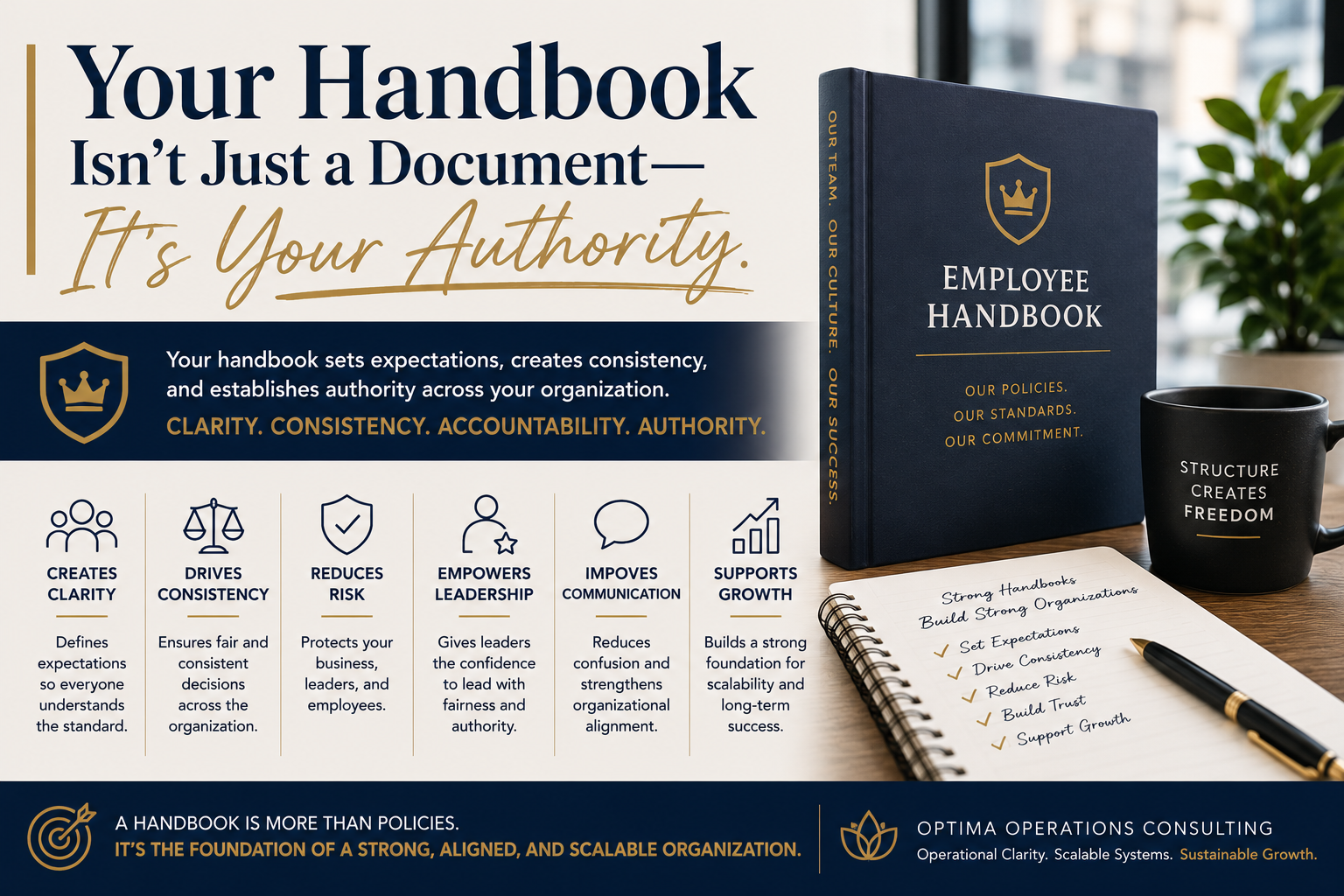

Your Handbook Isn’t Just a Document, It’s Your Authority
Most organizations treat their handbook like a compliance requirement.
Something written once.
Saved in a folder.
Reviewed only when there is a problem.
And rarely used as an active operational tool.
But the reality is this:
Your handbook is not just a document.
It is one of the most important authority frameworks within your organization.
It defines expectations.
It establishes consistency.
It creates accountability.
It protects leadership.
It protects employees.
And ultimately, it reflects the operational maturity of your business.
At Optima Operations Consulting, one of the most common things we see is organizations struggling with inconsistency, confusion, accountability issues, communication breakdowns, and leadership frustration — not because people necessarily lack talent, but because expectations were never clearly operationalized.
And that is exactly where the handbook matters.
A Handbook Creates Operational Clarity
When policies, expectations, procedures, and standards are unclear, organizations begin operating emotionally instead of consistently.
Managers interpret situations differently.
Employees receive mixed messaging.
Departments create their own unofficial rules.
Leadership spends unnecessary time handling avoidable conflicts.
Without structure, inconsistency grows quickly.
A strong handbook creates operational clarity by defining:
Expectations
Standards
Accountability
Communication guidelines
Workplace conduct
Leadership authority
Employee responsibilities
Organizational values
It creates alignment across the organization so employees understand not only what is expected, but also why it matters.
Because clarity changes everything.
Your Handbook Sets the Tone for Leadership
Whether leaders realize it or not, the handbook establishes organizational authority.
Not through control.
But through consistency.
A handbook communicates:
What the organization values
How decisions are made
How situations are handled
What standards exist
How accountability is enforced
What behaviors support the culture
And when leadership consistently aligns decisions with documented expectations, trust increases significantly.
Employees may not always agree with every decision, but people respect consistency.
What creates frustration is unpredictability.
One manager allows something.
Another does not.
One department enforces a policy.
Another ignores it.
That inconsistency creates operational instability quickly.
A handbook helps eliminate ambiguity.
Policies Protect More Than Compliance
Many businesses only think about policies from a legal perspective.
But operationally, policies do much more than reduce liability.
They:
Protect organizational consistency
Create fairness
Improve communication
Reduce confusion
Strengthen leadership confidence
Improve employee understanding
Support decision-making
Reduce unnecessary escalation
Policies create structure around situations that otherwise become subjective and emotionally driven.
And when organizations rely solely on “case-by-case” management without defined standards, inconsistency eventually damages culture.
Because when expectations are unclear, people begin creating their own interpretations.
A Handbook Should Reflect Operational Reality
One of the biggest mistakes organizations make is creating a handbook that looks good on paper but does not reflect how the organization actually operates.
Policies become outdated.
Processes change.
Leadership evolves.
Technology changes.
Operational needs shift.
Yet many handbooks remain untouched for years.
A handbook should evolve alongside the organization.
It should reflect:
Current operational processes
Workplace expectations
Technology usage
Communication standards
Leave structures
Performance expectations
Governance practices
Leadership accountability
An outdated handbook creates confusion instead of clarity.
That is why handbook governance matters.
Authority Requires Consistency
One of the most overlooked leadership challenges is understanding that authority is not built through titles alone.
Authority is built through:
Consistency
Communication
Structure
Accountability
Trust
Follow-through
When leadership avoids enforcing policies consistently, the handbook loses credibility quickly.
Employees notice inconsistency immediately.
And once policies become selectively enforced, organizational trust begins to erode.
This is where operational leadership becomes critical.
A handbook should not exist merely to satisfy HR requirements.
It should function as an operational framework that supports:
Leadership alignment
Employee expectations
Organizational culture
Decision-making consistency
Long-term scalability
Because scalable organizations require scalable structure.
Handbooks Reduce Operational Noise
One of the hidden operational benefits of a strong handbook is reduced noise.
Without structure:
Leaders answer the same questions repeatedly
Managers make inconsistent decisions
Employees become uncertain
Escalations increase
Conflicts become emotional
Productivity decreases
But when expectations are clearly documented and consistently communicated, organizations operate with greater stability.
That clarity allows leadership to focus less on reactive problem-solving and more on strategic growth.
And honestly, that shift matters more than many organizations realize.
Employees Want Clarity More Than Perfection
One of the biggest misconceptions about policies is believing employees dislike structure.
In reality, most employees want clarity.
They want:
Clear expectations
Fair treatment
Consistent leadership
Defined standards
Predictable communication
Operational stability
Unclear environments create anxiety, confusion, and frustration.
Structure creates confidence.
Because when employees understand the expectations, they are better positioned to succeed.
And when leadership communicates clearly, accountability becomes easier for everyone.
Final Thoughts
Your handbook is not just a document sitting in a folder.
It is one of the most important operational authority systems within your organization.
It communicates:
Leadership standards
Organizational expectations
Workplace structure
Accountability
Culture
Consistency
And when implemented intentionally, it becomes more than compliance.
It becomes operational clarity.
Because strong organizations are not built on assumptions.
They are built on communication, consistency, accountability, and structure.
And structure creates freedom.